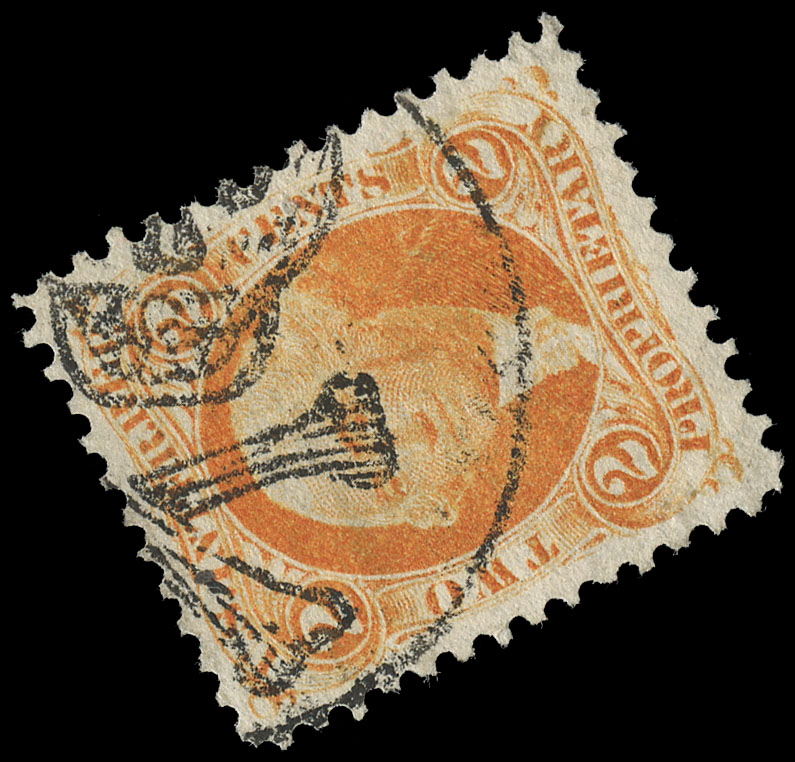
Thank you so very much Revenuecollector. This is invaluable information. I am attempting to write a brief summary of the skull cancel similar to work on the Devil with Pitchfork cancel done by W. J. Duffney (
http://www.ctpostalhistory.com/CtPP...pril2012.pdf).
What I am now curious about is why so very few postmasters utilized the commercial cancel if someone like Beckwith had developed a superior skull design by the 1860s. The only commercially produced cancel I have been able to find is the one shared by Coleville, PA Gardner, MA and Columbus, NJ (all used in the 1880s).
Seen here:

I've read Richard John's book and know that the postmasters were aware of others fancy-cancel work, hence the proliferation, but if Beckwith just used his design for proprietary marks it could've gone unnoticed? Fascinating.
I also get the "skull and bones" college club crossover to Beckwith's profession but believe most postmasters thought it was a visually-literal way of "killing" the stamp. Then tie in William Jackson's addition of KKK to the skull and x-bones for Union Mills cancels and the meaning turns to promotion/propaganda.
Pic for those interested:

JanS: Fancy cancels are my passion. From the geometric "garden path" to the straight forward N/S handshake after the war. I see it as art upon art, if preserved well providing truly rare gems. It just shows you how stamps don't need to be "mint" to hold beauty or value.





 Posted 04/12/2014 10:08 am