| Author |
 Replies: 17 / Views: 8,492 Replies: 17 / Views: 8,492 |
|
Pillar Of The Community
United States
644 Posts |
|
|
This comes up a lot on here. The stamp on the left is on "soft" paper. Notice how the paper has a "mottled" pattern to it. It almost looks like a mesh. The stamp on the right is on "hard" paper. Notice there's no pattern to the paper.  |
|
Send note to Staff
|
|
|
|
|
Valued Member
United States
240 Posts |
|
|
Rest in Peace
United States
763 Posts |
|
|
Bill,
Excellent photo! Thanks. Shows the difference quite well. Right stamp's paper appears to be "solid" whereas left stamp's paper it mottled. |
Send note to Staff 
|
|
|
Pillar Of The Community
United States
644 Posts |
|
|
Gary,
Yes. Soft, porous paper. The so called "soft" paper was developed to replace the labor intensive act of grilling stamps I'm told.
Bill,
Thanks! I think I got lucky with this pic... No gum, light color, unused stuff worked out well :) |
|
Send note to Staff
|
|
|
Pillar Of The Community
United States
1414 Posts |
|
|
Hard paper will be relatively bright under long wave UV light while soft paper will look "dead" in comparison. Some intermediate paper will fall between the two extremes. The transition from hard to intermediate to soft paper occurred before the nameplate on the door was changed from Continental to American Bank Note during the consolidation on Feb 4, 1979. Stamps or covers with dates on or before the consolidation date are considered to be Continental Bank Note products even if printed on soft paper.
It should be noted that some 1 cent and 3 cent hard paper stamps printed by American Bank Note Company exist. Selvage with the ABN logo or logo capture is needed to positively identify these stamps. |
|
Send note to Staff
|
|
|
Pillar Of The Community
United States
1946 Posts |
|
|
@billw2,
Great photo! Do you recall what information source told you that the reason for going to soft paper had something to do with getting away from grilling? Did they actually say that was the purpose for developing said soft paper? |
|
Send note to Staff
|
|
|
Pillar Of The Community
United States
1414 Posts |
|
|
Paper making transitioned from rag to chemical wood pulp paper as technology improved in the last half of the 19th Century reducing the cost of paper production. While rag paper was relatively thin and hard, wood pulp paper was softer and often thicker. Thicker soft paper used in the 1880s is sometimes referred to by collectors as "newsprint". |
|
Send note to Staff
|
|
|
Pillar Of The Community
United States
1946 Posts |
|
|
@billw2 While everything that cfrphoto just said is true, I want to hear what your source said about the relationship between soft paper and the use of a grill. All the more if they presented anything like argument or evidence to back it up. I had intended to show this earlier but cfrphoto beat me to it. If you have access to a longwave UV light, you can use it to help distinguish hard paper from intermediate and soft paper. 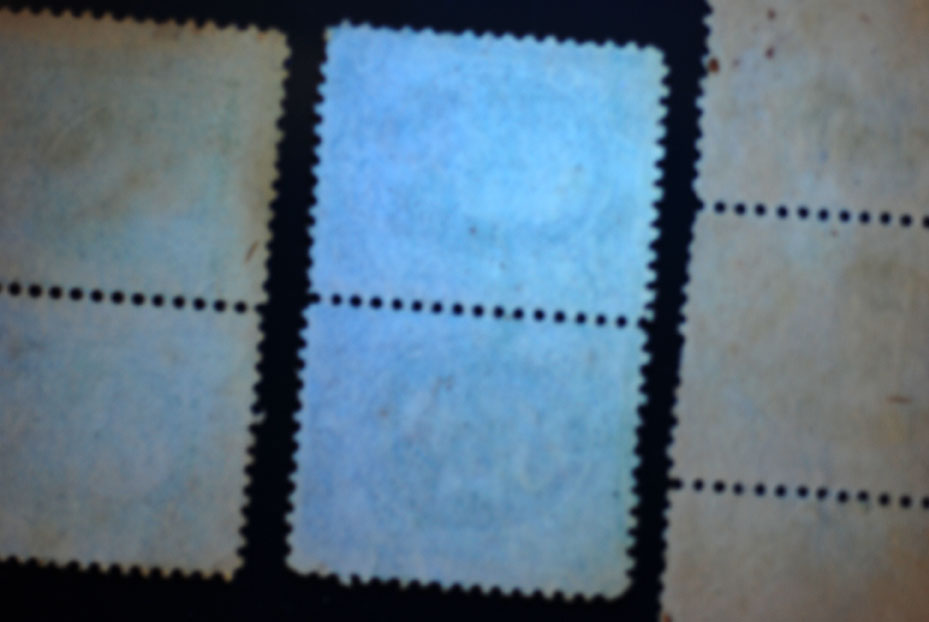 The pair in the middle is hard paper and the pair on the left is soft. The strip of 3 is intermediate. I heightened the contrast to make the image easier to see, but the relative luminence of the three is unchanged (not sure we can call it "fluorescence"). As you can see the two softer paper types appear similar under this light, but the hard paper is, as stated before, much brighter. Several factors cause that, but for us it is enough to note it. |
|
Send note to Staff
|
| Edited by essayk - 07/05/2014 11:16 am |
|
|
Rest in Peace
United States
763 Posts |
|
|
"Do you recall what information source told you that the reason for going to soft paper had something to do with getting away from grilling? Did they actually say that was the purpose for developing said soft paper?";
Excellent question. I do not ever recall reading the exact reason for the transition from "hard" (pre-1877) to "intermediate" to "soft" paper by the CBNCo/ABNCo but I think that Clark's explanation makes the most sense. I frankly do not believe it had anything to do with the ending of grilling, which for practical purposes ended in about 1871-72 (the Continental grills are not considered by students to be "regularly issued" but are rather "experimental" in nature) so since true "soft" paper was not regularly used until about 1878, there would seem to be no connection to grills and soft paper. Even the book that I consider to be the most valuable work on 19th C. U.S. stamps (Brookman) gives no "reason" for the transition.
|
|
Send note to Staff
|
|
|
Pillar Of The Community
United States
1414 Posts |
|
|
The reason for the changeover from hard to soft paper had little to do with the desires or needs of the stamp issuing entities. It was related to technology changes and cost of production. The market for stamp paper is not very large relative to the entire paper market. Unlike currency, there would have been little need to develop specialty paper for exclusive use of stamps. Stamp printers had to secure paper supplies with parameters consistent with the presses and printing procedures in place. Evan then turnover in paper manufacturers and inconsistent quality control presented challenges.
There is no reason to believe that major efforts went into developing paper suitable only for printing stamps. Numerous paper essays exist ranging from a laid paper design to patent papers designed to foil stamp reuse. One patent featured an explosive cap in the stamp that would explode and blacken the face of the stamp when cancelled. Except for a few double paper examples, none of these essays made it to production, likely because of cost not to mention practicality.
Stamp paper was a commodity, produced using contemporary technology. The bank note companies focused on cost, not on special requirements. They did not lead, they followed. When technology changed, the bank note companies followed to save money. |
|
Send note to Staff
|
|
|
Pillar Of The Community
United States
1946 Posts |
|
|
cfrphoto is welcome to think that way if he chooses, but it misses a lot. I sense he does not give the security printing industry of that day enough credit. From the practicalities of staying in business in a cut-throat competitive environment the security printers of the day had a great deal of interest in improving all aspects of stamp production. The government was unrelenting in its demand for superior product, and the companies had to keep up even when they had shackles applied from time to time. They developed close working relationships with particular paper companies, notably Crane and Wilcox, and in company explored the merits and demerits of technological innovation.
In my study of the patents associated with stamp production in this period, I have stumbled upon what I believe is the key element, and person, in the transition from hard to soft paper, and I am preparing that story among others for publication. Speculation is fun, but having the data stacks up better in the long run. We shall see. In the meantime, I am interested in hearing whatever people imagine was happening.
As for the hypothesis regarding the end of grilling, let us simply say that the end of grilling was an effect, not a cause, per se. But some personalities got tangled up in there that make for a rather colorful bit of history. |
|
Send note to Staff
|
|
|
Pillar Of The Community
United States
2947 Posts |
|
|
Were the stamp printers among the larger clients for the paper companies? |
|
Send note to Staff
|
|
|
Rest in Peace
United States
763 Posts |
|
|
"In my study of the patents associated with stamp production in this period, I have stumbled upon what I believe is the key element, and person, in the transition from hard to soft paper, and I am preparing that story among others for publication. Speculation is fun, but having the data stacks up better in the long run. We shall see. In the meantime, I am interested in hearing whatever people imagine was happening":
That would be a spectacular story indeed, and I for one, will anxiously await it! Where do you plan to publish it? Seems like a natural fit for the Chronicle? |
|
Send note to Staff
|
|
|
Rest in Peace
Netherlands
963 Posts |
|
|
Machine made paper always had a symmetrical wire structure [reflecting the linen-binding of the wire]. You can see the mottled struture as a representation of that. I.e. the rhombs in between the blue lines: 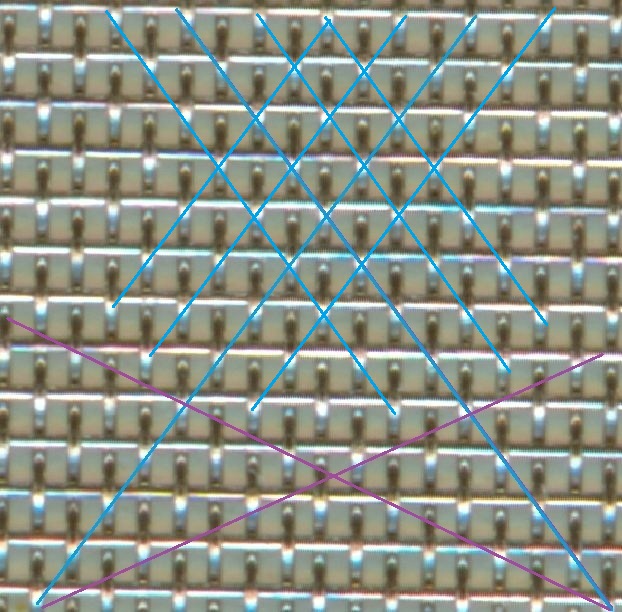 The direction of paper can also be recognized by the orientation of ther grooves/fibers! Probably running horizontally here! Only about 1938 the wire structure became asymmetrical due to the introduction of twil-bindings for the wire! |
|
Send note to Staff
|
|
|
Pillar Of The Community
United States
1946 Posts |
|
|
Very interesting pic, Galeoptix. Is that a super close look at a small section of an actual Fourdrinier or a mock-up of some kind? It's a little confusing, since I was expecting the warp and woof to be parallel and at right angles to the direction of travel for the production of a web or sheet. Here the lines seem to appear at 45 degrees, unless I am misunderstanding what I am looking at. I do realize there is a huge difference between an actual weaving with continuous threads (really long fibers) and the appearance of a weave from short fibers settling on a wire.
Nonetheless, your point seems to be that both hard and soft paper appear as "woven" (wove) paper, and differ mainly in the size of their fiber structure. The large fibers of soft paper owe to wood pulp, while the hard papers are made from rag fiber, mainly cotton and/or linen. In addition to differences in the tightness of the "weave" the luminence of the paper under UV will be much affected by the sizing agent used to bind the different types of fiber into a solid mass. And when it comes to stamps there are other factors as well.
@bill Weiss
yes, the Chronicle is my preferred venue. But I'm working on two other studies ahead of this one. It does get attention from time to time. |
|
Send note to Staff
|
| Edited by essayk - 07/06/2014 9:36 pm |
|
|
Pillar Of The Community
United States
644 Posts |
|
|
"Great photo! Do you recall what information source told you that the reason for going to soft paper had something to do with getting away from grilling? Did they actually say that was the purpose for developing said soft paper?"
I'm thinking that my father told me... and I want to say one of his buddies, perhaps Seymour Kaplan told him. Again, can't remember specifics but I do remember my father telling me that soft paper was much more absorbent of cancels. Hence the "I'm told" disclaimer. If I am wrong I'm not at all surprised, Richard Frajola just corrected me the other day on a belief that I shared with many students of foreign mail.
I would LOVE to see the article that you're working on once published. |
|
Send note to Staff
|
|
|
Replies: 17 / Views: 8,492 |
|




 Posted 07/04/2014 01:40 am


