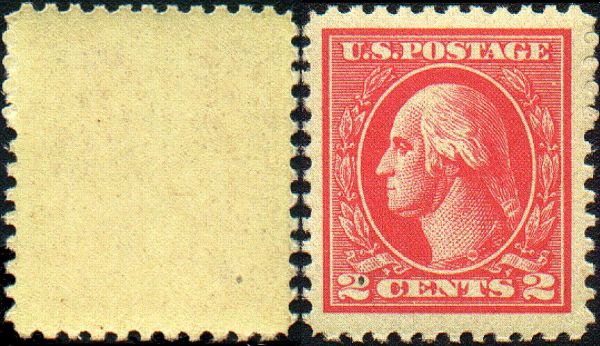
Thank you... I like to collect anomalies here and there, and found this one interesting, given it appears to not be an after-effect from usage (or manipulation), rather a paper flaw prior to printing...
I'm fairly certain it's OG, so I'll just go ahead and mount it next to its 'brother' 528B in my album...
As far as whether it detracts or devalues, or lowers a "grade", it depends upon size, location, visibility. If it is only visible from the back side, and very small (a tiny pulp or fiber), it may not detract or lower the grade. The W/F offset issues are rife with NPIs - they are fairly common on them, just sometimes you have to really be looking for them.
Thanks for the link to PSE, stallzer. My comment about the lowering of grade is trying to emphasize how noticeable it is. If the inclusion is present, but small enough to really have to look hard to see it, it may not be called out in the cert or affect the grade. If you look at higher magnification, you will probably see one or more natural paper inclusions on most stamps. In fact, if you look at almost any stamp, at higher magnification, you will find one or more faults or irregularities.
From PSE: "U.S. stamps occasionally have one or more natural inclusion specks embedded in the paper. These vary in size, color and location. They effectively lower the value of a stamp if they are visually objectionable and so the color of the stamp can also be a factor affecting the visual effect."
Disclaimer: While a tremendous amount of effort goes into ensuring the accuracy of the information contained in this site, Stamp Community assumes no liability for errors. Copyright 2005 - 2026 Stamp Community Family - All rights reserved worldwide. Use of any images or content on this website without prior written permission of Stamp Community or the original lender is strictly prohibited. Privacy Policy / Terms of UseAdvertise Here





 Posted 08/10/2014 6:35 pm