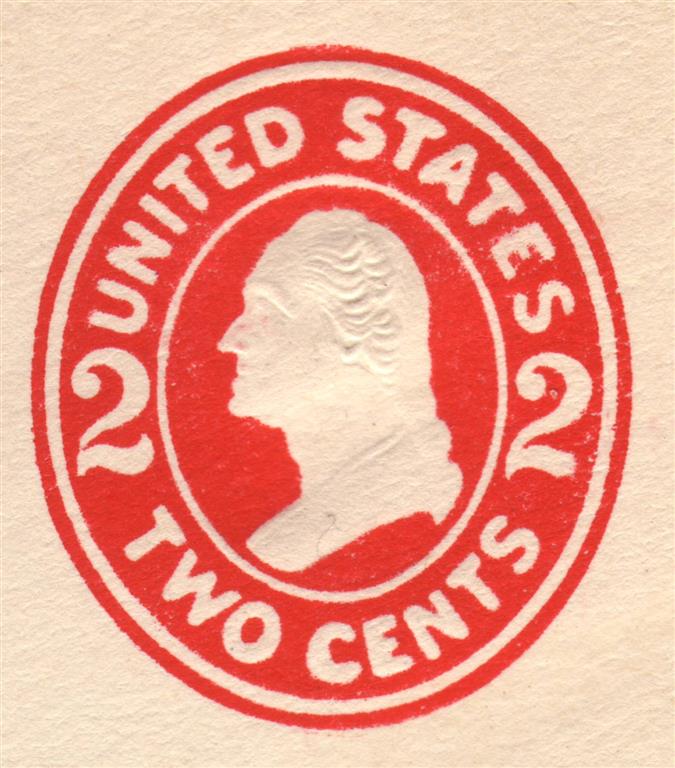
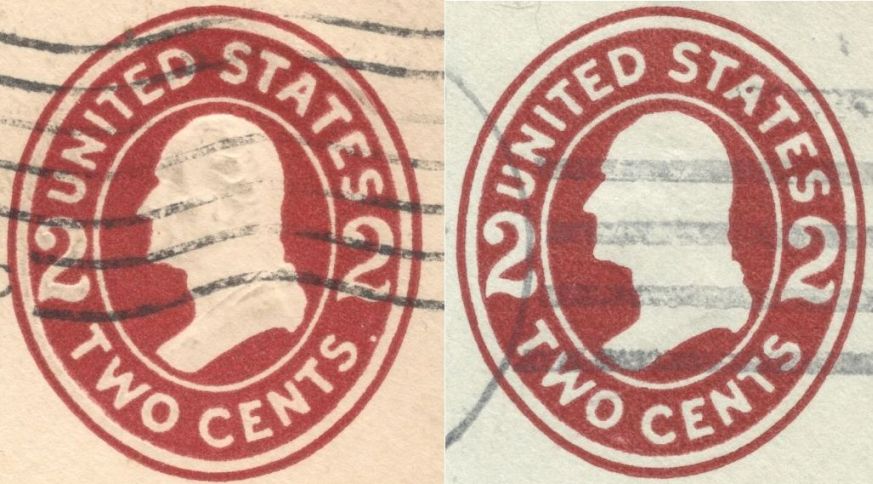
The impressions below were scanned at the same time on the same horizontal plane of the scanner to minimize error. They are both brown-red and are design type U91, so they could be:
U406 (white paper)
U407 (amber)
U408 (oriental buff)
U409 (blue)
W410 (manila)
The brown-red 2c U91 designs are subtyped by the die used. There are 3 die types with subtle differences between each other. The information in the Scott catalog and elsewhere on the web that distinguishes between them is sparse. Die type 3 is somewhat easy to identify based on the circular center of the "O" in "TWO" and the "C" in "CENTS". Also die 3 prints have coarse lettering.
I'm confident that the example on the left is die 3. I do not know for certain what die is responsible for the image to the right.
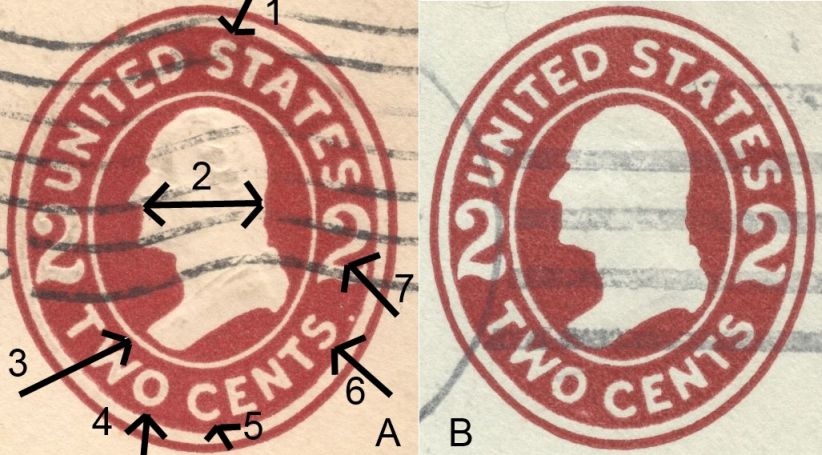
1. On B, the bottom of the "S" is elongated to the left.
2. On B, the bust is larger width wise.
3. On B, the upper edge of the bust near the inner frame is rounded upwards slightly.
4. On B, the "O" in "TWO" is elliptical instead of circular. A circular center of the "O" is indicative of die 3.
5. On B, the negative space inside of the "C" in "CENTS" is elliptical. The "C" is also slightly shorter. A circular appearance indicates die 3.
6. On B, the bottom curve of the "S" in "CENTS" has a wider line.
7. On B, the right "2" has wider lines.
Some difference may be due to variances in the transfer from the master die to the working die.
Scott catalog states: "Die 2. Similar to 1 but hair in two distinct locks at top of head." I'm not sure what that means, but subject B is worn from use and it is difficult to see the hair lines in the imprint.
I don't believe that it is die 3. So die 1 or 2? Unfortunately, I don't have a confirmed die 1 example to compare to. All of the die 1 examples I've found have a less upward curved edge of the bust at arrow #3.
*Edited for clarity.





 Posted 09/21/2014 02:01 am