| Author |
 Replies: 20 / Views: 14,643 Replies: 20 / Views: 14,643 |
|
Pillar Of The Community
United States
1115 Posts |
|
|
I believe this may be the Lake color variety. It appears to be a darker shade than any other I have seen on Scott 406 (Perf. 12). Understanding that scanners vary in color reproduction quality, and viewing on a computer screen also has its variations, I am hoping that comparing it to a "regular" shade will be useful.  |
|
Send note to Staff
|
|
|
|
|
Pillar Of The Community
United States
937 Posts |
|
|
I can't remember nor find through searching where I found these images: The bottom left two are supposedly PSE certified as lake: 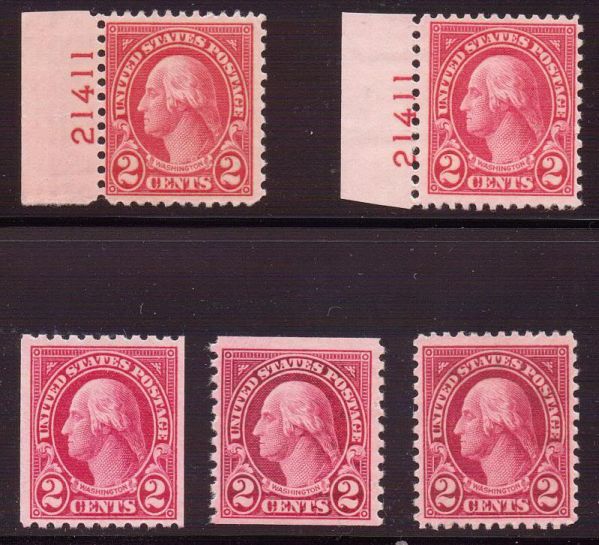 The leftmost stamp is lake: 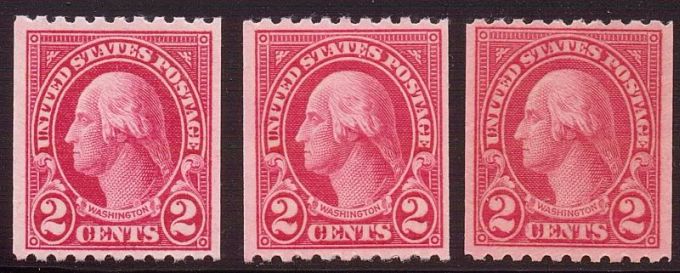 None of these are lake: 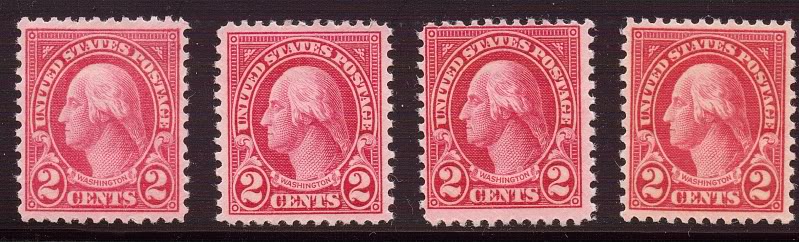 Others here probably know better than I, but I think that your stamp's significant shade difference does indicate that it is lake color. It also appears too much of a darker and more purplish shade than the examples above. Maybe it's chemically enhanced? -edit: Found them! http://www.stampboards.com/viewtopi...=50#p2495691http://www.stampboards.com/viewtopi...=50#p2575942 |
Send note to Staff 
|
| Edited by Historical DNA Collector - 10/07/2014 9:14 pm |
|
|
Rest in Peace
United States
82 Posts |
|
|
Orst - for what it is worth, here is one from a pair of #219D and #220 single. Identifying a "lake" when the majority of an issue is carmine is not easy. Some carmines are darker or deeper than others. This of course is not the issue you have shown but it may be of help in getting the "feel" for lake in comparison with carmine. Good luck Bill 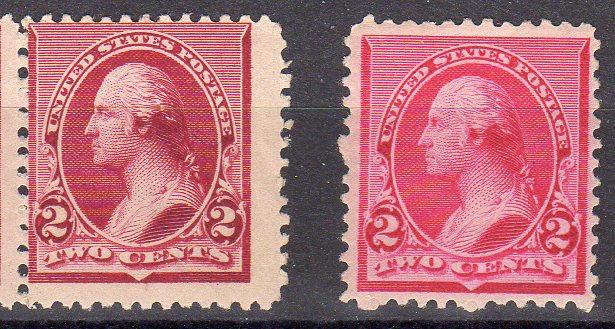 (after seeing the stamps in my post I must say that the actual lake is quite a bit darker and the carmine at right somewhat darker than what my scan has shown. that may distort the opinions that you and other readers may have.) |
|
Send note to Staff
|
| Edited by wbrob - 10/07/2014 9:32 pm |
|
|
Pillar Of The Community
United States
1756 Posts |
|
|
Pillar Of The Community
United States
1756 Posts |
|
|
Pillar Of The Community
United States
1756 Posts |
|
|
Pillar Of The Community
United States
1115 Posts |
|
|
Thanks, all, for your inputs and some comparative scans. My 406 "dark" shade appears darker in person (compared to the scan). It is not unreasonable to suspect that it may just be a very dark carmine or carmine lake shade and not lake! Didn't think about the possibility of it being chemically altered. I wonder if this stamp is known chemically altered to appear as a darker shade? |
|
Send note to Staff
|
|
|
Pillar Of The Community
United States
937 Posts |
|
|
It seems like any stamp of high value is faked in any way possible. Yours may just be over saturated due to unintended software changes. Consumer grade scanners aren't color calibrated very well. Often the scanner software tries to make up for it and will make changes that you didn't ask for. Some allow to you skip any "enhancing" of color, sharpness, etc. Many don't.
This experience once again humbles me.
disi, you question the PSE's business practices. Does that seem to be their motive more than laziness and/or incompetence?
|
|
Send note to Staff
|
|
|
Pillar Of The Community
United States
1756 Posts |
|
|
Quote:
disi, you question the PSE's business practices. Does that seem to be their motive more than laziness and/or incompetence? The most important consideration when choosing an expertizing entity is CREDIBILITY.... Given PSE's history and "highly-questionable" reputation and their roots... their credibility rating on a scale of 1-10 is NADA... ZILCH... NONE... |
|
Send note to Staff
|
|
|
Moderator

United States
12330 Posts |
|
|
All the certification services make mistakes; some might even be unavoidable in that at the time the stamp was originally certified certain information may not have been available to the expert. My concern with this issue is mostly about transparency and corrective action. First, do we simply allow the marketplace to decide what it takes to issue a certificate? Obviously there are some people who simply print out a 'self-cert' and advertise the stamp on ebay with it. What is the actually track record of each of the cert services? If I am going to drop several hundred dollars per years getting my stamps certs how do I go about picking the most accurate service? And how do cert services handle when they do make a mistake? You send in a stamp, get a cert, sell it and then are sued for it being a forgery. While you certainly might recover the cost of a cert what happens if the buyer sues you for more? How do cert services handle their mistakes? A good example is PF #463694 http://pfsearch.org/pfsearch/pf_grd...lledfrom=lkpThis block was bought to my attention as being a forgery that has been known to be a forgery for several years yet the cert still stands without notation or any indication that it is not legitimate. PF's original response was that they would need to re-examine the block before making a change in the cert. Is this the best approach for a cert service when a mistake is found? If the block never gets resubmitted the cert still calls out the block as real? Mistakes will be made, we are all human. But without over-sight of any kind it behooves cert services to be as transparent as possible and take immediate corrective action as soon as an issue is uncovered. Don |
|
Send note to Staff
|
| Edited by 51studebaker - 10/08/2014 2:46 pm |
|
|
Pillar Of The Community
United States
937 Posts |
|
|
"Taken without permission, directly from my RH White Color guides..." which was posted here not long ago: https://www.stampcommunity.org/topi...IC_ID=39434&I took that image and condensed it: 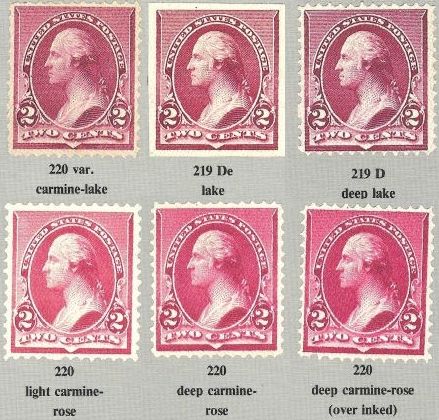 Here are the 3 examples that disi123 referenced: 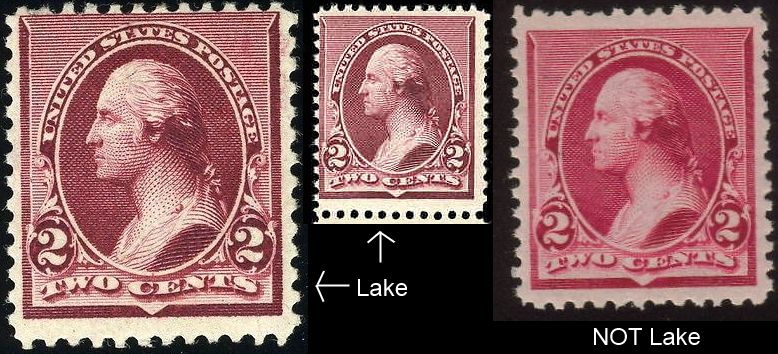 There's a significant color difference between these two sets. Could a few who have these stamps give their opinion of which set, or both, appear like yours? |
|
Send note to Staff
|
|
|
Pillar Of The Community
United States
937 Posts |
|
|
Don, good points and well said. I agree completely.
It does seem that having a overseeing entity would be best. However, I can't imagine how that would be accomplished without finding a way to do it profitably. It seems possible considering the availability of electronic communication and level of automation that the web has matured into. Know any venture capitalists that like stamps and risky endeavors? |
|
Send note to Staff
|
|
|
Moderator
United States
12330 Posts |
|
|
Here are a few examples from an old stock I have kicking around Don #219  #220/220a/220c  |
|
Send note to Staff
|
|
|
Pillar Of The Community
United States
937 Posts |
|
|
Don, your links are broken. I think that I figured out what you were trying to post here: http://dd-designs.co/dnloads/219D.jpghttp://dd-designs.co/dnloads/220.jpgHoly Bajebus, that's quite a collection. Can you comment on which if any and/or both of the above posted sets appear to have the same color as you can view on your monitor? Specifically, as compared to the physical examples of lake color that you posses? From viewing your collections, it seems like Lake has a much more bluish color of carmine compared to the nearly brown examples that disi123 referenced. |
|
Send note to Staff
|
| Edited by Historical DNA Collector - 10/09/2014 12:21 am |
|
|
Pillar Of The Community
United States
578 Posts |
|
|
Scans of lakes, reds and pinks are notoriously problematic (pigeon blood, pink, rose pink, Indian red, carmine lake, lake, etc., etc.) I rarely see scans of these stamps with accurately-reproduced colors.
If that stamp has a PSE cert as 219D, my guess is the stamp is 219D and the color of the scan is off. That's about a gazillion percent more likely than PSE misidentifying a 219D, IMO.
BTW, there are recognized (but Scott-unlisted) 219D shades that have quite a bit of carmine in them. There are also some "dark carmine" 220 varieties (which ARE Scott-listed) that can get pretty dark. If I get a chance later today, I'll scan a few items from my 219D/220 reference set and post in this thread - there are some shades where identifying 219D vs. 220 can get tricky and a reference set is important. My guess is that the stamp in question falls into that "tricky" area, but is correctly identified as a 219D. |
|
Send note to Staff
|
|
|
Pillar Of The Community
United States
937 Posts |
|
|
The thread started out with Scott #406 shade differences. We've seen examples of lake color varieties from many of the 2c series from 1890 to 1922. Can anyone comment on the range of shade varieties that exist in each series? Could you take a shade reference set of stamps and apply it correctly to any or all of the other series? srailkb, I agree that scanner error is the much more likely reason for the controversial 219d having a certificate. As Don has stated in this and other threads, human mistakes happen and no expertiser gets it right 100% of the time. I can't imagine the frustrations of colorblind collectors. Even for those that are not colorblind, some can detect hue difference better than others. You can estimate your ability with the test here: http://www.xrite.com/online-color-test-challenge |
|
Send note to Staff
|
|
|
Replies: 20 / Views: 14,643 |
|




 Posted 10/07/2014 12:01 pm


