Stamp Community Family of Web Sites
Thousands of stamps, consistently graded, competitively priced and hundreds of in-depth blog posts to read


Stamp Community Forum
 
Username:
Password:
Save Password
Forgot your Password?

This page may contain links that result in small commissions to keep this free site up and running.

Welcome Guest! Registering and/or logging in will remove the anchor (bottom) ads. It's Free!

Scott 406c Lake Color Variety

Previous Page
 
To participate in the forum you must log in or register.
Author Previous TopicReplies: 20 / Views: 14,298Next Topic
Page: of 2
Valued Member
United States
11 Posts
Posted 10/14/2014   01:07 am  Show Profile Bookmark this reply Add stamps776 to your friends list  Get a Link to this Reply
nope
Send note to Staff  Go to Top of Page
Rest in Peace
United States
763 Posts
Posted 10/16/2014   12:12 am  Show Profile Bookmark this reply Add Bill Weiss to your friends list  Get a Link to this Reply
I agree with Ken Srail. The identification of #219D is relatively simple. No expert service would make such a mistake. It must be a function of the scan or the photo.

Don makes some good points, but there is *NO* "oversight" of the expert services except the most important one - market perception. If an expert service is making lots of mistakes (and I don't know who "keeps score"!) then the marketplace will make the adjustments necessary in the long run and will favor those who become more respected than the others.

As far as transparency, I agree 100% with Don, but unfortunately, several of the bigger services are not huge fans of transparency, for fear, I suppose, of their competition gaining an edge somehow. It's a competitive field and several of the services are not for profit, while several more are, creating an uneven playing field in some ways or at least a different perspective from each other. I have, over the years, tried several times to act as a "go between" with the other services to try to get (for example), standardization of terminology or procedures. In each case, I received different levels of co-operation and different "requirements" from the services. And in every case, my initiatives were, in the end, abandoned for lack of co-operation.
Send note to Staff  Go to Top of Page
Pillar Of The Community
United States
578 Posts
Posted 10/16/2014   09:34 am  Show Profile Bookmark this reply Add srailkb to your friends list  Get a Link to this Reply
Just to follow-up on the 219D/220 color shades, here's a group of stamps from my reference collection:
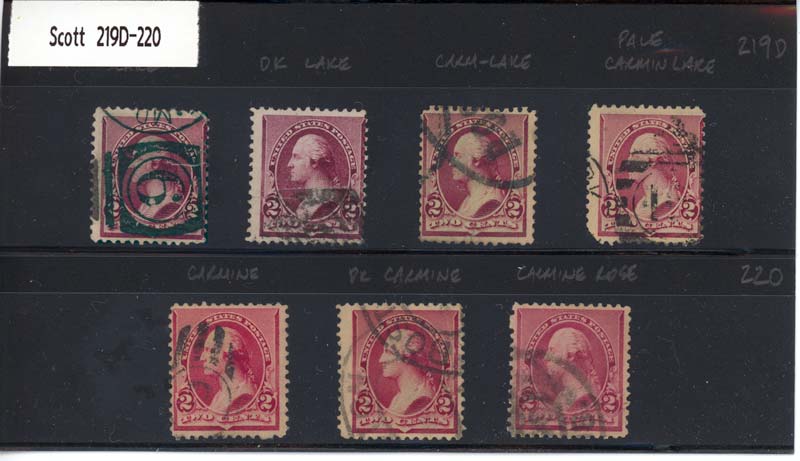


As you can see, some legitimate 219D shades have quite a bit of carmine in them (like the right stamp in the top row, which I call pale carmine lake,) and some of the 220 carmine shades get pretty dark (like the middle stamp in the bottom row, the Scott-listed dark carmine.)

These various shades of Scott 219D are well-known but for some reason not listed in the Scott Specialized (which just lists "lake.") There's no doubt that all 4 stamps in the top row belong in the 219D family though.

Comparing "dark lake" Scott 219D with "carmine" Scott 220 shows a very stark contrast of shades, leaving no doubt about the identity. However, comparing pale carmine lake 219D with dark carmine 220 isn't nearly as obvious... I frequently see "borderline" stamps like that misidentified (both ways.)

BTW, if you look back at the stockpages of 219D/220 stamps that Don posted earlier, you'll see some pretty "carmine-looking" 219D's (like the third stamp from the right, bottom row.) That stamp listed by itself might elicit the same questions about whether it was correctly identified as a 219D (it is, IMO.)
Send note to Staff  Go to Top of Page
Pillar Of The Community
United States
937 Posts
Posted 10/16/2014   10:48 am  Show Profile Bookmark this reply Add Historical DNA Collector to your friends list  Get a Link to this Reply
Srail, thank you for that scan. We can see the variations of each type on one scanner (yours) and one monitor (ours).

The threshold between the two closest examples is subtle. I wonder how expertising services differentiate them? It used to only be experienced eyeballs. What about now? Color calibrated equipment and software? Is there a single threshold point?
Send note to Staff  Go to Top of Page
Edited by Historical DNA Collector - 10/16/2014 10:49 am
Pillar Of The Community
United States
578 Posts
Posted 10/16/2014   11:20 am  Show Profile Bookmark this reply Add srailkb to your friends list  Get a Link to this Reply
IMO, all major expertizing firms have good reference collections. That's why they're very unlikely to misidentify a shade like 219D (and if they do, much more likely a clerical error than an error by the expertizer.) I think a bigger issue is one of evolving standards. What qualifies today as Indian red (or pigeon blood pink, or blackish violet, etc.) isn't necessarily what used to qualify as that shade...

That makes buying rare shades with old certs pretty risky. And just to be clear, standards don't always "tighten." In some cases (some might argue "many" cases,) the standards have weakened, and stamps undeserving of certs as those scarce shades are now receiving them.
Send note to Staff  Go to Top of Page
Page: of 2 Previous TopicReplies: 20 / Views: 14,298Next Topic  
Previous Page
 
To participate in the forum you must log in or register.

Go to Top of Page

Disclaimer: While a tremendous amount of effort goes into ensuring the accuracy of the information contained in this site, Stamp Community assumes no liability for errors. Copyright 2005 - 2026 Stamp Community Family - All rights reserved worldwide. Use of any images or content on this website without prior written permission of Stamp Community or the original lender is strictly prohibited.
Privacy Policy / Terms of Use    Advertise Here
Stamp Community Forum © 2007 - 2026 Stamp Community Forums
It took 0.3 seconds to lick this stamp. Powered By: Snitz Forums 2000 Version 3.4.05
