| Author |
 Replies: 83 / Views: 12,283 Replies: 83 / Views: 12,283 |
|
|
|
Pillar Of The Community
United States
937 Posts |
|
|
Posting a large scan would help us a lot.
However, I do see something odd about your stamp on the right in your last picture.
Side by side, it is clear that the stamp on the left has wider spacing of the perfs on the side. Counting across the horizontal of your left stamp, of just the design, there are 11 holes. This shows that the left stamp is perf 11 horizontally.
Comparing the two together, the left stamp has much thinner lines. This is seen pretty clearly in the horizontal lines in the upper triangles.
This makes the stamp on the left to be a rotary print that is perfed 11 horizontally. So it is a 636.
A 636 has perfs that measure 10.5 vertically. The right hand stamp has a slightly narrower spacing of perfs. Looks like perf 11 vertically. This is confirmed by the presence of 12 holes vertically across the design.
The stamp on the right much thicker lines and is perf 11 vertically, therefore it is a flat plate printing.
This design has two Scott #s for flat plate prints. 556 and 556b. 556 has perf 11 on all four sides. 556b is perf 11 all the way around EXCEPT for one side. That side would be perf 10 on either the top or bottom. That side could be all perf 10 or partly perf 10 then transitioning to perf 11.
I've checked your stamp using photo editing software and I feel confident that it is NOT a 556b.
However, something is odd about the stamp on the right. It has approximately 10.5 holes across the design on the top and bottom.
I cannot explain how this came to be. It does look like the stamp on the right is perf 10.5 by 11.
Also, it seems that you have confused which one you are trying to describe. The 636 on the left would measure at 22.5mm tall. The stamp on the probably would not measure 22.5mm tall.
Hopefully I'm not making a mountain out of a mole hill. However, I do see what you are talking about. It would take a clear scan for us to figure out more. It's possible that someone reperfed it. Why someone would do that in unknown to me. |
Send note to Staff 
|
|
|
Valued Member
72 Posts |
|
|
Thank you for your reply ...I have two Scott #636 stamps but the stamp I am referring to has different perforations it is not 11 x 10.6 it is 10.5 x 11
I do not mean to question you but they both can't be #636.
I did post an image of the two stamps side by side and you can clearly see they do not match however I am a new member and I am not sure if the images I posted actually show up at the other end ( I'm finding it a little tricky to post images ....but I'll keep Practicing...!)
If you did not see the image please let me know and I'll try to repost it ...if you did see the photo you must have seen the difference.
Thanks
Andrea |
|
Send note to Staff
|
|
|
Pillar Of The Community
United States
937 Posts |
|
|
I did see the images that you posted. Using photo manipulation, I was able to see that your stamp does seem to be perf 10.5 x 11. I agree, your suspect stamp does not appear to be a 636.
Since it is a flat plate printed stamp and due to the timeline of how these were made, I highly doubt that it was a perforation experiment. Nor do I think it is like the rare perforation varieties of the early 1920s.
It is not listed in the catalog. It could be unique. It could have been re-perforated by someone. We could both be wrong and it is 11 x 11.
It is unique if it's legitimately 10.5 x 11. Will other people find it worth a lot of money? I don't think so. However if I found one and the perfs were legitimate, I would make a spot for it in my album.
Posting more pictures won't help. You will need to scan it at least 600 dpi. That way we could see what the perfs look like up close. 1200 dpi would be better.
You're welcome. Thank you for the puzzle.
-Edited for clarification |
|
Send note to Staff
|
| Edited by Historical DNA Collector - 10/20/2014 7:12 pm |
|
|
Pillar Of The Community
United States
6668 Posts |
|
|
More than that you would need to have it certified. Did someone practice re-perfing and screw up ? Is it perhaps the work of a re-perf apprentice who then heard, "Perf 11 horizontally not vertically you idiot". You would need to certify that the perforations were made at printing time. |
|
Send note to Staff
|
|
|
Pillar Of The Community
United States
1414 Posts |
|
|
This discussion seems to have gotten needlessly convoluted. The original posting contained an image of a 4 cent flat plate Scott 556. A later post showed it next to a perf 11 x 10 1/2 rotary press 4 cent Scott 636. Side by side comparisons of flat plate and rotary press stamps are not generally useful beyond establishing whether the stamp is a flat plate or rotary press product. To check perforations of a 556, another flat plate stamp should be used. From what I can see the bottom perforations should be checked. Unfortunately they are damaged, but it should be straight forward to compare with another perf 11-72 flat plate stamp. Some of the posts above seem confusing and speculative to me. Accurate comparisons or measurements should be taken before speculating on the existence of a never before seen perforation variety. New varieties are discovered from time to time, but they would generally have some basis to exist based on already known details of stamp production. I was lucky enough to fins a new imperforate coil variety many years after the end of the production run. Not every coil has been opened and examined and not every plate number usage has been reported, but reporting a new and unprecedented perforation variety not seen in any other stamp stretches credibility beyond the breaking point. I do have a couple of 20 cent perf 12 on one side otherwise perf 10 Washington/Franklin stamps. I am still looking for the left side and top now that I have the bottom and right side. Of course, it is not difficult to notice that the perf 12 sides have clean round holes, a dead-bang cinch indication that the perforations are fake. Evidently some faker had only a perf 12 machine. What was really amusing is that I was able to acquire one of the stamps on ebay. The seller never noticed. Clark 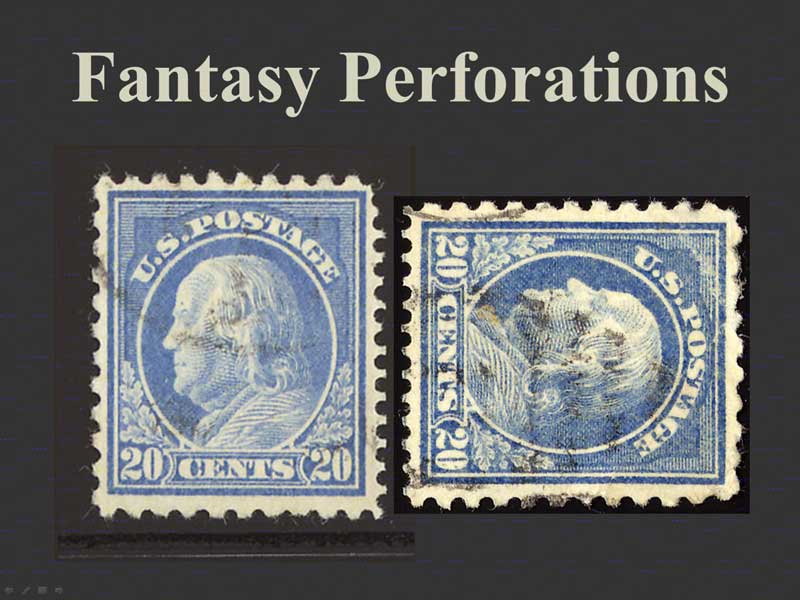 |
|
Send note to Staff
|
| Edited by cfrphoto - 10/20/2014 8:16 pm |
|
|
Pillar Of The Community

United States
1498 Posts |
|
|
Just to muddy the waters ... and broach the highly improbable ... I'll mention that Scott has a footnote referring to 556b. This is the perf 11 Martha where either the top or the bottom (not both) is perf 10. In the footnote, Scott mentions that there is a used transitional stamp known where the left top is perf 10 & the right top is perf 11.
But I have no explanation for perf 10.5 at both top & bottom ... unless someone did a reperfing job on a 556, perhaps trying to fake a rarity. But then why get it wrong? C'est la vie. |
|
Send note to Staff
|
|
|
Pillar Of The Community
United States
937 Posts |
|
|
Hello Clark, I had not intended for any of these posts to be definitive. Yes, flat plate and rotary perforations are not the same. However the bottom of both stamps in one photo are in nearly the same plane which allowed me to compare them: 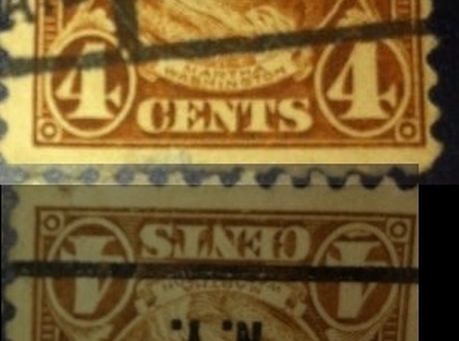 I wasn't trying to speculate that a new perforation variety had been found. I was merely stating that I could see what she was trying to communicate to us. With a scan, we could see if the perfs look legitimate. With an expertization, then a new perforation variety could potentially be defined. It sounds like you've been through that, how does a new variety become acknowledged? Chances are that this one has been re-perfed for whatever reason. I've had many examples cause me to scratch my head and wonder. For an example, look back to my laughable 544 post. Regardless, the curiosity is there and she reached out asking for information. I had my question answered in that thread, I'm attempting to answer her question here. Respectfully, Ryan P.S. I'm envious of discovering a new variety. Have any pics of your find? |
|
Send note to Staff
|
| Edited by Historical DNA Collector - 10/20/2014 8:44 pm |
|
|
Pillar Of The Community
United States
1414 Posts |
|
|
Quote:
But I have no explanation for perf 10.5 at both top & bottom I don't believe that anyone has established that the flat plate stamp is perf 10.5 on the top and bottom. Recall that perf 11 flat plate pins are spaced .072 inches on center while rotary pins spaced .070 on center is also called perf 11. A perforation gauge is not a measuring tool. It is a classification tool. The perforation gauge is the number of perforations that fit completely between lines spaced two centimeters apart. It would be quite easy for an inexperienced collector to conclude that flat plate stamps are perf 10 1/2 or that rotary stamps are perf 11 1/2 at the top. Perforation gauges and the measurements to the nearest 1/2 millimeter in the Scott catalog are not accurate enough to be conclusive. The Kiusalas US Specialist gauge was intended to produce more accurate results because he reasoned correctly that the engineers and machinists who engineered and built US perforating machines in the 19th and early 20th century used English measurements and would have had little familiarity with the Metric system. Clark |
|
Send note to Staff
|
| Edited by cfrphoto - 10/20/2014 8:44 pm |
|
|
Pillar Of The Community
United States
1414 Posts |
|
|
Quote:
Yes, flat plate and rotary perforations are not the same. However the bottom of both stamps in one photo are in nearly the same plane which allowed me to compare them: . I would really like to see a comparison of top and bottom from a scan. The stamp may have a transition from perf 11 to what is called perf 10 on the top or bottom. Actually, the perforation spacing does not match flat plate 10-79 or even rotary press 10-80. Genuine examples I have examined follow a distinctive pin pattern that can be matched somewhere at the left or right transition or along the row. Not that many pins are involved. Unfortunately, some perforations at the transition point are damaged, but the vertical and horizontal positions of the holes can checked against a reference like the 498g block sold some years ago in a Siegel auction sale. If the top and bottom perforations on the same stamp don't match, then there could be cause sending the stamp in to be expertized. An overlay test can be done in Photoshop or Photoshop elements by selecting a small area in the margin, then Select Similar once or twice, then Layer via Copy. Holding down the control key allows the new layer to be moved until the top and bottom perforations just touch. I have shown this technique several times at the APS Summer Seminar and at the APS StampShow in Sacramento a couple of years ago. I learned the technique from Scott Trepel of Siegel Auctions at Washington DC 2006. However, a scan at 1200 DPI or higher resolution is important. It is possible to do this test with a 600 DPI scan. A digital camera cannot be used unless the stamp is mounted in a copying stand. Clark |
|
Send note to Staff
|
| Edited by cfrphoto - 10/20/2014 9:02 pm |
|
|
Pillar Of The Community
United States
937 Posts |
|
|
Clark, I agree, a scan is necessary. No one has been able to confirm the actual measurements so far. I already looked to see if a perf 10 whole or transitioning was possible. This is the result of a quick test similar to yours. Your test may be much more accurate: 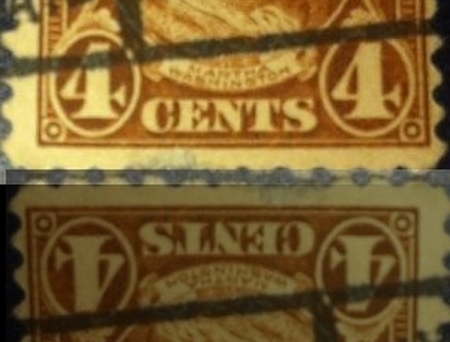 It's not as definitive as a scan, but it appears that any portion of it being perf 10 on the bottom is not possible. I did the same test with the top and found the same. Of course, only one side would be affected on a 556b. |
|
Send note to Staff
|
| Edited by Historical DNA Collector - 10/20/2014 11:08 pm |
|
|
Valued Member
72 Posts |
|
|
How can both stamps be a 636 when they are perforated differently
My Scott cat says the #636 is perforated 11 at the top and 10.5 at the side ....and I have two of them
What I would like to know is why is there no mention of an A159 perforated 10.5 at the top and 11 at the side ... |
|
Send note to Staff
|
|
|
Pillar Of The Community
1849 Posts |
|
|
Quote:
What I would like to know is why is there no mention of an A159 perforated 10.5 at the top and 11 at the side .. Because NONE were issued. |
|
Send note to Staff
|
|
|
Pillar Of The Community
United States
937 Posts |
|
|
Bellfastgirl, there seems to be some miscommunication. You only have one 636. We don't know what the other one is. It was never officially issued by the U.S. Postal Service. That variety of perforation has not been noticed by philatelists before. So, there is no Scott catalog listing for it.
There is a possibility that the perforations were altered. If you post a large 1200 dpi scan, we may be able to tell you more. |
|
Send note to Staff
|
|
|
Valued Member
72 Posts |
|
|
I have two 11 x 11 and one 10.5 x 11 I did not take a photo of both of the 11 x 11 stamps
2 + 1 = 3
sorry for the confusion ....I will take the stamps and get them scanned my scanner produced a poor quality scan .
To the smarty pants who said NONE were issued ...Perhaps you are WRONG
thanks |
|
Send note to Staff
|
|
|
Pillar Of The Community
United States
937 Posts |
|
|
Hey now, this isn't a competition. At least I don't think that it is... |
|
Send note to Staff
|
|
|
Replies: 83 / Views: 12,283 |
|




 Posted 10/19/2014 10:42 am


