| Author |
 Replies: 14 / Views: 2,099 Replies: 14 / Views: 2,099 |
|
|
Valued Member
United States
485 Posts |
|
|
Hello. Perf on this looks to be 11? It was hard for me to gauge as it is attached to post card. It is postmarked with a NY address, 1924. Can I remove it with warm water? Any tips on removing? Does it look rotary press to you? Thanks! 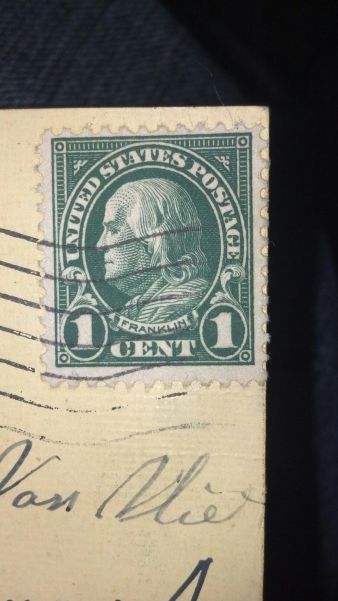 |
|
Send note to Staff
|
|
|
|
|
Pillar Of The Community
United States
937 Posts |
|
|
Personally, I'd leave it on there. I love full covers.
Try to identify it first, then maybe take it off.
Did you compare it to a rotary or flat plate printing? Do the vertical perforations seem to be 10.5?
If you think that it is dated 1924, then it would probably be a flat plate printing. It looks to me to be a flat plate printing. |
Send note to Staff 
|
| Edited by Historical DNA Collector - 10/26/2014 12:15 am |
|
|
Pillar Of The Community
1849 Posts |
|
|
Rest in Peace
United States
7097 Posts |
|
|
I agree with HistoricalDNAcollector to both leave it on cover and that it's likely a flat plate printed Franklin. |
|
Send note to Staff
|
|
|
Valued Member
United States
485 Posts |
|
|
Pillar Of The Community
United States
937 Posts |
|
|
If you want to remove it, then there are many websites that detail how to do so as well as many youtube videos. It's your choice.
Maybe you could post the rest of it and we might be able to give you even more reason not to remove it. Notable people, places, and times can make that stamp on cover worth collecting. The stamp itself is worth very little.
Regardless of the cover showing something that makes it valuable, taking the stamp off will guarantee that it is worth pennies. |
|
Send note to Staff
|
|
|
Valued Member
United States
485 Posts |
|
|
Well, I just did the paper over stamp, and lightly rubbed pencil over. The design definitly came through pretty clear. I do understand that flat print can sometimes do this but I don't think I've had a design rub through this well from a flat print. Also, I did find that there were a few 1923/24 rotary printed, of course very very few. It's fun to think about what if but I know that's a lottery pick. |
|
Send note to Staff
|
|
|
Pillar Of The Community
United States
937 Posts |
|
|
You are very correct that a very small amount of 1924 printings are rotary for this series. Both rotary and flat plate printings will show an "Intaglio" design which has raised edges compared to an offset printing.
None of this series are offset printed. If it were possible, which it isn't, then I like to use very cheap tinfoil and a Q-tip.
The color and thickness of lines in the detail make me think very strongly that your stamp is a flat plate printing.
The Washington/Franklins are all very much a "lottery pick." It takes quite a while before their identification becomes easy.
Every single W/F stamp is like a lotto ticket or scratch off card. The chance of it being worth something significant is very low, but that chance is there.
It takes time to know how to identify them. It's not easy. Regardless it's a heck of a lot more fun than spending a dollar for a scratch off card to end up throwing in the trash. You end up with a properly identified stamp that is nearly 100 years old. It might be very common and worth pennies, but it's not trash. |
|
Send note to Staff
|
|
|
Valued Member
United States
485 Posts |
|
|
Thumbs up Historical DNA! Thanks for all the info. Yes, I am finding the Franklins and Washington very difficult but very fun. I have been buying a lot of post cards, just searching for the fun of it. Absolutely better than buying lottery tickets and smarter too! Lol |
|
Send note to Staff
|
|
|
Valued Member
United States
485 Posts |
|
|
How about this guy, DNA? Measures 11 perf. Has a green apple color. Testing my progress here. 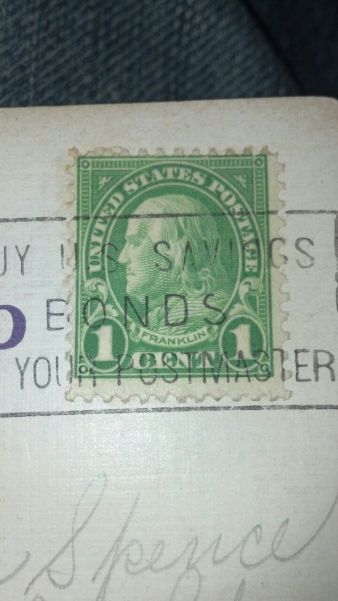 |
|
Send note to Staff
|
|
|
Pillar Of The Community
United States
937 Posts |
|
|
You now know that your first stamp is flat plate. Rotary stamps have a design size that is taller and/or wider than flat plate prints. So compare this one to it. Both are on cover which makes this a bit difficult. You could remove the flat plate from the cover to make it easier to compare. However, the flat plate print is conveniently situated at the edge, so vertical comparison would be just as good on or off cover. Comparing horizontal design size can be done with both staying on their covers. Lay the flat plate cover on top of the suspect cover. Then use rulers or any good straight edges to line them up. Using http://1847usa.com/1922identifier.htm we see that rotary prints with perf 11 can be approximately 0.25 to 0.5 mm taller. For horizontal, you'd be looking for an approximately 0.75 mm difference. All stamps vary a small amount in size, so it may take other methods if it's hard to tell by comparing them. As you noted, the color is quite different, however recognizing color takes the longest to learn. For now, just use the fact that rotary prints are usually much less bold/strong in color. Whenever you post an image or a scan, crop it to just the stamp. Your "guy" appears to be wearing blue jeans :) |
|
Send note to Staff
|
| Edited by Historical DNA Collector - 10/26/2014 11:15 am |
|
|
Pillar Of The Community
1849 Posts |
|
|
Pillar Of The Community
United States
937 Posts |
|
|
Valued Member
United States
485 Posts |
|
|
Pillar Of The Community
United States
937 Posts |
|
|
maverickx, please be sure that you understand that Kevin was confirming what I_Love_Stamps and I thought about your first stamp. My last reply was in reference to your second stamp. |
|
Send note to Staff
|
|
| |
Replies: 14 / Views: 2,099 |
|



 Posted 10/26/2014 12:01 am


