| Author |
 Replies: 28 / Views: 5,559 Replies: 28 / Views: 5,559 |
|
Pillar Of The Community
United States
1946 Posts |
|
|
Here is an item I think you might find interesting. 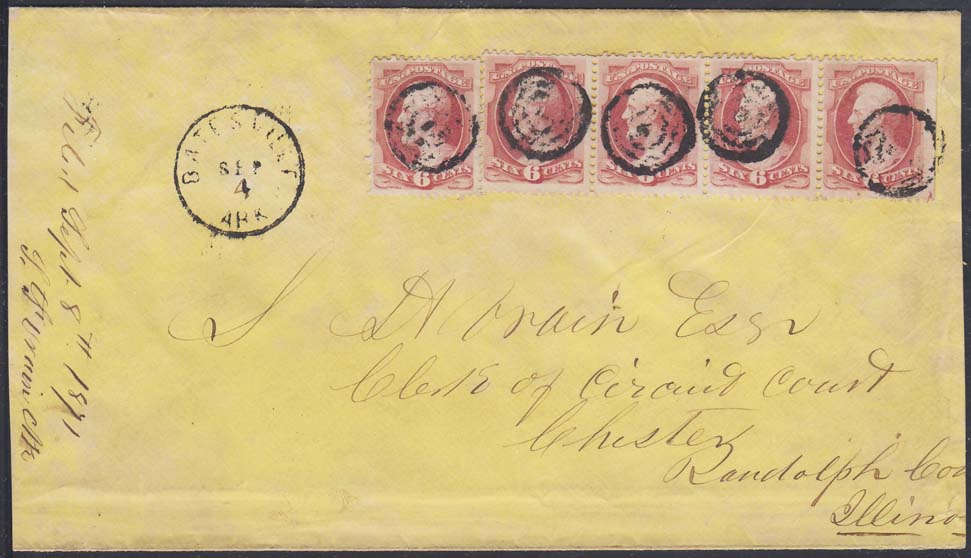 It came out of the recent Siegel "Curtis" auction, and is one of those examples of a cover that is interesting on both sides, albeit for very different reasons. This cover is particularly unusual because it has the distinction of having its own entry in the Scott US Specialized catalog as a special item under US #137. Whats the big deal? This is a courthouse cover originating in Batesville, Ark on September 4 with a strip of 4 plus single of the National BNCo grilled six cent. It was bound for a courthouse in Chester, Illinois, and the clerk docketed it for filing on September 8, 1871, a nice usage when they were still pretty faithful about grilling, but were beginning to get irregular about it. The strip has been "lifted" and repositioned a long time ago in order to do a detailed study of the grill characteristics. The Siegel describer mentions that the largest known multiple for this stamp is a block of 6, but suggests that this is one of the largest multiples presently known, and may be the largest since the block has not been seen for a while. But the grilling pattern is a bit erratic, and that is what make it interesting. The H-grill is strong on the straight edge stamp on the right, moderately well struck on the stamp second from right, and on the unattached single. However the stamp in the center of the array, the third from the right in the strip, shows no grill. 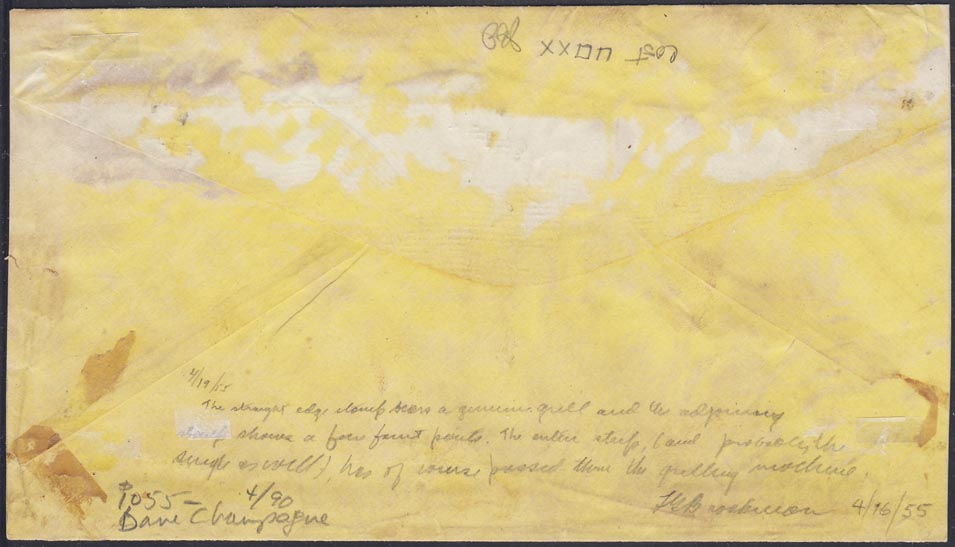 The reverse of the cover is devoid of postal markings, and is defaced with old mounting scars and notes by various dealers. But the longest notation there is in the hand of Lester Brookman, one of the notable authorities of the mid-twentieth century. His note comments on the grill pattern on this strip and reads as follows: 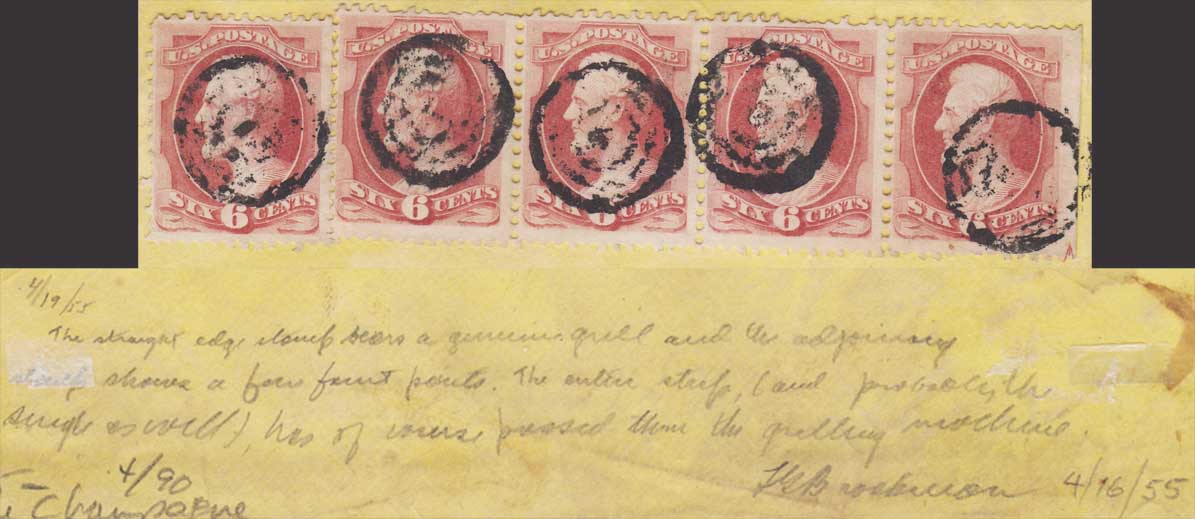 Quote:
The straight edge stamp bears a genuine grill and the adjoining stamp shows a few faint points. The entire strip, (and probably the single as well), has of course passed thru the grilling machine. - LGBrookman 4/16/55
Grill and non-grill pairings for the early Bank Note issues are sufficiently uncommon that they tend to get catalog listing for several denominations, and that is the basis for the listing of this cover in the Standard catalog. But to me the reverse is also interesting to philatelists for the autograph of Lester Brookman it bears. I don't know that I would pay extra for it, but it's nice to have. I was amazed to pick up the whole thing for less than the price of two disjoined singles. Go figure. |
|
Send note to Staff
|
|
|
|
|
Pillar Of The Community
1849 Posts |
|
|
Pillar Of The Community
United States
5894 Posts |
|
|
Pillar Of The Community
United States
3295 Posts |
|
|
Was Mr. Brookman the person who lifted and or repositioned the stamps, or can the grills be seen form the front. I'm sure the the strong grill on theb straight edge stamps shows on the front, but was asking about the weaker grilled stamps. Fortunate that the note excaped with just minor mounting traces. Very nice cover, thank you for showing it. |
Send note to Staff 
|
|
|
Pillar Of The Community
United States
1820 Posts |
|
|
Nice! To me the annotation of a past philatelic giant like Ashbrook, Chase, Perry, Brookman, Neinken etc. is always worth a little something extra. |
|
Send note to Staff
|
|
|
Valued Member
72 Posts |
|
|
Very nice piece. I just looked up the auction results, and you definitely made out well on this one. |
|
Send note to Staff
|
|
|
Rest in Peace
United States
763 Posts |
|
|
Very nifty item! I have seen a number of these over the years ((though I do not recall any on the 6c value). I think that most collectors tend to ignore these - believing that they simply demonstrate poor workmanship by the printer, rather than the more exciting way you (and me!) and others look at it as a "grill omitted" on one (or more stamps). There is no question that if the ungrilled were separated out from the others, it would simply be an ordinary #148! (Even though there is "proof" of it's original status.
I can remember oldtime famous dealer Jack Molesworth doing exactly that - trying to sell a "grill omitted" on one that was (somehow) separated from the pair and even though accompanied by expert cert showing it in it's original state, no-one would buy it!
Thank you for showing it! |
|
Send note to Staff
|
|
|
Valued Member
United States
56 Posts |
|
|
Old stamps on the original old envelop that they were stamped on, not something you see everyday. Very nice. |
|
Send note to Staff
|
|
|
Rest in Peace
United States
7097 Posts |
|
|
NICE cover! So that's the largest multiple of that stamp with the grill and the lack thereof? Neat! |
|
Send note to Staff
|
|
|
Pillar Of The Community
United States
2963 Posts |
|
|
An incredible item. Thanks for sharing with us!
Brian |
|
Send note to Staff
|
Brian Riley
APS 223349 |
|
|
Valued Member
72 Posts |
|
|
Quote:
I think that most collectors tend to ignore these - believing that they simply demonstrate poor workmanship by the printer, rather than the more exciting way you (and me!) and others look at it as a "grill omitted" on one (or more stamps). I can believe this, but I certainly don't understand the "nothing more than poor workmanship" mindset. Something like this, to me, is a historical artifact that illustrates the limitations of the relatively primitive production process of the time. And it borders on EFO territory, in my opinion. Quote:
There is no question that if the ungrilled were separated out from the others, it would simply be an ordinary #148! (Even though there is "proof" of it's original status.
I can remember oldtime famous dealer Jack Molesworth doing exactly that - trying to sell a "grill omitted" on one that was (somehow) separated from the pair and even though accompanied by expert cert showing it in it's original state, no-one would buy it! Now this I can understand. Personally, I wouldn't be interested in a single grill omitted stamp, even if it came with ironclad proof of it's provenance as part of a larger piece from a grilled issue. To me, the value of such an item is in the piece that combines both variants, not in its constituent parts taken as individuals. Now, if both parts were present, though separated, I'd still consider that to be desirable, as the entire piece would still be there. |
|
Send note to Staff
|
|
|
Rest in Peace
United States
763 Posts |
|
|
Expanding on the "poor workmanship" a bit, the National Banknote Company had every contract from 1861 to 1869 and, as we know, both the 1867-68 and 1869 issues were grilled, so the feeling, I think is that since applying grills was 1. Part of the 1870 Contract agreement with the POD and 2. They had been grilling all stamps since 1867 that there was no good reason for them not to produce solidly-grilled stamps in 1870. But really, lots of the grills, particularly on the high values, are very weak, sometimes only showing a few points or rows. So collectors blame it on the poor workmanship. But interestingly, I have seen these "grill omitted" on one or more stamps on some of the low values too, so there might be another good explanation(?). |
|
Send note to Staff
|
| Edited by Bill Weiss - 11/22/2014 12:08 am |
|
|
Valued Member
72 Posts |
|
|
I'm about as far from an expert on the matter as one can be, but as I recall, Brookman implied that National was pretty lackadaisical with the grilling of the 1870 issue, for whatever reason. That being the case, I would think that one of the first corners they would have cut would have been to increase the number of sheets run through the grilling machine at the same time, thus technically fulfilling the contract, while increasing throughput, and having the side effect of producing lighter to nonexistent imprints on the bottom-most sheets.
And presumably with 19th century machines, tolerances were much wider than today, so that pressure applied across the grilling apparatus, as well as the height of the grill points themselves, could have varied enough that adjacent stamps could have received markedly different depth of impressions, particularly towards the bottom of a stack of sheets.
In addition (and I realize I'm stacking conjecture upon conjecture here), I would suggest that they might have had a reason to put high value sheets at the bottom of stacks of low value sheets while putting them through the grilling apparatus. Consider this: a sheet of 200 90c stamps has a face value of $180; in today's money, that's roughly equivalent to $3,000. Similarly, a sheet of 30c stamps would be equivalent to $1,000 today, and a 24c sheet would be $800.
Now, think about all the procedures and checks that companies have in place today regarding the handling of higher value items - among other things, every item must be accounted for and handled under strict supervision, including scrap/waste from the production process. Surely companies had similar procedures in place in the late 19th century. So, if you were the guy working the grilling apparatus in 1870 (or his supervisor), would you want to run a batch of nothing but 24/30/90c sheets through, taking the chance that one or two on the top might be grilled too heavily or otherwise torn during handling afterwards because of the strong grill? Or would you think it safer to put the high value sheets at the bottom of a stack of lower value sheets, thus minimizing the chance of having to document the loss of an $800-$3,000 item, and potentially drawing extra scrutiny to yourself?
|
|
Send note to Staff
|
|
|
Pillar Of The Community
United States
1946 Posts |
|
|
Moon, I see a lot of speculation in your last post, and some pretty powerful assumptions. But I can't tell from all that what you know for sure. So let me ask, what makes you think they mixed denominations in the grilling process? How would you propose to test your theory? |
|
Send note to Staff
|
|
|
Valued Member
72 Posts |
|
|
Essayk, as you say, my last post is mostly conjecture. As I said - I'm far from an expert, more like an interested student. I'm just throwing out some ideas that come to mind that might explain why we see clear grills next to faint-to-nonexistent grills on adjacent pairs. And I took that conjecture a bit further as a possibility that might account for Bill's observation that high value stamps are particularly prone to exhibiting weak grills.
Again, this is all conjecture. All I know for sure is that Brookman noted that National was lazy (my words) with their grilling of the 1870 issue, and that multiple sheets were grilled in one pass through the apparatus. But, since we know that grilling was an additional step after printing, it seems to me that we can't assume that it was only ever applied to sheets of a single denomination in any given pass through the machine.
But, again, that's just my conjecture. I apologize if I'm missing something that would render all this moot. |
|
Send note to Staff
|
|
|
Valued Member
72 Posts |
|
|
Of course, a more obvious explanation for the apparent propensity of high values to exhibit weak grills is that high value stamps are more likely to be examined closely, and thus to have a weak grill noticed. |
|
Send note to Staff
|
|
|
Replies: 28 / Views: 5,559 |
|




 Posted 11/20/2014 4:20 pm


