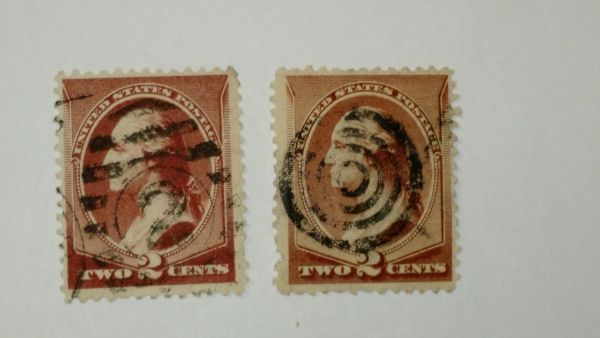
The trial colors are indeed rare. Most are die proof items, but some exist as plate proofs on card in various shades of "lake." All those are imperforate. The Sample stamps (in the Specimen section) are perforated on stamp paper, and come in several shades. They need a bit of explanation. Here is a composite peek from some of my old exhibit pages:
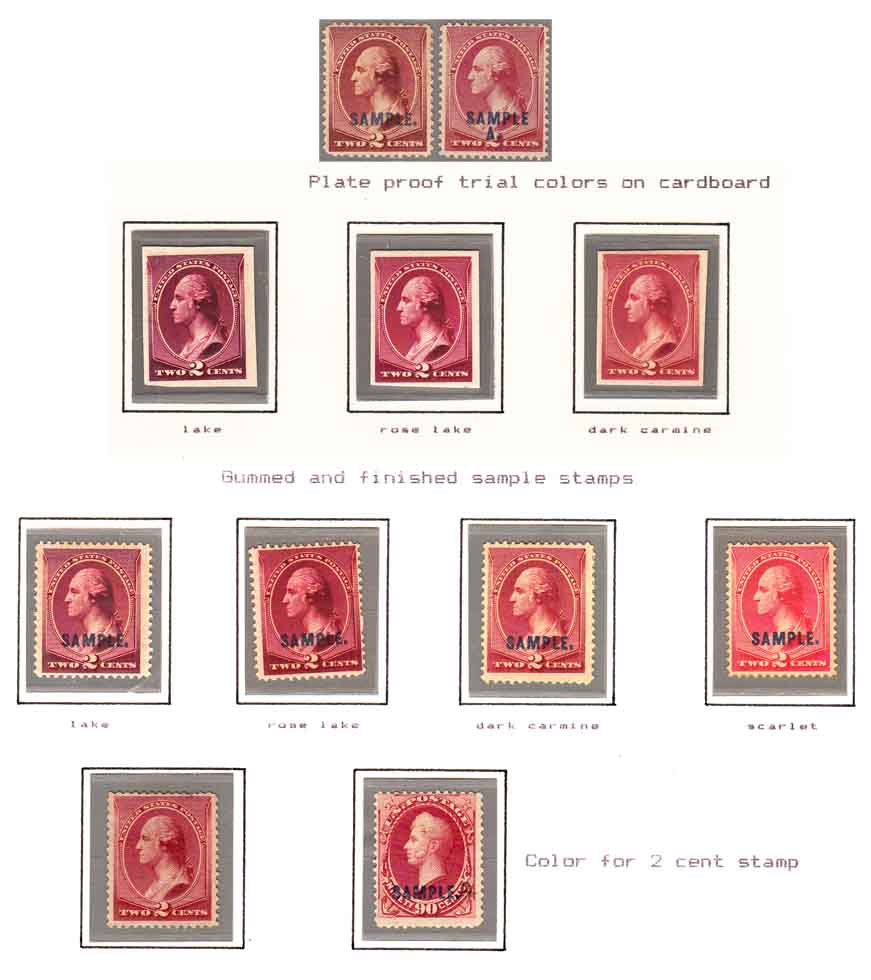
In 1889 the government was toying with the idea of reducing the size of postage stamps with its next stamp production contract, and wanted to revise the color scheme of the denominations whether it reduced the size or not. The Sample stamps were color samples attached to the forms of specification given to contract bidders. Those overprinted "SAMPLE" were for stamps of larger size, while those overprinted "SAMPLE A" gave the scheme for stamps of smaller size.
In the grouping I am showing you, the top row shows the SAMPLE and SAMPLE A color samples as they were intended to be attached to the forms of specification. Note that the one on the left has a shade like the 2c of 1883, but the other is a lake shade. This was supposed to represent the color "carmine" for a new series of stamps in a smaller size.
The second row is a set of the shades of the plate proof trial colors, which were pulled to help prepare the samples. The American Bank Note Co. was having trouble coming up with an appropriate shade for that in an ink that was not based on aniline dyes.
The third row is the set of shade proposals they submitted for the Sample stamps, which, for convenience, were overprinted "SAMPLE" despite the fact that all were candidates for the color "carmine," the color for 2 cent stamps of smaller size. To see the one they picked look at the stamp on the right in the top row again.
The fourth row is an example of a stamp that was supposed to be overprinted "SAMPLE A" but had a problem and they didn't overprint it. That left them short of the samples they needed for the forms of specification, so they made a hasty substitute from the 90c SAMPLE stamps.
As collectors we live with the fallout of their attempts to get the color mess untangled, which they were not able to do before the new series had to go into production in 1890.





 Posted 12/11/2014 09:40 am