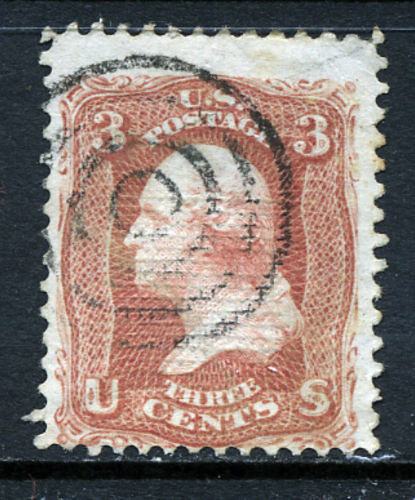
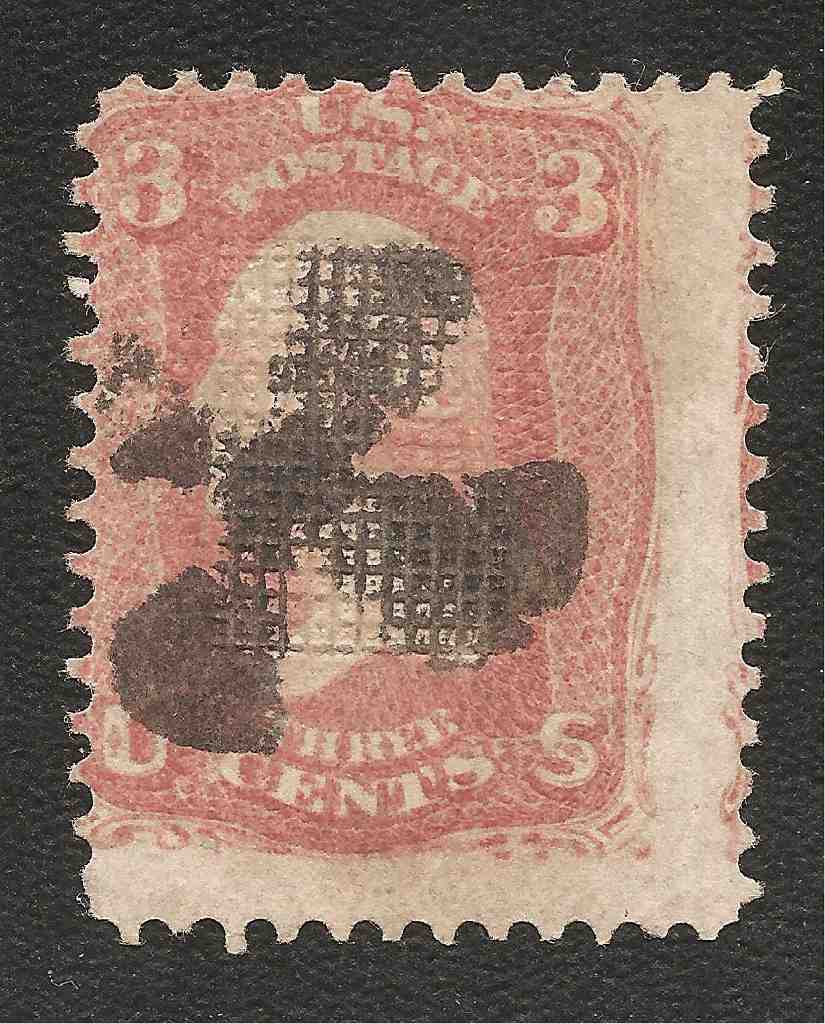
Brian, I'd like to comment on technique a bit since the lighting issue is critical and can be tricky. Here is an image of a late state H grill, which is a "points down" grill.
Here the "X" shape of the points can be seen on the tips of the points protruding down on the reverse, and they appear as incised figures between the round pips on the obverse. These are characteristics of well impressed points down grills. That I think you know and could anticipate. The lighting for this photo was off axis, and came in from the side of the stamp design.
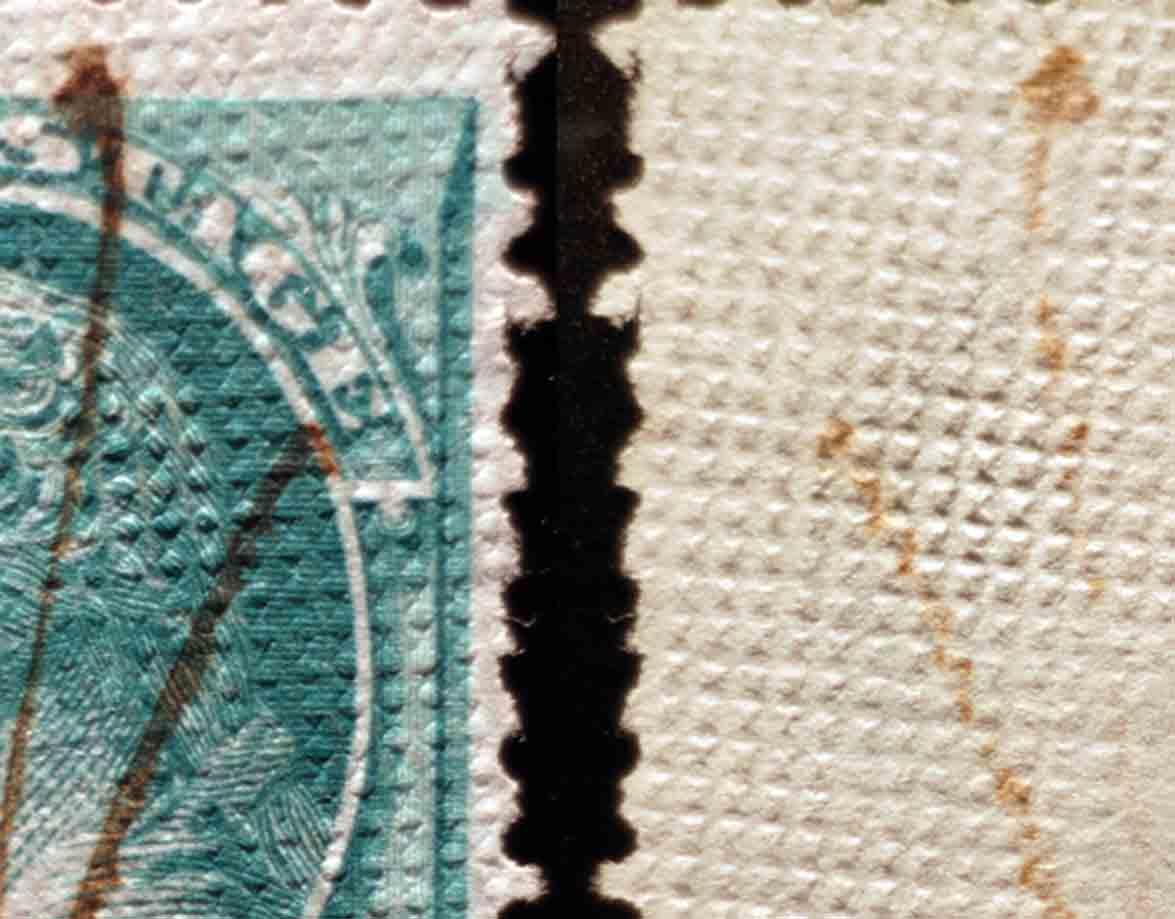
What then do you make of this next grill, points up or points down?
The reverse appears to show Xs on the points, and the obverse shows pips, although the incised Xs are not clear. So you might be inclined to call this another points down grill. But you would be wrong if you did.
I threw you a ringer here to make a point. This grill is one of the 11x14 essay grills on the 2c Banknote, and when you view it in hand you can see that it is in fact a points up variety. But the photo doesn't show it that way, right? Why not?
In this case the lighting was off axis, but came in from the TOP of the stamp design. You can tell by the positions of the bright sides and shadowed sides of what appear to be the points. [Although at first blush you might think I have that turned around.]
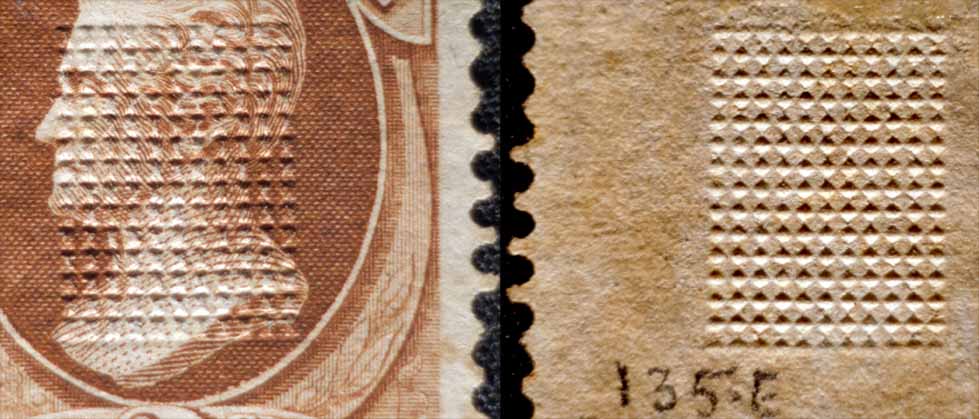
Keeping the stamp and the camera in exactly the same relative positions as in the shot above, let's see what happens when we move the light source so it comes in from the side, relative to the position of the stamp.
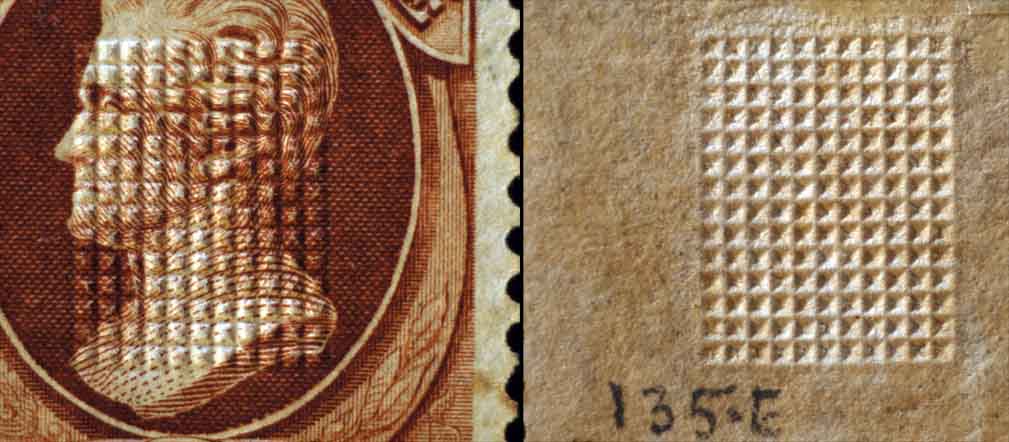
This image gives a true representation of what you actually see when you look at the stamp freehand. On the reverse side the points show up as RECESSES not protrusions, while on the obverse the array of pips gives way to a set of "pillowed squares." (Which have the characteristic X of grill points when we look closely enough.) So this is indeed a "points up" grill, since it is the freehand observation that determines that.
My point in doing this exercise is to emphasize that for photographing grills it is important to control the lighting so that the shape of the grill in the photo image corresponds to its appearance in a freehand view. It is the interplay between light and shadow that allows a two dimensional photographic image to approximate the appearance of a three dimensional figure. But the direction of the light source can also create optical illusions in the image.
So the principle is this, for illuminating grills, use an off axis light source that approaches the subject from its side relative to a view of the image when upright.
Edit. added thought. Putting graphite on the reverse side of a stamp with a points up grill is not going to put anything on the tips of the points, It is just going to smear around on the openings of the holes forming the points on the other side. And since the points are up, on the design side, the use of graphite with points up grill is not a good idea at all. My 2c.





 Posted 02/23/2015 08:46 am