| Author |
 Replies: 14 / Views: 2,875 Replies: 14 / Views: 2,875 |
|
|
Valued Member
United States
131 Posts |
|
|
I believe this is just a plain 499 Washington that has been trimmed on the right. Not sure what the line on left edge is? Perhaps the stamp is from a booklet pane? Perf 11, no Watermark, FP. At first I thought perhaps a coil but with Perf 11 it can't be that. The toga rope loks like a strong type I and not a Ia. Just trying to learn about this series. No scanner, but see picture if I can get it out on the sight. 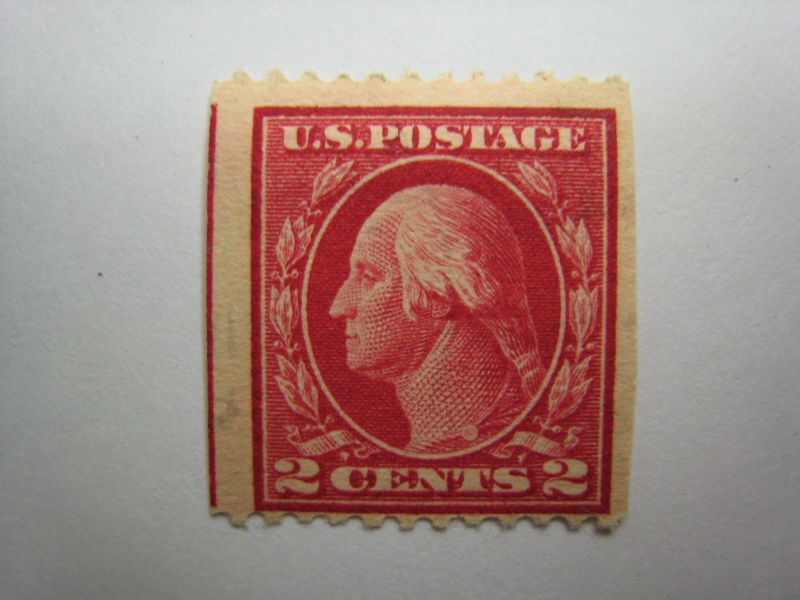 |
|
Send note to Staff
|
|
|
|
|
Pillar Of The Community
United States
937 Posts |
|
|
Hello and welcome chaulkdust. That username makes me think that you are a teacher.
The line to the left is another impression that was cut into when this stamp was originally produced. Notice how it is the same height as the full design (i.e. the line doesn't extend past the upper and lower parts of the full impression)
It appears to have a natural straight edge at left. The right side looks like a non-straight cut with scissors. With no watermark, I believe that you have a #499 as you suspected.
However, I wonder if this stamp started its life as vertically imperforate. I'm eager to hear the assessment from the more experienced members here. |
Send note to Staff 
|
Ryan = HDNAC = DNA = HDC = Hysterical DNA Collector = Historical DNA Collector = me who just loves stamps :) |
|
|
Pillar Of The Community
United States
1756 Posts |
|
|
Positively a 499 edge copy, perfs trimmed at right...
could not have been an imperf... upper and lower
perfs are positively not reperfs... |
|
Send note to Staff
|
|
|
Pillar Of The Community
1849 Posts |
|
|
Rest in Peace
United States
763 Posts |
|
|
Historical DNA said "vertically imperf", therefore the top and bottom perfs have nothing to do with that possibility. But of course, there is no way possible to conclude that an item such as this originally came from a pair (or more) that was imperf vertically because there are lots of stamps that came from sheets that were dramatically misperfed such that some individual copies had unusually freaky-large large margins. |
|
Send note to Staff
|
|
|
Pillar Of The Community
United States
1756 Posts |
|
|
My question would be if this stamp has gum... With the color removed the stamp appears to be a cancel... 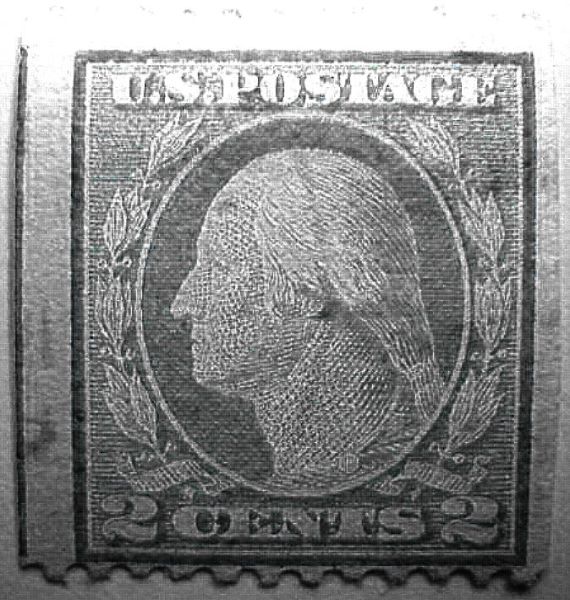 |
|
Send note to Staff
|
| Edited by disi123 - 01/31/2015 11:10 pm |
|
|
Valued Member
United States
131 Posts |
|
|
The stamp does not have gum. Thanks for all the reply's. I guess I can safely put this with my other 499's. Just one last question, since I'm new to this - what does Historical DNA mean? Thanks. |
|
Send note to Staff
|
|
|
Pillar Of The Community
United States
1946 Posts |
|
|
Historical DNA is the avatar name of the first person who responded to you. |
|
Send note to Staff
|
|
|
Pillar Of The Community
United States
937 Posts |
|
|
"Vertically imperf" refers to two stamps that don't have vertical perforations between them, and which are not imperforate on all 4 sides. I speculated that your stamp might have originally been that type. As Bill Weiss stated, there is no way to know for certain without having one or more stamps adjacent to it with no perfs between them.
I'm still trying to figure out why the vertical line at left is the same height as the design. Maybe it's because of the plate's layout and poor cutting? Kevin's theory of miscut booklet panes seems plausible. |
|
Send note to Staff
|
Ryan = HDNAC = DNA = HDC = Hysterical DNA Collector = Historical DNA Collector = me who just loves stamps :) |
| Edited by Historical DNA Collector - 02/01/2015 6:39 pm |
|
|
Valued Member
United States
131 Posts |
|
|
I know this may be beating a dead horse, but I have some more information about this stamp. I was going to file it away as a weird 499, but decided to take a closer look at it again. Mainly because it just doesn't look right. I checked both L/R edges under magnification looking for any traces of perf holes - found none. Re-measured the design and it's 19 1/2 x 22 (Rotary - instead of Flat Plate?). Checked a bunch of 499's and never found a design near this size. Usually about 19mm give or take a small bit +- 1/8mm, and mostly 22 1/4- 22 1/2 - none I checked at 22mm? Perhaps this means nothing as well.
The line at the left is still annoying. I measured the frame design of the stamp at the left again (exactly 22mm. I measured the partial line at the way left (exactly 22mm). This puzzles me for a variety of reasons. I went looking for booklet panes with broken guide lines - I couldn't find any examples. Of course that doesn't mean there isn't one out there? Also, whats the odds of the broken guide line matching the design size exactly? The gap between the left line and left frame design is exactly 2mm. Another exactly?
The stamp had no gum and it did have a hinge remnant on the back. Since initially I checked the watermark with the hinge in place and didn't see any watermark. I soaked it off and checked again. Yep, no watermark hidden under where the hinge was.
I just want be to sure as I can be before I 499 it to death in my stock book!
|
|
Send note to Staff
|
|
|
Valued Member
21 Posts |
|
|
I agree with your original assumption that it is a miscut booklet pane showing the border of the stamp to the left with right perfs trimmed.
At perf 11, I believe the only rotary is a type III (546). Yours looks like type I. A large example. Is there set off? |
|
Send note to Staff
|
| Edited by Franklin - 06/07/2015 4:11 pm |
|
|
Valued Member
United States
131 Posts |
|
|
Wouldn't the booklet pane still be perforated between the stamps? Unless it was perhaps a blind perf like the below 499? 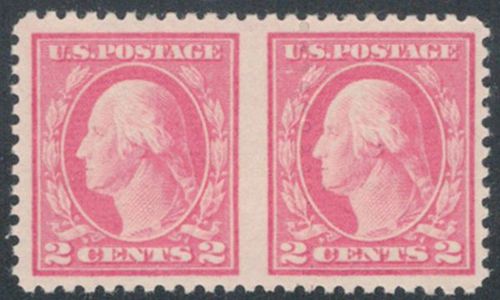 |
|
Send note to Staff
|
|
|
Pillar Of The Community
United States
1026 Posts |
|
|
Booklet panes weren't perforated between the panes, and were cut from sheets with the stamps the same distance apart as normal sheet stamps. If the cut between two panes is misplaced enough a portion of the adjoining stamp would show, as it does in the left side your example. On the right side the stamp has been cut with scissors, giving a curved line. It might have been trimmed when taking it out of the booklet, it might have been trimmed when taken from the envelope and it might have been an imperf between booklet. The first two are significantly more likely than the third. :) Remember that the perforations were done at a different time than the cutting for individual panes, so it's quite common to have a pane that has well centered perfs and radically shifted side cuts, or normal side cuts with radically shifted perfs, or both shifted... |
|
Send note to Staff
|
|
|
Valued Member
United States
131 Posts |
|
|
Yes, I guess the only conclusion is 499 of some type. So into the stock book it goes.
Thanks |
|
Send note to Staff
|
|
|
Pillar Of The Community
United States
1414 Posts |
|
|
The stamp is a booklet pane single trimmed on the right. It is fairly easy to check with a lay down comparison with a 499. The booklet pane stamp will be slightly wider and maybe shorter than the sheet stamp. The difference will be a fraction of a frame line width. Measuring the stamp design with a ruler won't help much. It is possible to measure the stamp and a companion reference copy if they are scanned into a program like Photoshop Elements. The scanner will add metadata to the image that will enable it to be measured. It is not possible to measure the design if the image originated as a digital camera photograph or if the scan was resized after it was created.
Clark |
|
Send note to Staff
|
|
| |
Replies: 14 / Views: 2,875 |
|



 Posted 01/31/2015 7:19 pm


