| Author |
 Replies: 22 / Views: 4,037 Replies: 22 / Views: 4,037 |
|
Valued Member
United States
69 Posts |
|
|
Hi Everyone, I am unsure of the Scott number for this stamp. It has no grill. Thanks in advance for the help. 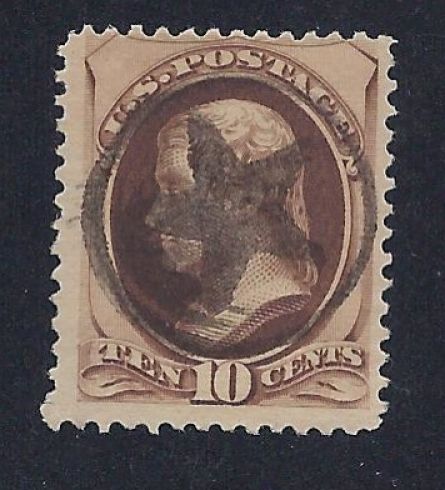 |
|
Send note to Staff
|
|
|
|
|
Valued Member
Ireland
169 Posts |
|
|
Valued Member
United States
69 Posts |
|
|
Thanks Gladiators001 its not going anywhere. Just wanted to get it in the album in the right space. |
Send note to Staff 
|
| Edited by SavStamp - 02/12/2015 6:33 pm |
|
|
Rest in Peace
United States
7097 Posts |
|
|
Valued Member
United States
69 Posts |
|
|
Pillar Of The Community
United States
578 Posts |
|
|
I_Love_Stamps, I think this one is an American Bank Note Company printing (based on the look of the perfs -- they have the characteristics of "soft paper," not the Continental wove (or transitional) paper.) I'm pretty sure (but apparently not as "sure" as Gladiators001) that it's Scott 188, but there's a chance it could be Scott 161. It definitely exhibits the secret mark so will be one of those two Scott numbers. While not the best centering, the star cancel makes it an attractive, collectible example. |
|
Send note to Staff
|
|
|
Rest in Peace
United States
7097 Posts |
|
|
You're Absolutely right srailkb my apologies. It's been a few months since I toiled with the large banknotes. It does seem to be a brown-yellow on my monitor at least but the paper I can't tell weather it's soft or not?
I can tell it's pre 1882 by the lack of the vignette dot but that's not always reliable as you pointed out however, I cant see how many vertical lines (4 vs. 5) in the border. The fray of the perf teeth is probably the biggest clue here on paper type.. |
|
Send note to Staff
|
| Edited by I_Love_Stamps - 02/14/2015 04:35 am |
|
|
Valued Member
United States
69 Posts |
|
|
Hi Guys, Thanks for the help I_Love_Stamps the paper feels brittle so I would rule out soft paper. Thanks again |
|
Send note to Staff
|
|
|
Pillar Of The Community
United States
578 Posts |
|
|
SavStamp, if you take a picture of the stamp like shown below, with a strong light behind it, we'll probably be able to tell pretty conclusively if it's a Scott 161 or Scott 188. The most reliable way to determine paper type (IMO) is under longwave UV light. Hard papers are bright (because they contain cotton.) Soft papers are "dead" (because they consist of sulfited wood pulp.) The "flick" tests and their variants (what I assume you're referring to when you say it "feels brittle") only work in the most obvious cases (IMO) and aren't reliable. Visual inspection (essentially doing what the picture below shows) is what just about every expertizer does. There are visual characteristics to the paper when viewed this way that can conclusively determine type. 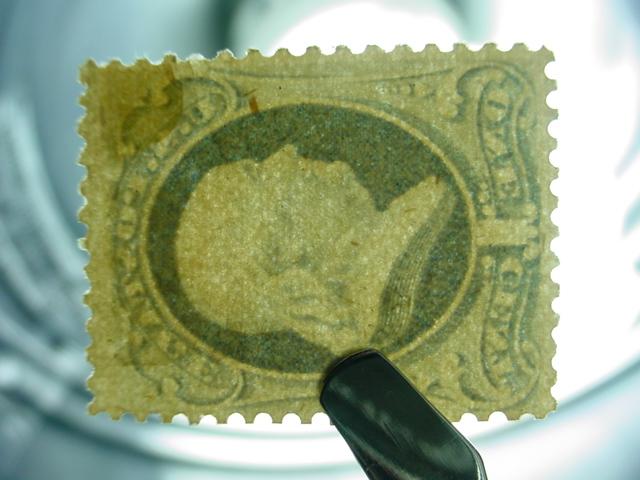 |
|
Send note to Staff
|
|
|
Pillar Of The Community
United States
1946 Posts |
|
|
Although it is commonly said that the soft paper stamps of American BNCo are printed on a high wood pulp fiber paper, on the order of newsprint, the recent study by John Barwis published in full form in the Proceedings of the First International Symposium on Analytical Methods in Philately, and in a somewhat briefer form in the USPCS Chronicle, disputes this. After presenting the analytical methods used and the data obtained, Barwis comments, " At no time in either of the American Bank Note Company's two printings was newsprint - cheap paper made from 'groundwood' - used for postage stamp production. Groundwood is made by pushing logs against a grindstone, whereas the American papers are cotton. The few wood fragment [sic] seen in the Continental and American papers are most likely just debris that found its way into the pulp."
He also presents a finding that contradicts the report of Roy white, "In none of the samples was any evidence seen that would support the presence of soda/sulfite pulp in the American Bank Note Company printings, as reported by White (1983:64-65)."
The presence of alum in the sizing agent is what gives the paper of 1878-1881 the characteristically yellowish appearance overagainst the brighter white of the earlier printings and the dull white of the later paper.
The difference in fluorescent characteristics under longwave UV light can be accounted for in the different types of paper sizing used. The intermediate papers of Continental and American in 1879 are sized with a rosin/alum sizing combination, and the soft papers from 1881 are sized in starch. The early papers of National and Continental, 100% cotton rag, are sized with a gelatin. The biggest differences under UV are between the gelatin sized papers and the rosin/alum sized paper from 1979-1881. This is more due to the reflectance characteristics at the surface than to differences in fiber.
|
|
Send note to Staff
|
| Edited by essayk - 02/16/2015 10:09 am |
|
|
Pillar Of The Community
United States
578 Posts |
|
|
What I know is that the longwave UV test is pretty conclusive for identifying soft vs. hard banknote papers (I use it frequently on tough papers, and have never seen an American that was anything but "dead" under longwave UV.)
Admittedly, I've not really looked into why that is, just accepted the commonly-held notion that it was the cotton vs. wood pulp differences. However, in light of your post & the new information in the Barwis paper, it could very well be the work of paper sizing differences. Maybe I'll take a few minutes today & read that Barwis paper -- I find the banknotes to be a very fascinating area to study - lots of changes & varieties! Thank you essayk for bringing this to my attention. |
|
Send note to Staff
|
|
|
Pillar Of The Community
United States
578 Posts |
|
|
I should probably take a moment to correct something else in my statement above - I HAVE seen American Bank Note Company papers that are not "dead" under longwave UV, but that's because they've been bleached to brighten/clean or remove a cancel. While they're not "dead" under UV, they do have a very distinct look and are easily discernible. |
|
Send note to Staff
|
|
|
Rest in Peace
United States
763 Posts |
|
|
I personally believe the easiest way to differentiate hard. intermediate and soft papers is by simply holding them to a light source, such as Ken Srail shows us above. Once you get the "feel" for the way the different papers look you will never really have much trouble with the correct ID. The most confusing are the intermediate papers which look softer than hard, but harder then soft! But again, once you can recognize intermediate paper, you will be able to ID it.
And interestingly, expert services normally consider an intermediate paper to be the least expensive stamp. I've never really agreed with this, but that is the "standard". It really is important with the Officials and to a lesser extent, the low value Newspaper stamps where the difference in price between a hard and soft paper is considerable in many cases (for example look at prices for O81-82 versus O112-113 to see the disparity). |
|
Send note to Staff
|
|
|
Pillar Of The Community
United States
578 Posts |
|
|
I agree with Bill - if you look at enough of these, you'll identify the paper with a 1-2 second glance with a strong light behind. However, for the tougher/borderline examples (intermediate vs. soft) the UV light does help and can be a very valuable tool (yet another reason to spend the money on a good quality dual-wavelength UV lamp!) |
|
Send note to Staff
|
|
|
Rest in Peace
United States
7097 Posts |
|
|
There are both American and of course Coinental printings on the same paper and I personally believe it occurred in the beginning when they handed the plates over and all the other materials and the paper was used (most probably) until it run out. They're referred to as intermediate papers (I learned that from Essayk - Thank you).
I see Bill covered that already. Sorry. |
|
Send note to Staff
|
|
|
Pillar Of The Community
United States
1946 Posts |
|
|
Quote:
I personally believe it occurred in the beginning when they handed the plates over and all the other materials and the paper was used (most probably) until it run out. [emphasis mine] This is a common misunderstanding of what happened in 1879. In February of that year, the National, Continental, and American Bank Note Companies merged into what came to be called the American Bank Note Company - Consolidated. Whatever equipment and supplies were owned by Continental came into the consolidation and continued in use as always. Initially it probably didn't move an inch until such time as the disposition of assets could be determined and distributed. But the work of fulfilling the contract continued unabated. |
|
Send note to Staff
|
|
|
Replies: 22 / Views: 4,037 |
|




 Posted 02/12/2015 2:17 pm


