| Author |
 Replies: 17 / Views: 4,179 Replies: 17 / Views: 4,179 |
|
Pillar Of The Community
United States
670 Posts |
|
|
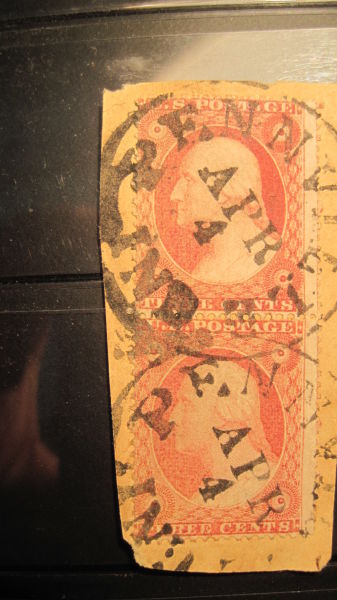
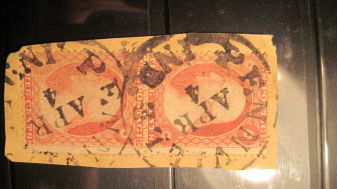
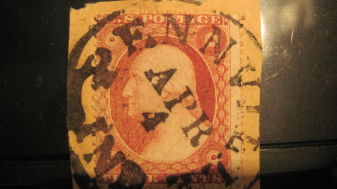
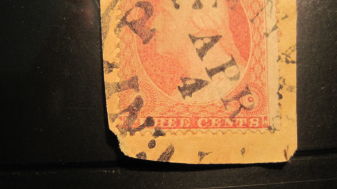
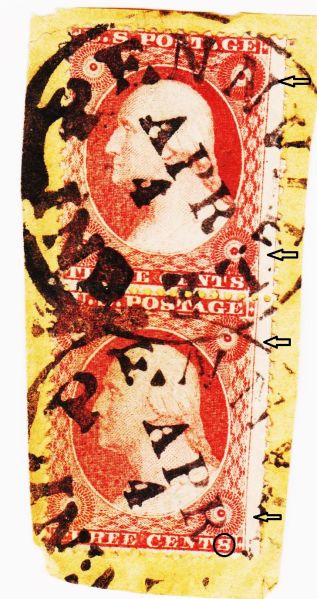
I've learned a lot about the 1851 1c Franklins, so I thought I'd start on the 3c Washingtons. I bought a bunch of 26s so I could look at actual stamps. I think I've already found 2 26a's. The first image looks like it has a line break in the upper right corner, but that perf also looks damaged. This is the one I'd prefer to be a 26, but even without seeing line breaks I'm sure it's a 26a. Who wants to take a stab at why I'm sure? I won't exclude Sinclair, he might be starting to feel left out. :)  This one also looks like a 26a. I'm fairly new at this, so didn't know any of the recut lines got as close together as they do on this stamp (lower left).  |
|
Send note to Staff
|
|
|
|
|
Pillar Of The Community
United States
2555 Posts |
|
|
Those are two really nice Type IV's, especially for just being mixed in with a bunch of 26's. That bottom left frameline end of the second stamp illustrates in spades why the Scott catalogue description of the Type IV is misleading when it comes to some stamps. I am not sure how you are so confident in the top stamp but I can tell you an ID is possible without seeing the break at upper right or the date of usage or without plating it to a specific position. |
Send note to Staff 
|
|
|
Pillar Of The Community
United States
670 Posts |
|
|
Sinclair, you touched on what makes me sure (it might be more accurate to say "99% sure") it's a 26a. I'm interested to hear how an ID is possible without the factors you mentioned.
EDIT: While googling 26a I found an old thread where you described the 26a lines as more crooked than the 26. Is that what you were referring to? |
|
Send note to Staff
|
| Edited by raymodj - 01/14/2015 7:22 pm |
|
|
Pillar Of The Community
United States
2555 Posts |
|
|
Yes. The framelines on Type IV stamps were re-cut individually, one stamp at a time, resulting in crooked framelines. The framelines on Type III stamps were apparently re-cut with the aid of a straight edge doing the whole column of ten stamps at once. |
|
Send note to Staff
|
|
|
Rest in Peace
United States
763 Posts |
|
|
I would defer to Sinclair on this because he is truly expert on these stamps, but I would have agreed with Ray that it is definitely a 26A because of the trace of the design of the stamp above it that shows on the fifth and ninth (from the left) perf tips. So that indicates it's NOT a top row copy, but rather from an interior row. So if the break at the top right isn't "fake" (from being scraped away) it should be a 26A.
What is wrong with my assumption Winston? |
|
Send note to Staff
|
|
|
Pillar Of The Community
United States
670 Posts |
|
|
Bill, I think you're right and I think Sinclair agrees it is a 26A. We were just discussing ways to ID this as a 26A without considering the upper right line. Sinclair pointed out that crooked lines help ID the 26A. I was looking at something else that I think makes the top stamp a 26A and was wondering if anyone wants to guess what it is. |
|
Send note to Staff
|
| Edited by raymodj - 01/14/2015 11:34 pm |
|
|
Pillar Of The Community
United States
2555 Posts |
|
|
Bill,
There is nothing factually wrong with your assumption. However, I see enough Type III stamps listed as Type IV due to a false-positive detection of a line break that I believe it is prudent in all but the most obvious cases to conduct an additional confirming test. Having a stamp such as this, showing only a single line break ending on a potentially damaged perf tooth, easily puts this stamp into the realm of needing additional confirmation. It is a simple test to conduct. If you have the image on your computer you can open it in Paint or any other image editing software and compress the image vertically to 10% of original height. The characteristic crooked lines of Type IV stamps will almost always be evident. With the stamp in hand you can also tip it so that you are looking down the framelines at an oblique angle. Again, the crooked lines will be obvious and confirm the Type IV identification. This simple test would eliminate nearly all of the misidentified Type III/IV stamps. |
|
Send note to Staff
|
|
|
Rest in Peace
United States
763 Posts |
|
|
Thank you Winston! I assume when you explain the second test, you are merely looking "across" the stamp with cross-lighting, at the framelines? If so, that is a nifty (and easy!) check method - which I like better than the first one which would require a lot more time. |
|
Send note to Staff
|
|
|
Pillar Of The Community
United States
2555 Posts |
|
|
I usually just have the light in front of me or over me and look down the framelines with the stamp tipped. Side light probably wouldn't help much. |
|
Send note to Staff
|
|
|
Pillar Of The Community
United States
670 Posts |
|
|
Is that a faint alignment dot upper right? I think it is but not positive. The lines seem too straight to be a 26A Also, when Scott changed the Types on the 3c Washingtons, was the Type IV changed from 26a to 26A? I see it both ways.  |
|
Send note to Staff
|
|
|
Rest in Peace
United States
763 Posts |
|
|
To me, those framelines look somewhat crooked! And unless it's a top row copy, I think it is 26A. But Winston will know for sure......... |
|
Send note to Staff
|
|
|
Pillar Of The Community
United States
2555 Posts |
|
|
I think it is probably a Type IV but it is such an awful printing it is hard to tell. The break at upper seems to be pretty clear and the lines do wander a little. There is no guide dot at upper right. You may find one in that location if it were a top row stamp but this isn't an A relief stamp.
The old Type IIa, Scott 26a is the new Type IV, Scott 26A. |
|
Send note to Staff
|
|
|
Pillar Of The Community
United States
670 Posts |
|
|
Thanks Bill and Sinclair. I need to look at these a lot more to see the difference between crooked and straight on a stamp like the one above. The earlier examples were more obvious to me.
Sinclair, I think you're saying you know it's not A relief without the need to look for a guide dot. Do you know this is not an A relief stamp because there is no damaged transfer above lower left rosette? Or something else? |
|
Send note to Staff
|
|
|
Pillar Of The Community
United States
2555 Posts |
|
|
Correct. All top row, A relief stamps show the so-called damaged transfer.
|
|
Send note to Staff
|
|
|
Pillar Of The Community
United States
670 Posts |
|
|
Well, no more 26a's, but here's a 26 with a very small amount of the imprint. Looks like it starts with the end of the word "Engravers". Much closer to the stamp than I thought it would be.  My first impression of this was a double center line. Chase says the perf plates all had a single center line, so this must be the edge of the next stamp.  Looking at all these 26s, I've noticed that the tessellated design running up the right side is often much clearer than the tessellation on the left. Is that actually true, and if so why? |
|
Send note to Staff
|
|
|
New Member
United States
4 Posts |
|
|
Replies: 17 / Views: 4,179 |
|




 Posted 01/14/2015 11:56 am