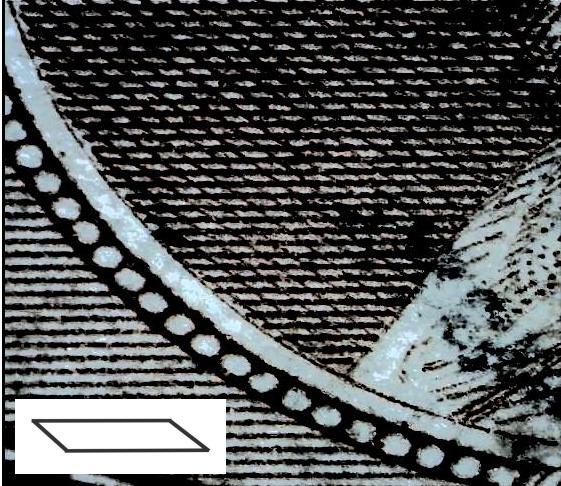
| Author |
 Replies: 45 / Views: 10,866 Replies: 45 / Views: 10,866 |
|
|
|
Rest in Peace
7742 Posts |
|
|
Pillar Of The Community
United States
1414 Posts |
|
|
Bill,
Diagonal lines running in both directions would be clear on a 211B. This is a case where a high quality 10x loupe would be sufficient although 15 power would be OK. A high definition scan should show all of the fine line detail depending on the scanner resolution. The lines were on the plate, but under production conditions it was not possible to ink the plates as thoroughly or apply as much pressure rotating the press by hand.
Clark |
Send note to Staff 
|
|
|
Rest in Peace
7742 Posts |
|
|
Quote:
Diagonal lines running in both directions would be clear on a 211B. This is a case where a high quality 10x loupe would be sufficient although 15 power would be OK. A high definition scan should show all of the fine line detail depending on the scanner resolution. The lines were on the plate, but under production conditions it was not possible to ink the plates as thoroughly or apply as much pressure rotating the press by hand. Clark...  Oh, I get it..through it back in my stock book and forget about it..Correct..? Robert |
|
Send note to Staff
|
|
|
Pillar Of The Community
United States
1414 Posts |
|
|
Yes. There are other far more productive searches. In looking through piles of 2 cent Washington from the Washington/Franklin issue, I have found more than 80 type Ia Scott number 500, a few coil waste stamps including a couple of perf 11 545. I have also found a couple of 449 rotary coils and a lot of type II coils. There should be a couple of the scarce 491 in there when I have time to look. Another area is 1868 grills. I have found a couple of 3 cent Z grills, a few D grills and a couple of C grills, all classified by someone else as E grills, or never looked by anyone. From time to time I offer Scott 210 in lots of 500 in ebay auctions. I quickly scan the pile for one that may have the 211B color, a pale red brown without the yellowish cast or brownish cast often seen in 210 populations. In lots of that size, it is possible that better cancels will surface which may be one of the reasons that such lots receive multiple bids. Still, even if I miss a 211B I get enough for the lots over time to more than cover any potential "losses" because I missed noticing a 211B. Another option at shows may be to look at covers assuming you arrive early. However, covers are more popular and attract more knowledgeable buyers than obscure and potentially much less common stamp varieties. Clark |
|
Send note to Staff
|
|
|
Rest in Peace
7742 Posts |
|
|
Great...Now your making me pull out my stock book again...haven't paid too much attention to my American stamps because Canadian is my choice..BUT, got to start looking outside Canada once I a while..Don't want to even think about looking at my WW stamps..haha
Robert
Thanks again Clark. |
|
Send note to Staff
|
|
|
Pillar Of The Community
United States
578 Posts |
|
|
Here are a few scans I did with the 211B from my reference collection vs. a normal 210 (the example I saved because it was the closest shade match to a genuine 211B.) The scanning & post-processing are constant for both stamps. The 211B is on the left, the 210 on the right. 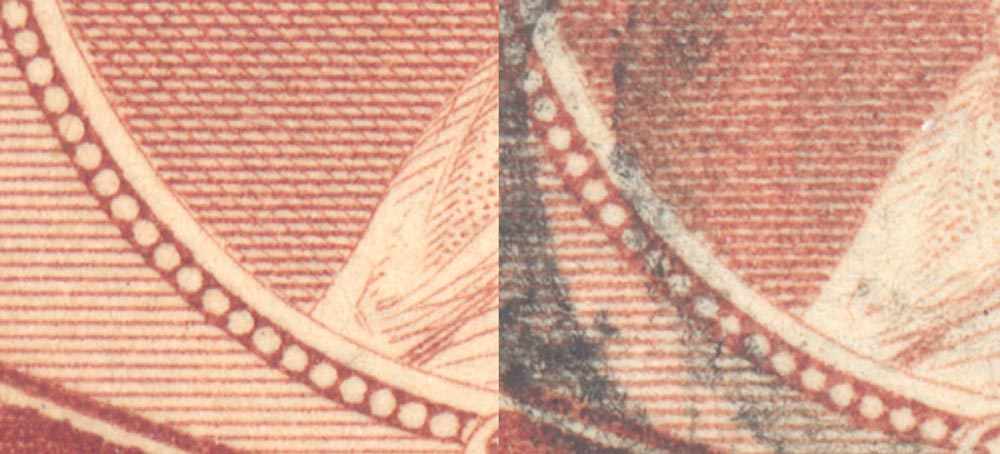 ...while the cross-hatching will help in the area previously discussed, I've seen 210's that are pretty sharp there. I usually look in the area shown in the scan below. The crispness in the heavily inked area at the base of the bust & detail of the vertical lines just to the left of the 2 are more helpful (IMO) in identifying steam press printings vs. regular 210's. 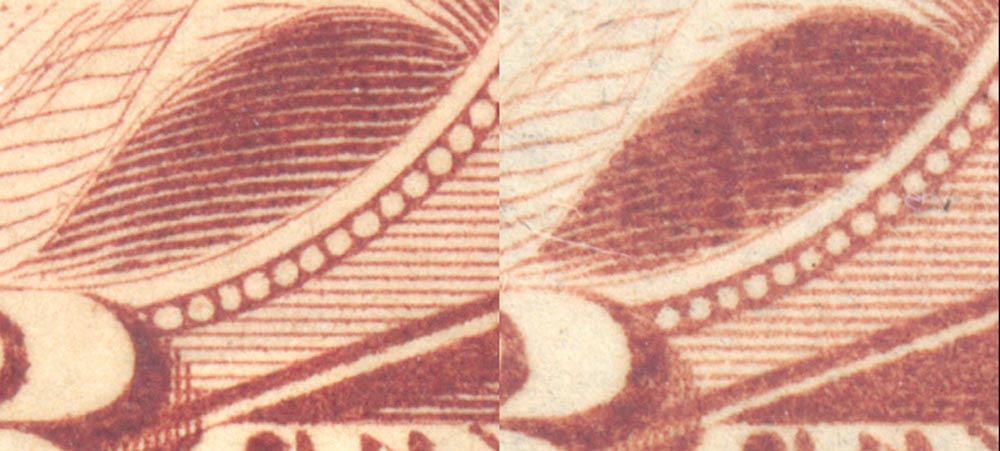 I hope you find these scans helpful/useful. |
|
Send note to Staff
|
|
|
Pillar Of The Community
United States
578 Posts |
|
|
Rest in Peace
7742 Posts |
|
|
srailkb...Nice pictures and I put my so called (something) next to yours...Boy o boy...it is close.. Robert 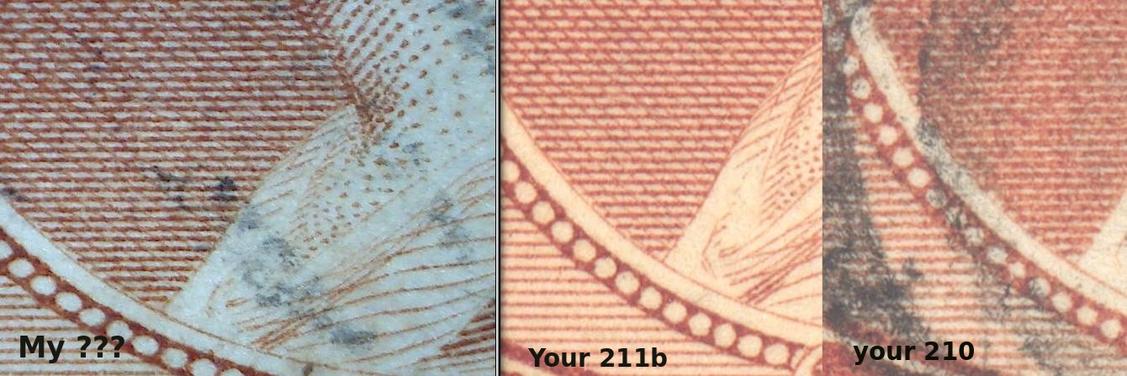 |
|
Send note to Staff
|
|
|
Rest in Peace
United States
763 Posts |
|
|
Ken,
Thanks for posting those terrific pictures (and to Robert too!). Indeed. I just compared my 211B with a 210 and can easily see (with 15X) the big differenc in the crispness of the lines to the right of the "2". |
|
Send note to Staff
|
|
|
Pillar Of The Community
United States
578 Posts |
|
|
wert, I believe your stamp is a 210. Like I said, I've seen 210's that are pretty sharp in that area. How does yours look in the other area I compared? Also, remember that post-processing (contrast, sharpening, etc.) can greatly impact appearance. My comparison was a controlled comparison. It can be very misleading to compare subtleties like these using scans created from two different scanners... |
|
Send note to Staff
|
|
|
Rest in Peace
7742 Posts |
|
|
srailkb...Here is the other area you were talking about..Probably does not change things, but here it is any ways. Robert 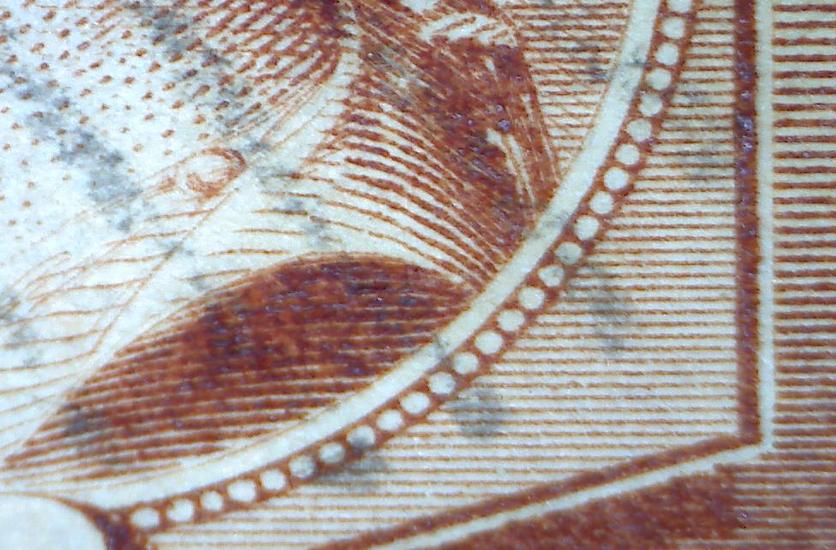 |
|
Send note to Staff
|
|
|
Moderator

United States
5109 Posts |
|
|
OK, I have to jump in with my example. Probably a standard 210, but my USB scope found some interesting lines on the lower right. Is this a very light double transfer? (Similar items are Re-Entries on Ralph's site.) Relatively nice lines to right of bottom 2. 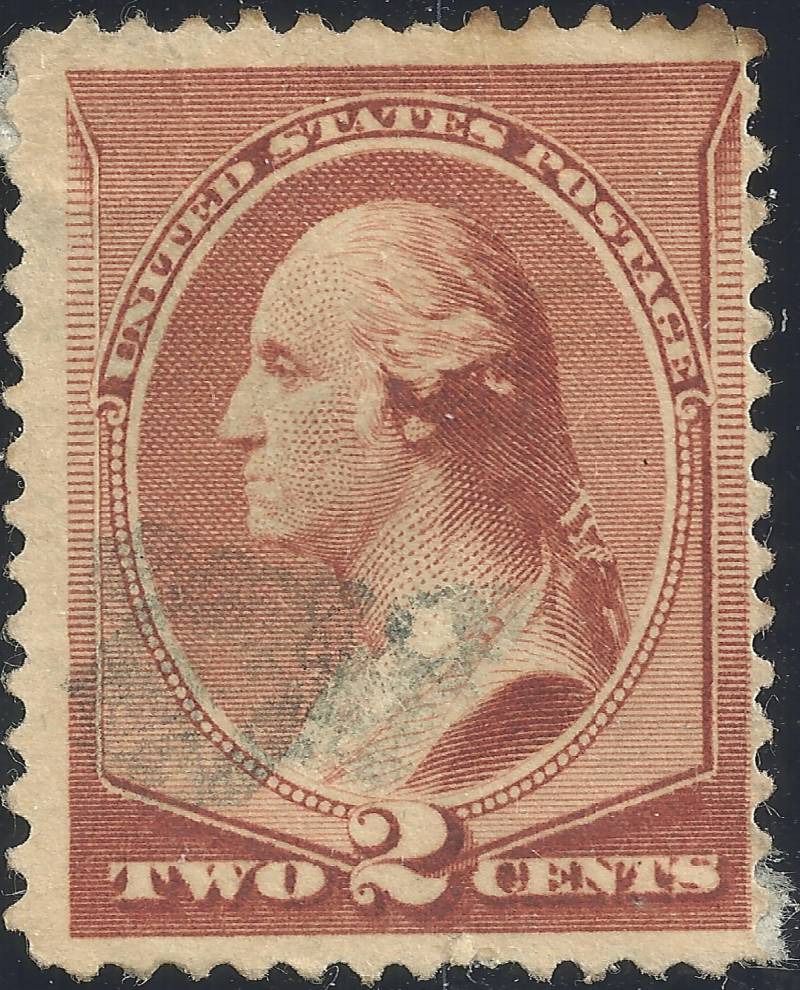 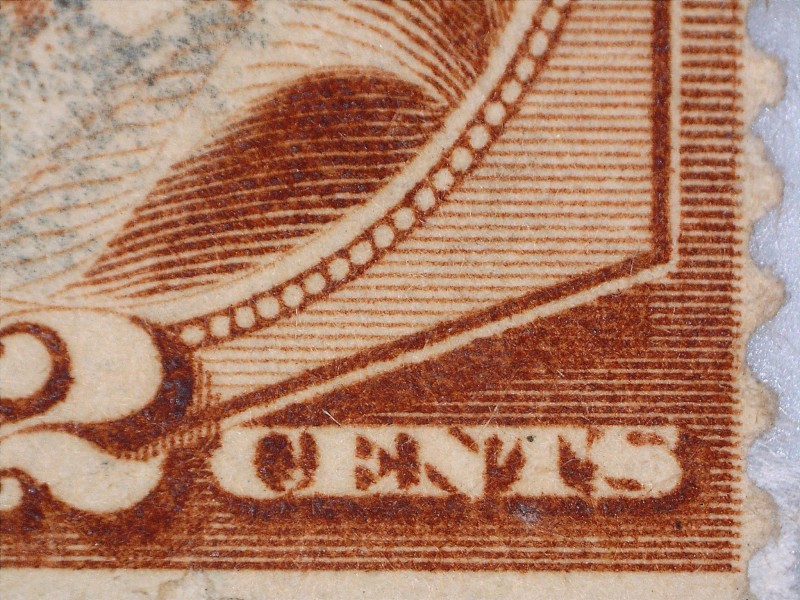 |
|
Send note to Staff
|
|
|
Pillar Of The Community
United States
578 Posts |
|
|
wert & partime, both are 210's IMO. Lines are too fuzzy/poorly defined in that area.
There's a "crispness" to the impression that just doesn't exist on regular 210's. Tough to describe, but almost immediately evident to those who have seen quite a few over the years.
P.S. I checked a couple of SAMPLE overprinted 210's with very crisp impressions and the cross-hatching does go all the way to the bottom in the left oval area. As a result, I don't think that's a good "test" for 211B's (Bill, probably the reason it's "unpublished," LOL.) However, on those SAMPLE stamps, I DO see differences to the right of the "2", and especially in the heavily inked area of the lower bust (the other area I identified in my previous post.) There's a "feathering" and light "bleed" on the 210 impressions (even the finest impressions from the newest plates) that's not there on 211B. |
|
Send note to Staff
|
| Edited by srailkb - 03/14/2015 08:20 am |
|
|
Moderator
United States
5109 Posts |
|
|
Quote:
wert & partime, both are 210's IMO. Lines are too fuzzy/poorly defined in that area. Yep, totally agree. But the degree of fineness is sometimes difficult to see without a true example side-by-side. In any case, I'm still wondering about the extended lines on the right side. Is this a DT? Thanks in advance. |
|
Send note to Staff
|
|
|
Pillar Of The Community
United States
1946 Posts |
|
|
Bill, I took a really close look at a 211B center gutter pair, and an early shade, early state of 210, and even there I saw a difference in my sample. The distinction you noted held up in that case. But I am going to extend it to a study of several types of proof and experimental stamps of this design and will give you pictures and a report as soon as I have something. This is a noteworthy observation in my opinion, at least parallel to some of the fine printing distinctions Willard documents.
I just saw Ken's post. Actually Ken, I think this distinction, if it holds up over the range I am going to study, will help to nail down that most of what we call 211B was actually stamp paper proof material very much in the same mode as the Sample and Sample A overprints. |
|
Send note to Staff
|
| Edited by essayk - 03/14/2015 1:07 pm |
|
|
Replies: 45 / Views: 10,866 |
|




 Posted 03/12/2015 5:25 pm