| Author |
 Replies: 45 / Views: 10,868 Replies: 45 / Views: 10,868 |
|
|
|
Pillar Of The Community
United States
1946 Posts |
|
|
Late to the game, nothing really new:
I limited my first look to the vignette background crosshatching left of Washington's bust.
I looked to see whether this was visible all the way to the base of the vignette frame (i.e. "it showed")
I used a 16x glass on the following for 210, 211B, and 213 (the 2c green)
Die proofs:
210P1 and (Roosevelt) 210P2 and 213P2 all show it
213P1 later
Plate proofs
a 210P3 single in metallic red does not show it completely
all four positions of a 210P3 block in brown red show it well
none of the three 210P4s I checked show it.
a 210P on stamp paper in metallic red shows it weakly
Both positions on a 213P3 pair show it
4 examples (in two pairs) of 213P on stamp paper failed to show it
Stamps
210 metallic red - (2 examples, one on FDC) does not show it
no later 210 or 213 examples show it
Experimentals
211B special printing pair: both sides show it
None of the following show it
vert and horiz laid paper, (blocks and singles in at least two subtypes)
honeycomb watermark
wavy line watermark
and one unlisted watermark
Trial Color Samples
210TC4 lake - all positions in a block of 4 show it, but in varying strengths
210SK
lake - all 4 positions in a block show it
rose lake - all 4 positions in a block show it
210SL one of two singles shows it well, one weakly
210SL without ovpt - one shows it very weakly
I have a few more colors and examples not available for testing at the moment. I can report on them later.
So far there's nothing new to report.
I have not yet looked at the lines at the base of the vignette to the right of the "2".
|
Send note to Staff 
|
|
|
Rest in Peace
7742 Posts |
|
|
Quote:
I have a few more colors and examples essayk...Do any of my stamps (very first post) show and colour variation..??? Robert |
|
Send note to Staff
|
|
|
Pillar Of The Community
United States
1946 Posts |
|
|
I'm afraid I can't help you with that, Robert. All of the images in that first pic have unnatural color on my monitor. They have an orange-ish (yellow AND red) overcast to them. (How's that for tech talk?!) I can't compare them to anything except each other, and even there they all seem to be about the same shade. Sorry. |
|
Send note to Staff
|
|
|
Rest in Peace
7742 Posts |
|
|
You know what essayk...This has ALWAYS been the problem of people posting stamps and inquiring about colours..Your scanner scans a different colour than mine and my monitor displays a different colour than yours..So, I have made arrangements with a paint manufacturer to use their expensive colour match machine to scan a dozen or so of my stamps...NOW..say I have one colour called #gh10221 (just say)..Then anyone can approach the same store and get a #gh10221 sample to see EXACTLY what colour my stamp is..
Slowly we could set up a database with this info..Sound good..??
Robert |
|
Send note to Staff
|
| Edited by wert - 03/14/2015 4:47 pm |
|
|
Pillar Of The Community
United States
1946 Posts |
|
|
Chip systems! I remember when the Munsell chips were being touted for use by specialists wanting to compare notes. The Methuen Handbook of Colour, complete with a comparator/viewer, was the poor man's alternative (mine), but it didn't use chips and was widely criticized. The old color standard by Robert Ridgeway (1912) was the backbone of Brazer's system for color nomenclature, and clean copies still sell for $2000 or so. One bugaboo for all these was the problem of uniformity over a wide distribution. Time and storage conditions add variability too. Still it works within predefined limits.
Trying to get a chip to match a monitor output is going to run into the old RGB vs CMYK standards mismatch problem. Projected color from a monitor is additive (starting from black as the sum of all), but the reflective color from chips is subtractive (starting from white as the sum of all). So the same two colors which appear identical in one condition of ambient light, will usually look different from one another when the ambient light changes. Moreover, the light from the monitor impacts the way you see the color of the chip, unless you have some kind of isolation setup. It's not very intuitive, to be sure. |
|
Send note to Staff
|
| Edited by essayk - 03/14/2015 5:13 pm |
|
|
Rest in Peace
7742 Posts |
|
|
Ok..Forget I mentioned it..I will do the process for myself only..sorry.
BTW, I was not referring to monitor/scanner as such..I was referring to stamp in hand and colour match sample in hand..
Robert |
|
Send note to Staff
|
| Edited by wert - 03/14/2015 5:23 pm |
|
|
Pillar Of The Community
United States
937 Posts |
|
|
Robert, it can be done without too much effort.
Stamp colors can be accurately compared if you color calibrate your scanner. As long as two images are both color calibrated then they can be compared on any monitor. The monitor does not have to be color calibrated. The images won't look exactly like the stamp's color in real life but that doesn't matter. If the two were the same shade in real life, then they will appear as the same color on any monitor and their measured color values (eyedropper tool in image editing programs) will be the same or very close. If the two stamps are noticeably different in real life, then they will appear noticeably different on the monitor.
This requires a color calibration target for $20, a scanner capable of 16 bit (high bit depth), and following a tutorial to set it up. This will get you around 95% accuracy for a few hours of your time. Once it is set up, it doesn't take much time to maintain it. Maybe 30 minutes every month or two or even longer.
To make a database of the scarce/rare stamp shades it would take volunteers willing to scan their certified stamps next to a color calibration target. |
|
Send note to Staff
|
Ryan = HDNAC = DNA = HDC = Hysterical DNA Collector = Historical DNA Collector = me who just loves stamps :) |
| Edited by Historical DNA Collector - 03/14/2015 6:09 pm |
|
|
Pillar Of The Community
United States
1946 Posts |
|
|
Yes, that was what those systems I mentioned were intended to do. If everybody gets chips from the same source and batch, then the standard is common. But you still have to control for the light used to illuminate the viewing area and the amount of reflective material around the subject. If you use a halogen lamp rated at 4700K and I use a CFL rated at 5600K, then the game is compromised (possibly by more than the 900 degrees Kelvin difference). Not too much, but the actual output of consumer grade lamps are seldom up to spec.
Still, how precise do we have to get? We can pretty much get the general idea, right? If you specify the lighting and viewing conditions you used in the first place, others can get close. |
|
Send note to Staff
|
| Edited by essayk - 03/14/2015 5:38 pm |
|
|
Rest in Peace
7742 Posts |
|
|
And just to add some thing silly but true essayk..I was reading a publication from a lady in England (cant remember where I found it), and she said (now get this), DO NOT look at stamps within 2 hours after eating eggs..Apparently the ingredients in eggs alters your eyesight colour perception for up to 2 hours..YIKES
Oh and she also said that a colour before 1:00 pm will like different in the later afternoon.
Robert |
|
Send note to Staff
|
| Edited by wert - 03/14/2015 6:19 pm |
|
|
Pillar Of The Community
United States
937 Posts |
|
|
I have no idea about the egg thing, but the color temperature of sunlight does change throughout the day. In digital imaging two common white points are D50 and D65. D50 is the color temperature of sunlight when the sun is near the horizon. D65 is the color temperature of sunlight at noon. D65 = 6500 Kelvin. If you want to read more: http://en.wikipedia.org/wiki/Standa..._illuminants |
|
Send note to Staff
|
Ryan = HDNAC = DNA = HDC = Hysterical DNA Collector = Historical DNA Collector = me who just loves stamps :) |
|
|
Pillar Of The Community
United States
1360 Posts |
|
|
OK guys, I picked this up in Aldrich's auction a couple of weeks ago, with a PSAG cert (flawed, but wanted a reference copy), as 211B. I definitely see the cross hatching all the way to the bust on the left, but the right, although thick, is still detailed enough to be separate. I compared this with the only unused 210 I have, which must be a late print, because it's really fuzzy. It does seem to be a very detailed, fine print. Looks like it is the real thing? It is a completely different shade than the 210's I've seen... 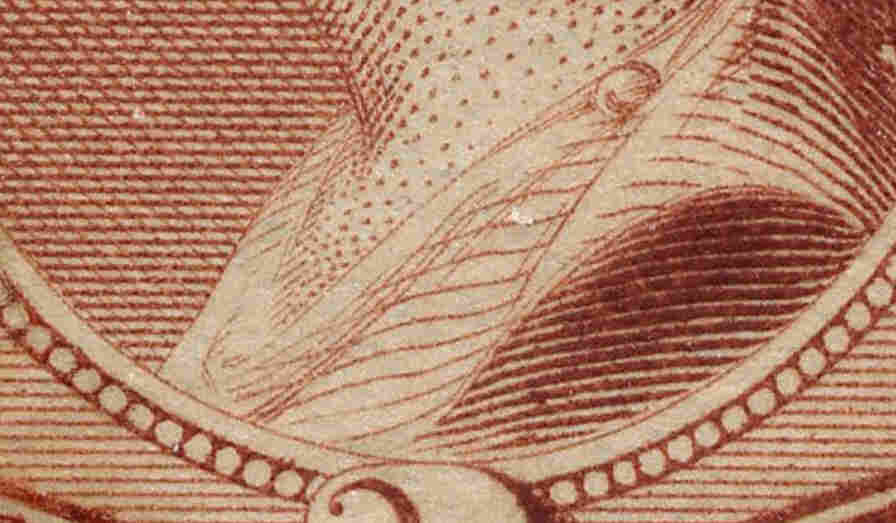 Thanks, Ray |
|
Send note to Staff
|
|
|
Rest in Peace
7742 Posts |
|
|
Quote:
It is a completely different shade than the 210's I've seen... ok.. what everyone is saying,is I DEFINITELY have a 210 and NOT a 211b..correct..?? |
|
Send note to Staff
|
|
|
Rest in Peace
United States
763 Posts |
|
|
Essayk - Thank you for those ,most informative posts as well as the time it obviously took you to carefully examine all of that material. It is a testimony to your accomplishments that you even have all of that material available to you. And you are not even a dealer! |
|
Send note to Staff
|
|
|
Pillar Of The Community
United States
1946 Posts |
|
|
Thanks, Bill. I must confess I was rather surprised by a couple of those results. I did not expect to find a P3 in which the lines did not show well, and that the bum turned out to be in the earliest color. I was surprised that the imperfs on stamp paper behaved more as stamps than proofs, inasmuch as it is the current status of the imperfs to thinks of them as proofs as Brazer did. I was not too surprised that the card proofs acted like stamps for this, although it was a surprise that the trial color TC4 block did show the fine lines. But I was very surprised, and disappointed I might add, that the stamps on watermarked papers all behaved as stamps, not as proofs.
I'm still trying to digest the significance of all that. Except for the die items I cannot yet tell what it is about the impressions that distinguishes the "show-ers" from the "no-shows." I would be happy to post scans of any of these things you or anyone might wish to see.
|
|
Send note to Staff
|
|
|
Rest in Peace
United States
763 Posts |
|
|
You are welcome. I wonder - and you know a lot more about this subject than me - what effect on the results you record (if any) have to do with whether or not the item was contemporary or not? If the die proofs show it, than it's resonable to assume(?) that anything printed contemporary with the die-making would show it and as the plates wore and later proofs were printed from those plates, the wear would cause those printings to NOT show it. For example, the P4s do not show it (all produced later) but the P3 does (printed before issue). But there are inconsistancies in that theory (such as why would the 1903 Roosevelt show it?).
More importantly, since your 210P1 DOES show it, shouldn't that automatically rule it out as a positive identifier for 211B? By that I mean that if the original die shows it then other contemporary items MIGHT. And if they might, then I think it nullifies it's value as a 211B ID? What do you think? |
|
Send note to Staff
|
|
|
Replies: 45 / Views: 10,868 |
|




 Posted 03/14/2015 3:53 pm


