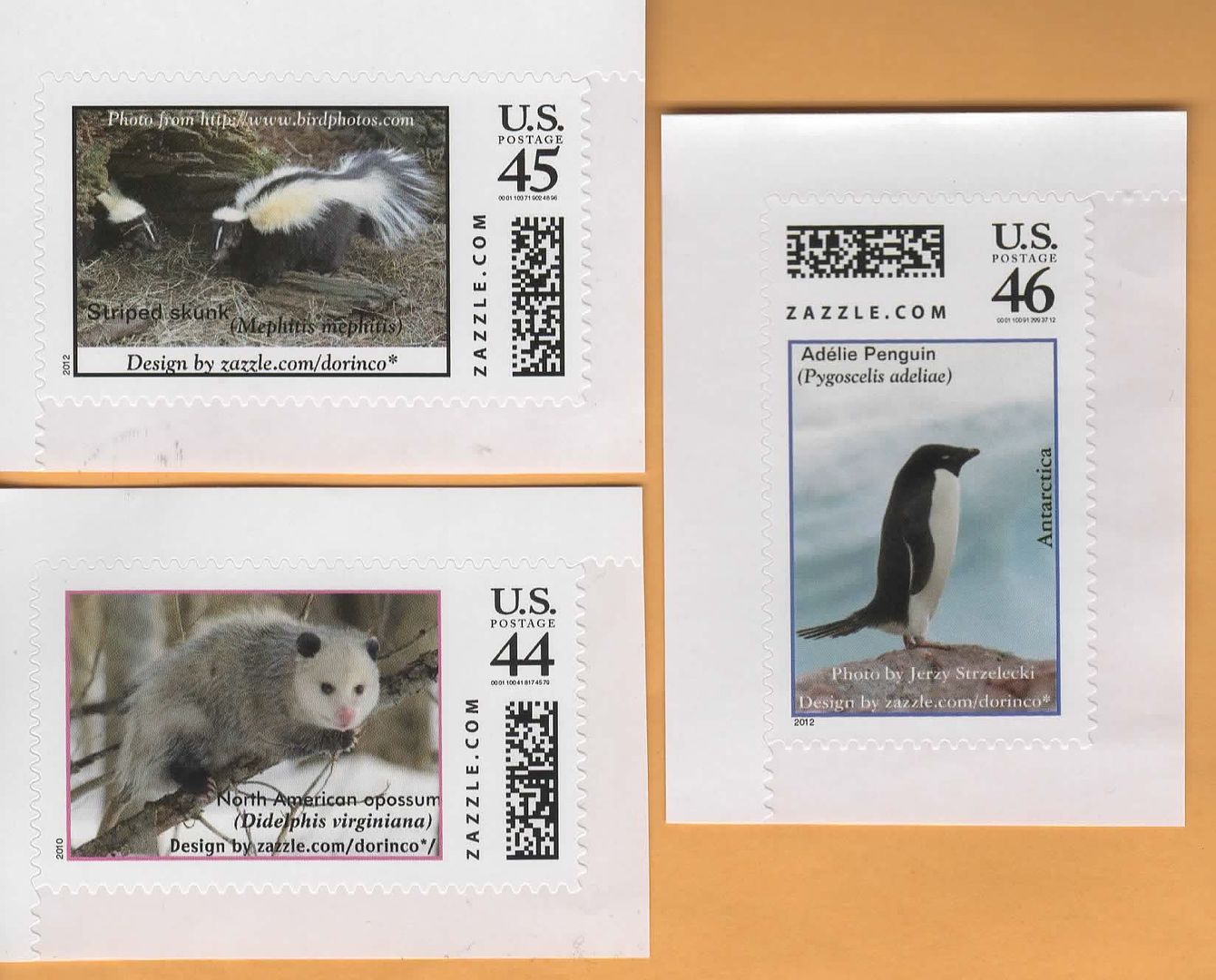
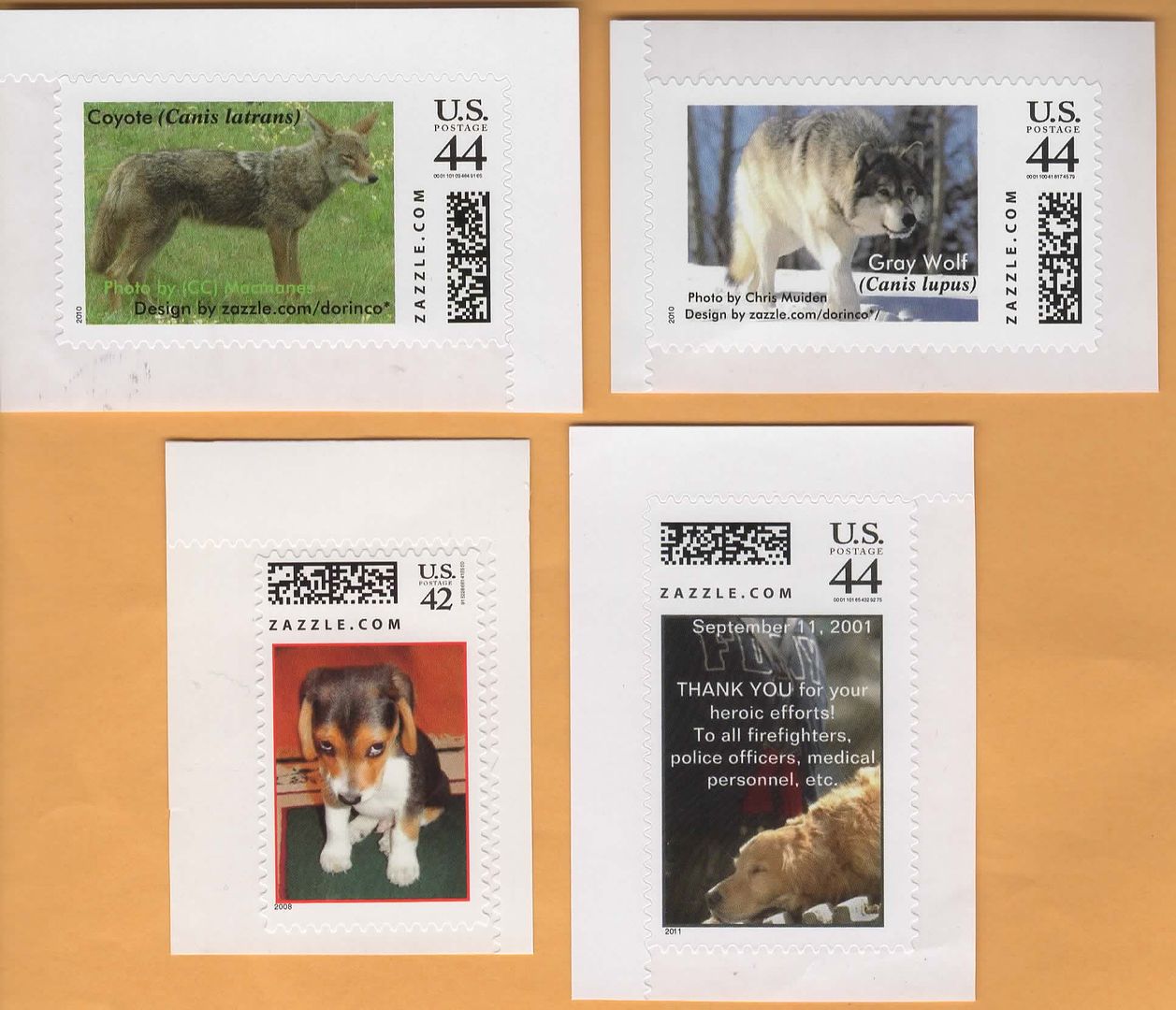
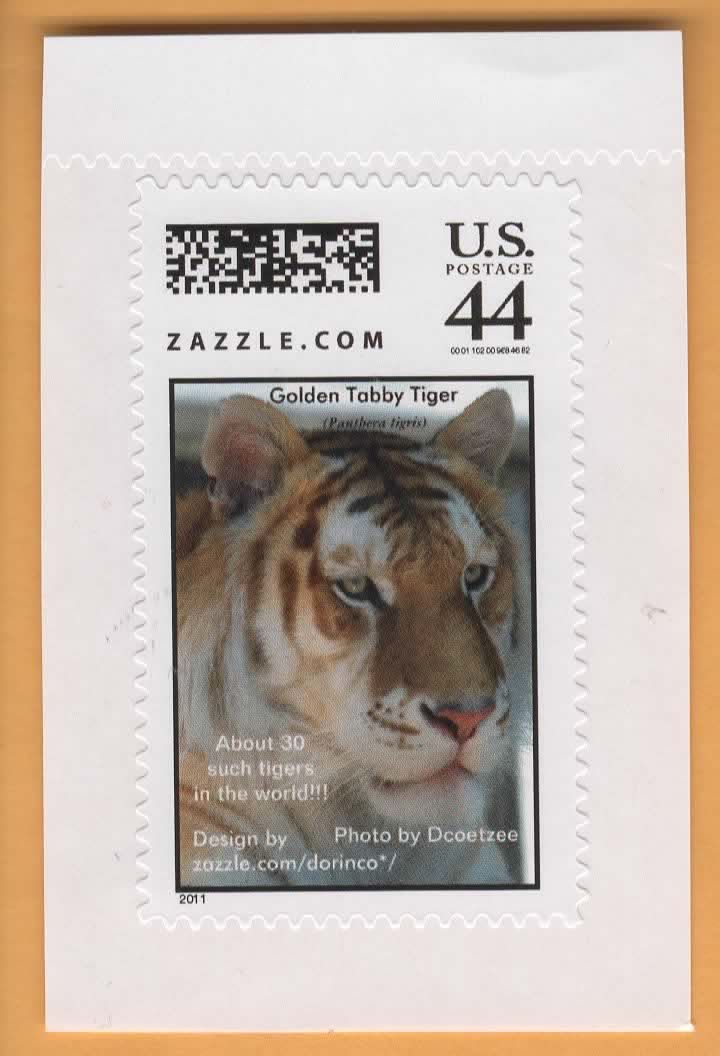
As I said before, on various websites:
"re: Personalized Stamps / Picture Postage
Let me share with you a few interesting and useful considerations about personalized stamps.
I have created, with Zazzle and other providers, over 150 different designs of personalized stamps, from several countries, of which I have actually bought, generally in sheets of 20 stamps each, (and sometimes personally re-sold) personalized stamps in over 50 different designs. Some of those 50 were available for sale only to me, since I have only uploaded them to my Private Gallery at zazzle.com. Or, I have used providers with NO gallery to sell MY stamp designs to the public, such as endicia.com, pictureitpostage.com, royalmail.com, auspost.com.au, tntpost.com. Additionally, some of my other designs at Zazzle, the other 100 or so, were materialized by other people when they ordered them from my Public Gallery at zazzle.com.
If you want to explore ideas about what YOU, too, can create, please visit (you don't have to buy anything) my Public Gallery, the Postage section, at Zazzle: [email me if you want me to send you that link]. Or you can search by my main store name: dorinco.
For search engines consideration, I have put in the title both the American English version ("personalized") and the British English version ("personalised").
In English, "stamp" may also mean "postmark", "cancel", "rubber stamp" – but I use "stamp" for "postage stamp", and "postmark" for "the cancel applied with a postmarking device".
What is a personalized stamp? It's a stamp that is customized, to some degree, and it's valid for postage. Read the Wikipedia definition here:,or postage. Read the Wikipedia definition here:
http://en.wikipedia.org/wiki/Personalized_stamp. Not to be confused with a fantasy stamp, that is NOT valid for postage. Synonyms for a fantasy stamp are: "cinderellas", "artistamps", "fantasy local post" stamps (as opposed to some stamps of real local posts, that WERE valid for postage; for example, the Zemstvo stamps), etc. So, since they ARE valid for postage ("postal use"), the personalized stamps are a special kind of legitimate stamps. They are legal, therefore accepted for official use by the postal administrations.
Terminology is important here, because of the legal interpretations, philatelic interpretations, and the consequences of all that – specifically, HOW are the authorities and the people (stamp collectors or not) considering and using them. In all countries that allow the issuance of personalized stamps, they are recognized and named as such: "personalised stamps", "personal stamps", "IDtimbre", etc. In USA, the technicality of "legalese" (the language of lawyers…) has generated the term "customized postage", instead of "personalized stamp". There are laws that prohibit the modification of "currency", and postage stamps are viewed as some sort of currency ("legal tender").
Other American legal/postal interpretation is that "personalized stamps" are "some sort of meter labels" and USPS said that they "don't require postmarking".
In the context of such interpretations (more or less subjective), my interpretation is the following: personalized stamps are NOT simply "meter labels". They are intentionally manufactured to LOOK like stamps and to SERVE FUNCTIONS like stamps do, both postally and philatelically.
The personalized stamps sold by zazzle.com, for example, do NOT have a date of use on them (they will be indefinitely valid as postage for the denomination at which you bought them, such as 46 cents, for example). The truth is that the difference between traditional postage stamps and "meter labels" is becoming more and more blurred, worldwide, with the use of "variable value stamps" and various labels (meter or not) with images (customized or not). Meter labels of all sorts look more and more like traditional stamps.
My interpretation about postmarking not being "required" is that postmarking is NOT absolutely necessary, but it's OK to be done, for philatelic purposes, at least. In theory, the post office is supposed to decode the" barcode" information (IBI = information-based indicia) on the personalized stamp (I am talking about USA now) so no postmark is needed. In practice, most post offices still operate traditionally, handcanceling or machine-canceling them at the sorting facility. Even if the mail pieces have personalized stamps, even if the mail pieces have precancelation by a MPP device (Mailer's Postmark Permit, see USPS Form 3615)…
Now that we clarified, hopefully, the terminology and some interpretations of the official status of the personalized stamps, let's talk about what YOU can do, from now on.
YOU, the reader of this, may choose to diversify. Instead of (or in addition to) being a passive COLLECTOR of traditional stamps (designed by others, hired by national postal administrations), you might be interested in DESIGNING stamps of your own liking.
Since you'll probably never get the chance to do it with traditional stamps, approved by your national postal administration, you can do it with Personalized Stamps!
My main recommendation to you is to use zazzle.com, even if you use that website only for its superior capabilities of design, and then you take that draft design and finalize your creation with some other provider.
Also, Zazzle is the only provider of personalized stamps worldwide, as far as I know, that gives you a Public Gallery on their website. There, you can re-order or edit your creations, and everybody else in the world can order your stamp designs, if they want. But Zazzle only ships "customized postage" to U.S. or Canadian addresses, so you would need an American or Canadian partner to buy such stamps for you.
If you only want to insert an image, to design a stamp, it may be simple. But there are many tips and tricks about the other options and decisions, beyond that step. There's a learning curve.
If you want to manipulate an image, or to add text in various font types, font sizes, font color, orientation, placement, border, zoom, layers, etc., then it can get complicated and time-consuming. Frustrating, too. If you want and can afford to pay, you can hire somebody who knows exactly how to do it, according to your detailed specifications. In case you are computer-savvy, you can learn by yourself, eventually. That's what I did, since 2006."
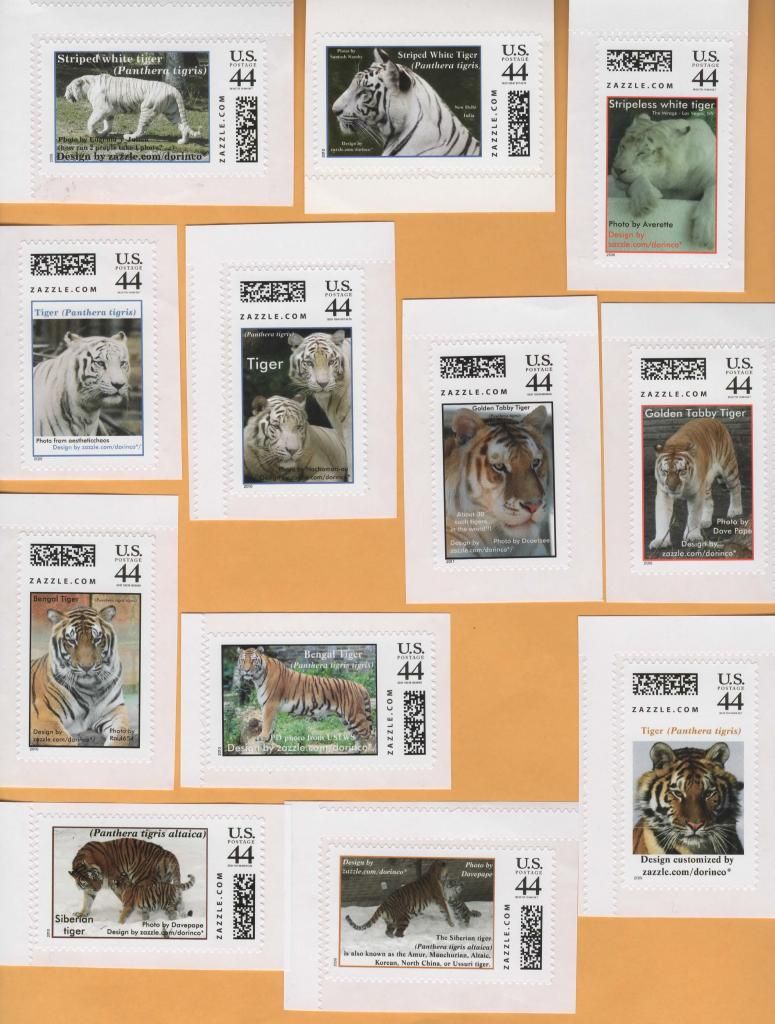





 Posted 03/17/2015 7:24 pm


 ...I'll answer later.