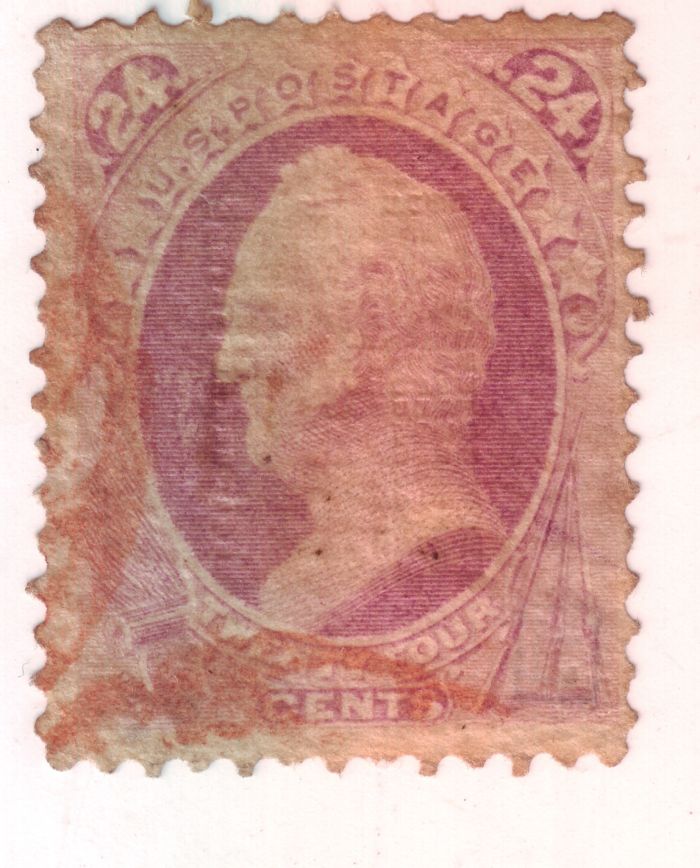
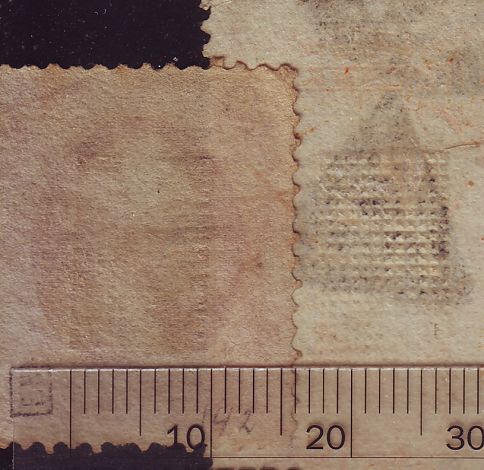
It has taken longer to get acceptable images for this than I anticipated, but I am committed to getting this information into your hands. This is a kind of primer on the four states of the latest grills (designated H and I) of the National Bank Note Company as they appear on the Profile Bust series of stamps, the Banknote Issues. Knowing what to look for will make it easier to spot and avoid fakes like the one this thread is discussing. My one regret is that these images are not to a common scale, so relative size comparisons between images will not be accurate.
The following discussion follows the work of Ronald Burns, who is principally influenced by the work of William Stevenson. From these two sources all the Scott listings for these grills, past and present, have been derived. Stephenson observed two grill "families" with distinct types within each. Burns has identified these subtypes as differing "states" of the grills from a single roller over time. Stephenson maintained, as does Burns, against Brookman, that it was not normal practice to grill more than one sheet at a time. Other factors contributed to the shapes of the grill points observed in the stamps.
Stephenson classifications:
The two grill types in use from 1870-1873 are the H and I which are differentiated on the basis of size and the treatment of the pyramidal grill points. The earlier H-grill is a "cross grill" based on point shape, and counts as 11-13x14-16 rows of points, the most common being 13x15. The I-grill results from significant regrinding the grill roller thereby reducing the grill size to 10-11x10-13 rows of points, the most common being 11x13. This is a flat-topped grill. Each of these grills exhibits two states, early and late, in which the shape of the grill points underwent change due to additional grinding on the roller. All of these grills were applied from a roller suspended above the design which was fed in face up, so the grills are "points down."
Here are examples of the four states of these grills and an explanation of each. They are from left to right: H-grill early, H-grill late; I-grill early, I-grill late. As noted above, these pictures were made to emphasize point shape and general appearance, but size comparisons of one grill to another will not be accurate.
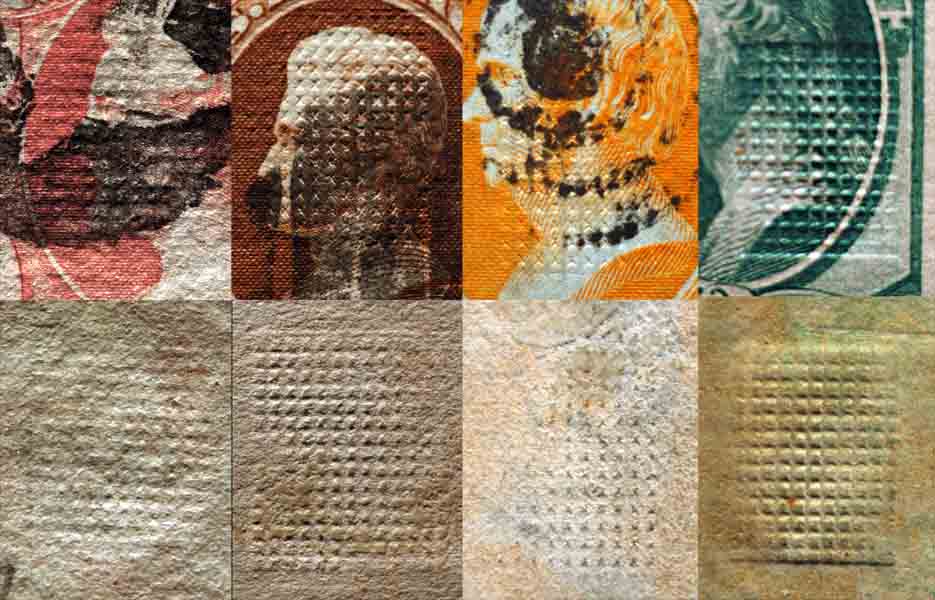 H-grill early-state: blunt pinpoint, poorly defined basically round shapes and typically incomplete strikes.
 The points on the grill roller were very pointed, but because the bed beneath the sheets was worn and not well aligned, the grill tended to bend the paper without breaking through, except in the case of very sharp points which penertate as small round pin pricks. This grill type is known for all 11 of the National Bank Note Company denominations - 1c 2c 3c 6c 7c 10c 12c 15c 24c 30c 90c
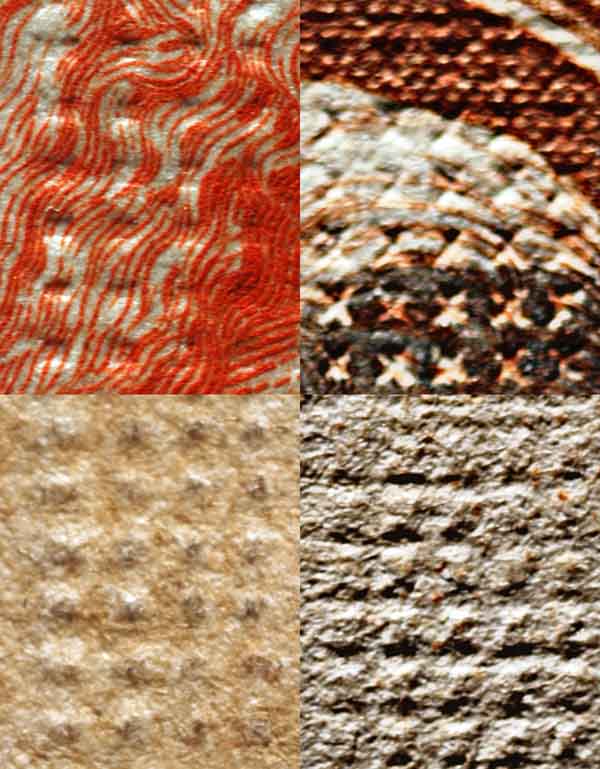
H-grill late-state: the obverse shows square depressions with an "X" pattern within, and circular "dimples" in each corner. The reverse shows square protusions, some with an "X" within. The cross pattern ("X") of the points is most noticeable in the ceter of the grill, but on progressing out from the center the points become increasingly truncated. This grill state is generally easily counted and complete, but differentiated by point shape even when incomplete.
Burns points out that some late state H grills exhibit "reverse embossing." This appears as the array of "dimples" on the obverse, as in the example illustrated here. This grill type is so far only officially known for 7 denominations - 1c 2c 3c 6c 7c 10c 15c
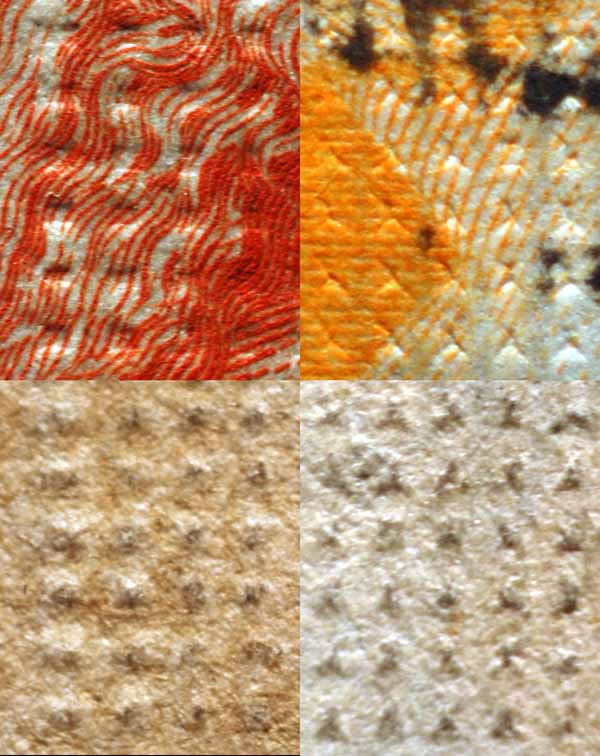
I-grill early state: "X" cut slightly truncated pyramidal bosses only the tips of which penetrate the paper. An array is often incomplete in the center.
Neither this grill state nor the early state H-grill exhibit reverse embossing. Strongly impressed examples which show the cross pattern may have some points which show the slight truncation of the pyramid. But these points are not as broad as on late state grills of either family. As a class these are the hardest grills to find of the four main types, but they are so far known for 9 denominations 1c 2c 3c 6c 10c 12c 15c 30c 90c
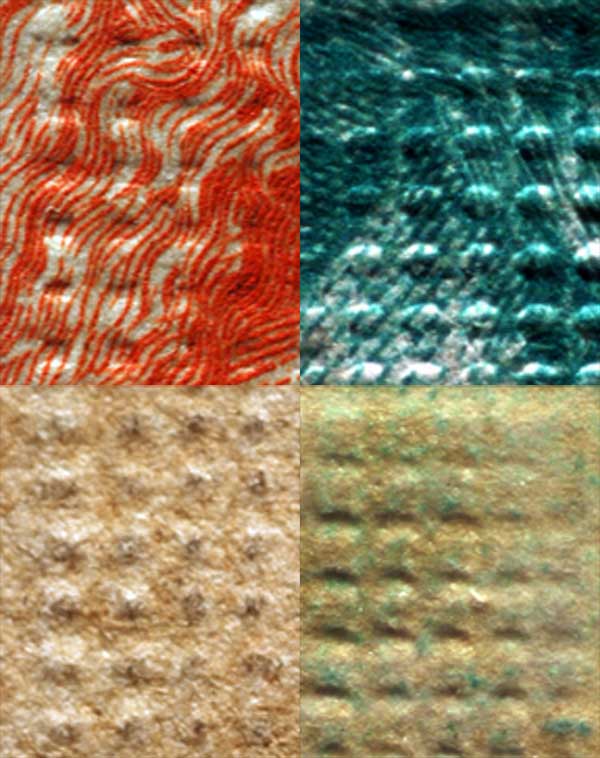
I-grill late state: strongly impressed grid pattern of "reverse embossing" with flat square depressions on obverse and square protrusions on reverse.
This grill state is the most complete and easiest to spot and identify of all the National grills. The reverse embossing is usually quite prominent and these grills are commonly well impressed, though exceptions do exist. The chief discriminating characteristic is the absence of a cross pattern in the grill points. Though readily identifiable, this grill has only been officially observed on 6 denominations: 1c 2c 3c 6c 7c 15c
Now that we have had a look at the documented grill types, let us do a side-by-side comparison of each with our suspected fake to see how it stacks up. Since our focus is point shape let us take a close look.
The subject stamp:
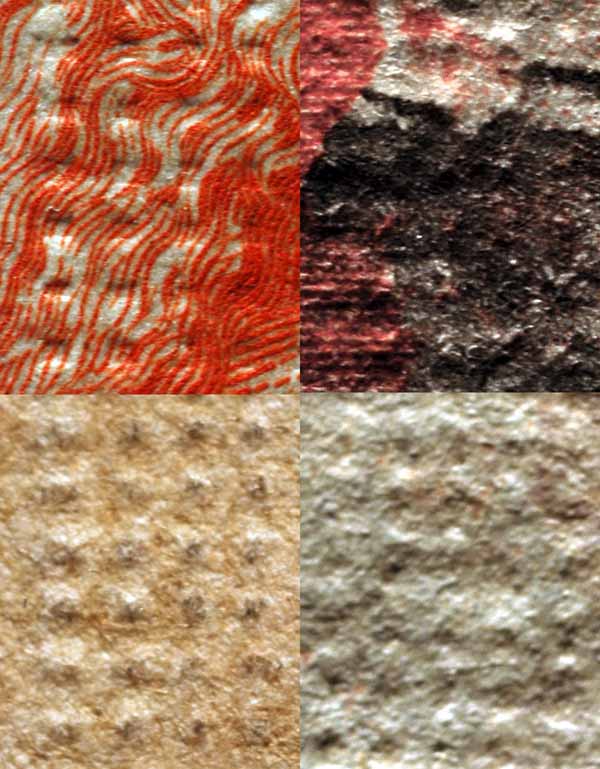
In my comments to the seller when I returned this stamp I said, "This grill presents as a strongly impressed array of 12x16 points shaped as small square truncated pyramids from the front, and rounded "biscuit" grill points from the reverse. Neither this configuration nor this point shape is consistent with any of the known H-grill or I-grill states."
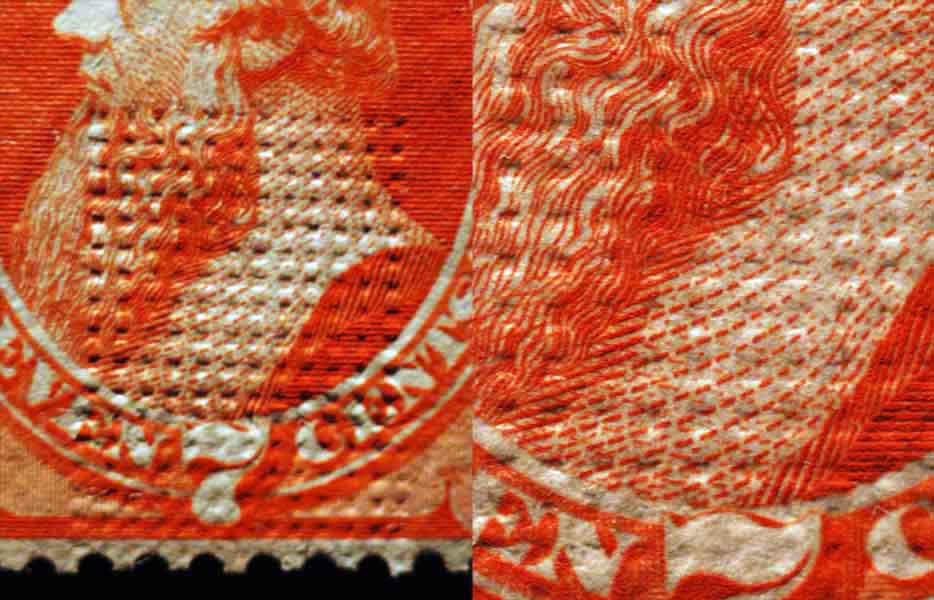
The size of the array fits within the range of possibilities for an H-grill, but its dimensions are not typical for what we usually see. It is a bit narrow and tall for the usual standard of 13x15. However, its horizontal dimension is just out of range for an I-grill, and its vertical dimension is decidedly too tall. So we should expect that the grill point characteristics will more closely resemble what we see among the H-grills. The fact that the entire grill is well impressed, and that the points appear to be small flat rectangles is a bit out of keeping from the outset.
H-grill early-state:
Strongly impressed well defined points on the obverse are not characteristic of early state H-grills. But surprisingly, the appearance of the points on the reverse does bear some close resemblance to what we see in an early H-grill.
H-grill late-state:
When we move to the late state H-grill, we observe some reverse embossing, as expected, but the complete absence of the cross pattern is inconsistent. The lack of definition to the points on the reverse is also inconsistent with a typical late state H-grill
I-grill early state:
From the standpoint of point shape, here is where we should see the greatest similarities to the standard, since the pyramidal points on our subject are somewhat reduced in size and the grill is well impressed. But again, the complete absence of the cross pattern on both sides is a problem. The points on the reverse are about the right size, but they do not have the same shape as normal early state I-grills.
I-grill late state:
The flat topped grill and the present of reverse embossing on our subject give a similar appearance on the obverse, except for the fact that the truncated pyramidal points are too small (and not really pyramidal). But the mismatch of the reverse views really gives it away that these grills are not of the same type.
In sum then it would appear that the closest parallel to the standard grill types is in the reverse side of the early state H-grill. That also supports the overall dimensions of the array. However, the strength of impression, and the obviously square shaped points on the obverse finally persuade us that this grill does not correspond closely enough to any of the known types for it to be genuine.
This quick primer does not go into all the features of the National grills (such as paper mesh) which might be used to authenticate these grills in a formal way. But with this introduction you should find these grills more understandable and less troublesome than trying to go it alone with the catalog descriptions.





 Posted 03/27/2015 12:39 pm





 would you take a look at this which also appears to be a fake and make any comments you may wish. I posted this stamp a number of years ago thinking (in my ignorance) that it was genuine. I am putting it up here for your enjoyment. It appears to be 12x16. It is probably not faked by the same person as your example. I bought it out of France on delcampe about seven years ago. Fortunately, I only paid $12 for it.