| Author |
 Replies: 26 / Views: 6,049 Replies: 26 / Views: 6,049 |
|
Pillar Of The Community
United States
6461 Posts |
|
|
Amongst collectors of U.S. revenues, the straight-line handstamp cancels from the Pacific Mail Steamship Co. are very popular and highly sought-after. Each cancel is the name of a ship that was used by the company, names including amongst others: China Japan Alaska Arizona Great Republic Henry Chauncey Montana Oregonian Rising Star Ocean Queen The cancels are visually very attractive. Some examples can be found in this thread: https://goscf.com/t/32902Examples in my collection can be found here: http://www.revenue-collector.com/cg...cific%20mailA simplistic valuation model would go as follows: 1. As a baseline, each strike of the cancel is roughly $40-50 in market value regardless of the stamp's catalog value, e.g., single strike examples of the more common ships can be found in the $50 range, whereas one with six strikes is likely to be in the $250-300 range. 2. 1st issue stamps are more common than 2nd and 3rd issue, with the exception of 1st issue imperfs ($5 denominations known with the ship AMERICA cancel). 3. The more full and well-struck the cancel(s), the higher the value. 4. The more striking the contrast between cancel and stamp, the more marketable and sought after. 5. Certain ships are more scarce than others. The most common are CHINA and JAPAN, then likely ALASKA, ARIZONA, and GREAT REPUBLIC. I still have yet to find examples of COLORADO, CONSTITUTION, COSTA RICA, GOLDEN CITY, and NEW YORK. One type of item that has been documented in articles of The American Revenuer, but I had never seen in person or even offered at auction or retail, came up this past week, and I had to pounce on it. R82c with seven strikes of the single-line cancels, three of the ship ALASKA, and four of the ship ARIZONA. The thought is that these were canceled at a central office, and because the two words look similar (both begin and end with the letter A, and are only one letter different in length), a clerk grabbed the wrong handstamp, realized their error, and then re-canceled with the correct handstamp. Mixed-ship occurences, while documented, are very scarce, with only a handful known to exist. This is a case where the minor faults on the stamp are utterly meaningless to its aesthetics and value. While it was an expensive purchase, I actually would have valued it higher than what was asked, given how scarce it is. I'm glad it wasn't at auction, as I'm not sure how high I would have gone to get it... 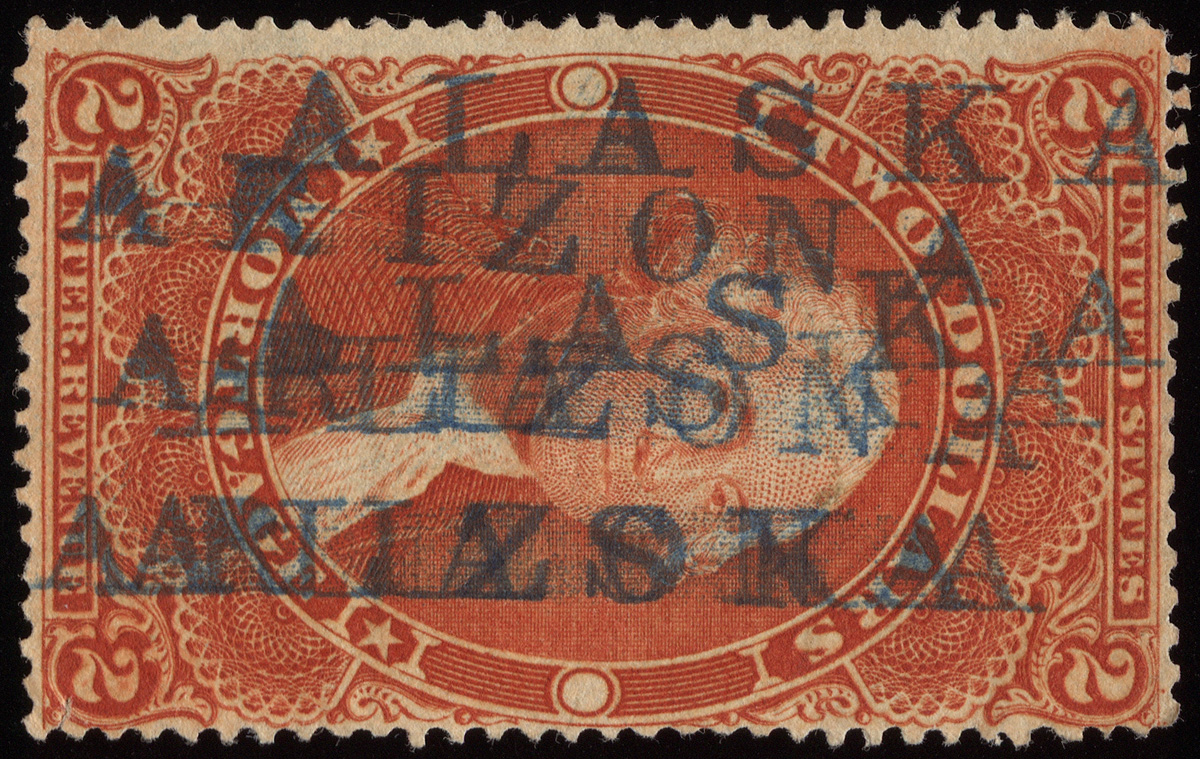 Interestingly enough, to date, no examples of Pacific Mail Steamship Co. straight-line cancels have ever been reported on document (per Mike Mahler and Richard Friedberg). These were most likely used on bills of lading (or perhaps more likely passage tickets as per the article below), which wound up in foreign destinations. Back in 1964, Hugh Shellabear wrote an article in The American Revenuer on this very subject: 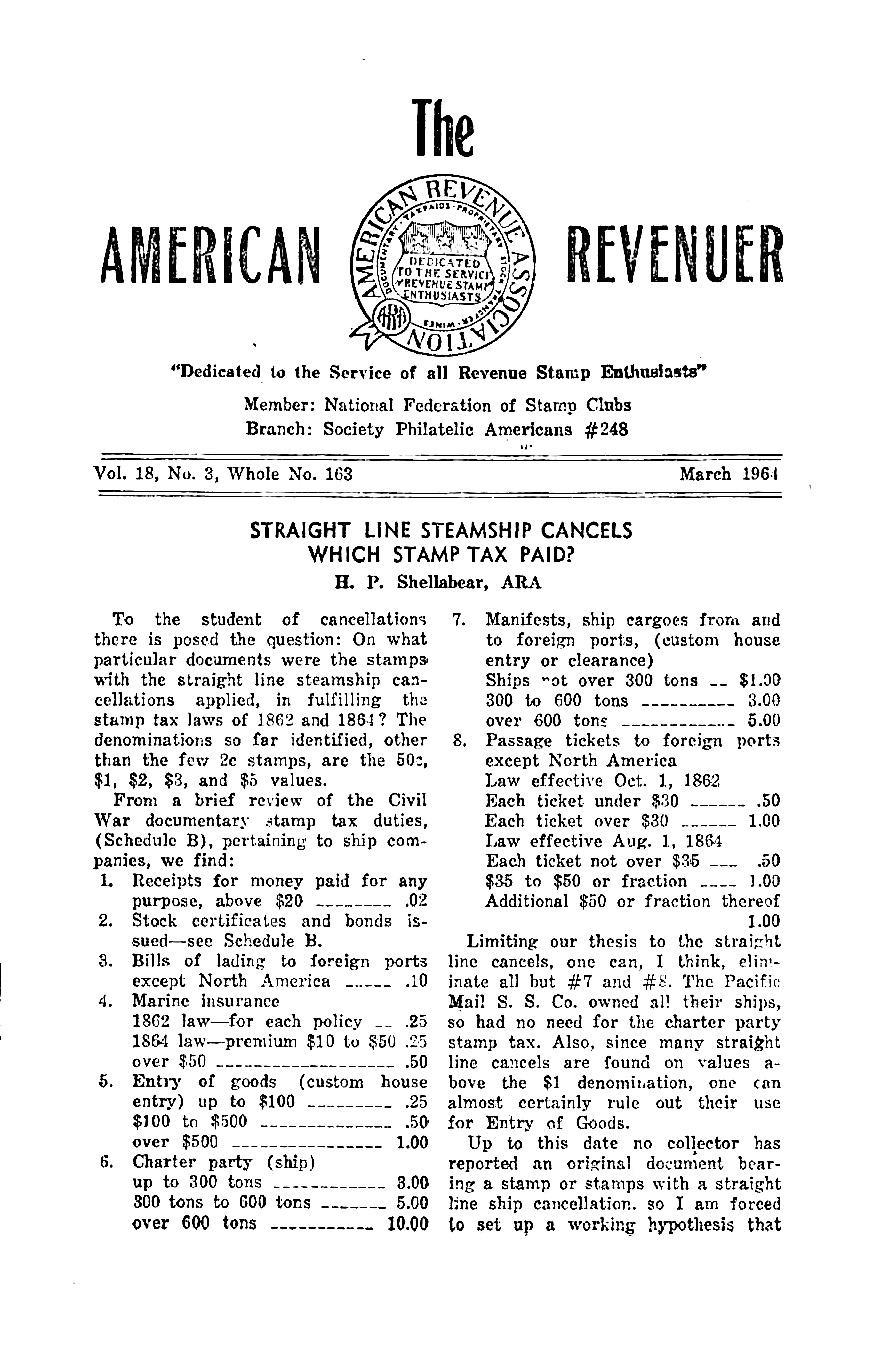 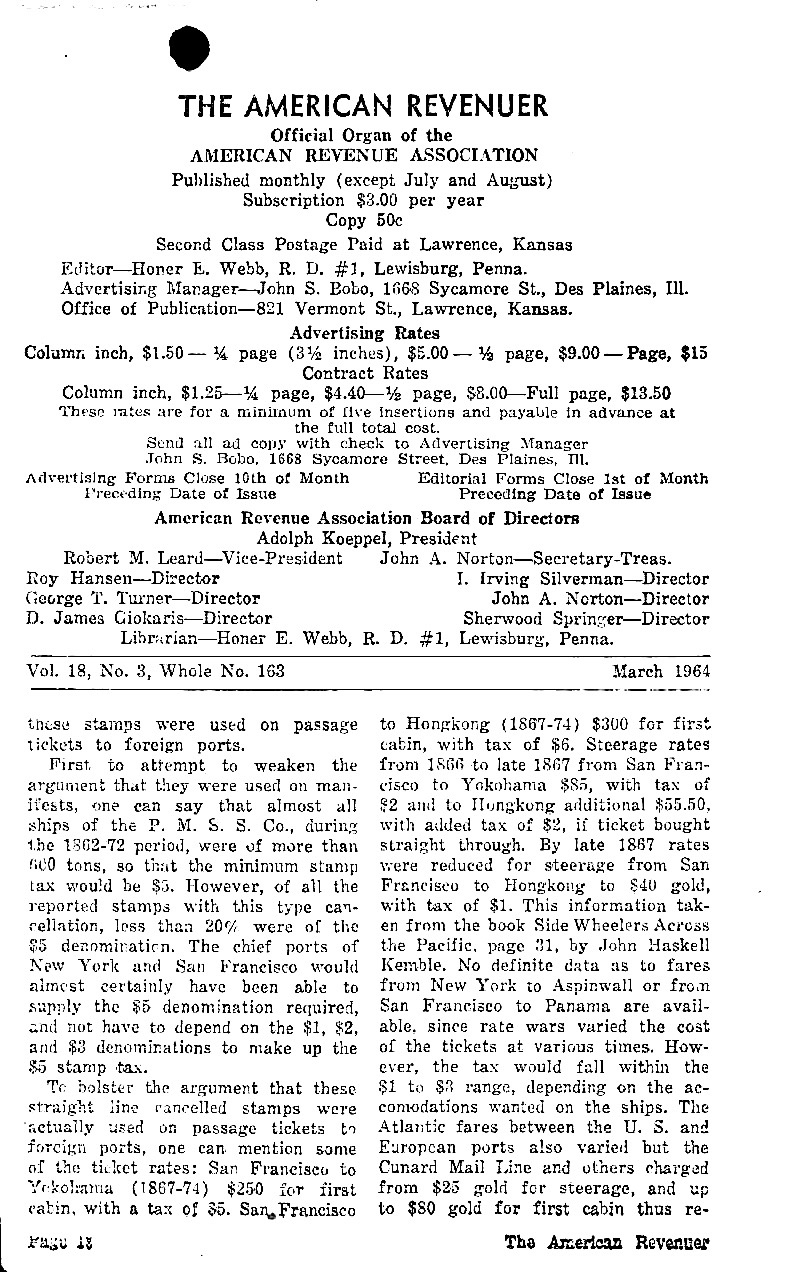 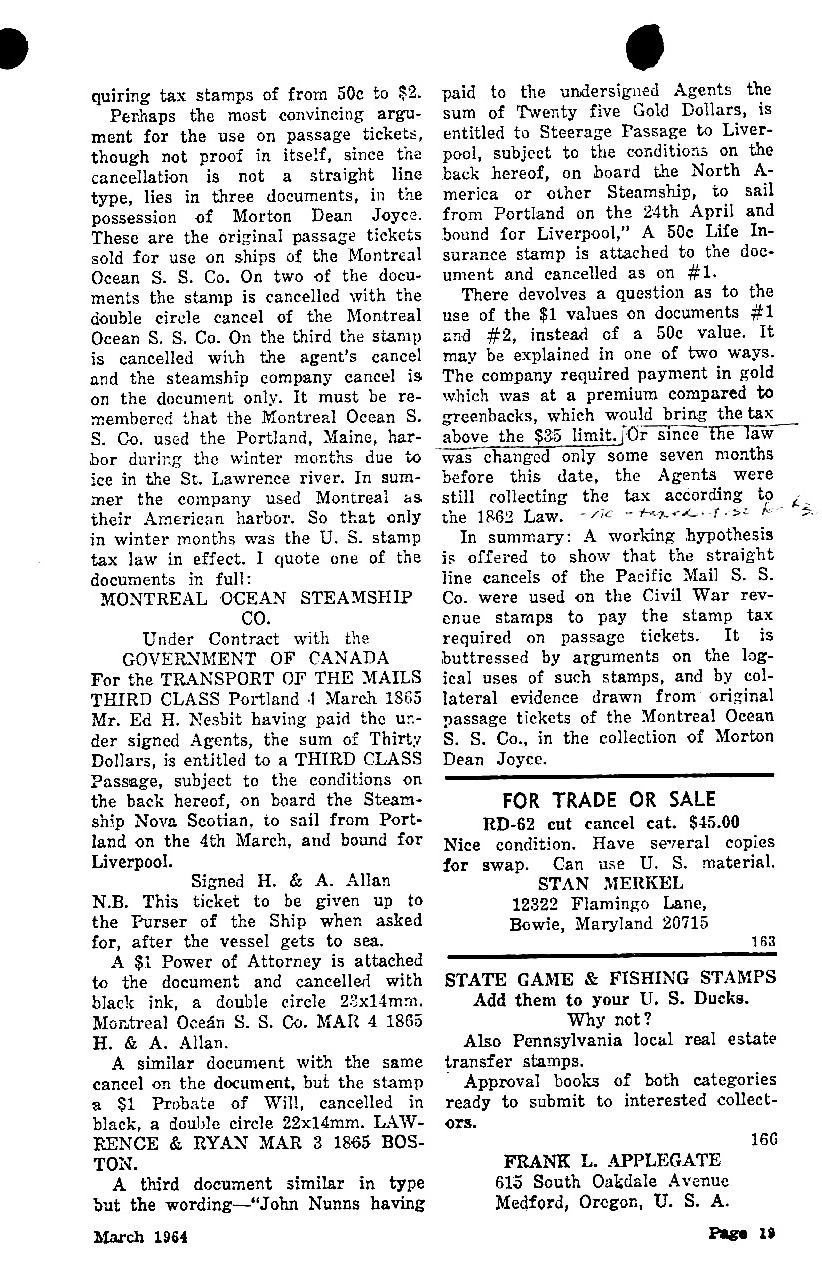 |
|
Send note to Staff
|
|
| Edited by revenuecollector - 05/16/2015 9:07 pm |
|
|
|
|
Pillar Of The Community
1151 Posts |
|
|
Revenuecollector, these Pacific Mail Steam Ship Cancels have always been a favorite of mine.
Cheers
Dave
|
Send note to Staff 
|
|
|
Pillar Of The Community
United States
3269 Posts |
|
|
Very interesting, didn't know that the Pacific Mail Steamship Co also canceled revenue stamps, have always seen covers with their cancels. Beautifull item! Thanks for sharing! |
|
Send note to Staff
|
|
|
Bedrock Of The Community
United States
10812 Posts |
|
|
Pillar Of The Community
1151 Posts |
|
|
"You will never find Costa Rica", why is that?
Give us you research knowledge why you made this statement?
Are there any Revenue Stamps with the cancel "Costa Rica"?
Dave |
|
Send note to Staff
|
|
|
Pillar Of The Community
United States
6461 Posts |
|
|
Bart, According to Jay Miller's 1985 TAR article updating Shellabear's work, the straightline cancel COSTA RICA does exist, designated #P-1M. Perhaps a different ship from the one in your link, but with the same name. See article here: http://www.revenue-collector.com/St...pCancels.pdf |
|
Send note to Staff
|
|
| Edited by revenuecollector - 05/17/2015 12:10 pm |
|
|
Pillar Of The Community
United States
791 Posts |
|
|
This is where I think the Scott Specialized is lacking. I would like to see the first, second and third issue listings with +$$ for cancels like it does for the early postage issues. There are many cancels which command a premium, but how much is hard to determine. It would be nice to have at least an idea. |
|
Send note to Staff
|
|
|
Pillar Of The Community
1151 Posts |
|
|
1typesetter, that sounds like a good idea, I like your idea.
Hope someday before I assume room temperature to see it happen, but expect if it ever does happen I'll be feeding the worms!
Dave |
|
Send note to Staff
|
|
|
Pillar Of The Community
United States
6461 Posts |
|
|
Quote:
I would like to see the first, second and third issue listings with +$$ for cancels like it does for the early postage issues. I have been making that and similar suggestions regarding reorganizing the 1st-3rd issue revenue section to first Jim Kloetzl and then Chad Snee, for several years now. I've received polite "we'll consider it" replies, but nothing more. My most recent attempt from this past December regarding revenue multiples and plate varieties: Quote:
I had sent you some commentary back in 2012 regarding my opinion that the treatment of multiples and plate varieties with respect to 1st-3rd issue revenues NEEDS to change. When updates occur to single stamp prices, frequently the prices for multiples and varieties are NOT updated accordingly, which then over the course of time throws the relative pricing completely out of whack.
For example, this morning I discovered that the price for R70a ($1 Lease imperf) and the double transfer at bottom on that stamp are both priced the same ($50) in the 2015 Scott Specialized. I looked back through the catalogs and in the 2005 Scott, the price for the regular stamp was $35 and the DT was $50, so through multiple price increases on the base stamp, the premium for the DT has gone from 42.8% down to 0% over the last 10 years.
That's only one example. There are many.
I'm going to re-present what I sent you back in 2012, because I believe it would solve this problem completely and also make life easier for those having to maintain/update the data. I am intending this as a model only for 1st-3rd issue revenues, not a general overall model, due to the focus on multiples and varieties that the collecting of these issues has compared to other stamps.
1. Treat pricing of multiples as a multiplier.
2. Treat pricing of plate varieties as an add-on (like cancels are treated in the front of book section).
3. Multipliers are applied before add-ons.
For example, currently R70a is listed as follows:
Base stamp: $50.00
Pair: $150.00
Block of 4: $500.00
Double transfer at bottom: $50.00 (erroneous)
Under my proposed model it would be listed as follows:
Base stamp: $50.00
Pair: 3x
Block of 4: 10x
Double transfer at bottom: +$20.00 (preserving approx. the same ratio as in 2005)
This has the added benefit of being able to accurately price multiples that contain varieties. For example, if I have an R70a pair with one of the stamps having the DT the price would be (3 x $50.00) + $20 = $170.00
Believe it or not, this is currently a big problem in the revenue collecting community: how to price multiples that contain other attributes. Right now it's all over the map because dealers, auction houses, and collectors have no guidance.
Of course the various multipliers and add-ons would (1) need to be obtained, which I would be happy to assist with, and (2) they would still have to be periodically updated as ratios change with the change to the base stamp value.
However, this avoids the problem where only base stamp values receive scrutiny. Varieties and multiples wouldn't be left behind and lose their inherent value compared to single stamps. Of course, it's much easier to use the above method for multiples and plate varieties than for cancels, other than for a few very high-profile cancels. The problem with using this method for revenue cancels is that there aren't hard and fast valuation rules re: "bank cancels" vs. "railroad cancels", etc., as there tend to be for front-of-book material. For example, there are proprietary cancels that will make a $1 stamp a $5 stamp and ones that will make a $1 stamp a $300 stamp. How do you codify that within the constraints of the Scott catalog? I don't know that you can. I think cancels need their own catalog so that listings can be more elaborate and provide more context. I have attempted to start the process by adding "Estimated Retail Value" to all the entries on my website, to at least give people some idea of what cancels or usages can be worth compared to Scott catalog values, or at least what I believe their values are. Perhaps, once I retire in 10-15 years, I'll work on extending that to a more formalized cancel catalog. |
|
Send note to Staff
|
|
| Edited by revenuecollector - 05/17/2015 6:28 pm |
|
|
Pillar Of The Community
United States
791 Posts |
|
|
Quote:
I have been making that and similar suggestions regarding reorganizing the 1st-3rd issue revenue section to first Jim Kloetzl and then Chad Snee, for several years now. I've received polite "we'll consider it" replies, but nothing more. Just goes to prove that revenues always have been and always will be the "ugly stepchildren" of philatelists. |
|
Send note to Staff
|
| Edited by 1typesetter - 05/17/2015 7:16 pm |
|
|
Bedrock Of The Community
United States
10812 Posts |
|
|
The problem with multipliers is that revenue multiples are all over the board as far as scarcity goes. Some are very common and some are very scarce and most range from somewhat uncommon to fairly scarce, there is no multiplier scheme that will come close to covering all the possibilities. Cancels are another problem, the value depends on too many factors to price as a simple list. Certain areas such as medicines and insurance companies are very popular and each company and type will have a certain range of values, some are very common and some are somewhat scarce and some are very scarce. Plus there are the printed's, each of which has it's own scarcity and value above and beyond the cat value of the stamp it's printed on. Some are only worth about $20, and some are worth 15x that. To do the first three issues any justice would add 10 or 15 pages to the catalog at a minimum; it's not happening. Any more than a complete overhaul of the Match & Medicine writeup or actual value ratings is coming. |
|
Send note to Staff
|
| Edited by revcollector - 05/17/2015 8:01 pm |
|
|
Pillar Of The Community
United States
6461 Posts |
|
|
Bart,
I think you missed a point with regard to my suggesting using a multiplier for revenue multiples. I'm not suggesting a single multiplier for all revenues, but rather that two multipliers would be listed under each stamp, i.e., a different multiplier for pair and for block of 4 for R1a, R1b, R1c, etc.
While that wouldn't cover irregular multiples and blocks of 6, 8, etc. It would cover the most common scenarios, just as front-of-book listings tend not to list anything but pairs, blocks of 4, and plate blocks of 4, 6, 8, etc.
As I mention above, providing values for cancels within the constraints of the Scott catalog would not work, as the pricing is not as cut-and-dried as it is for front-of-book material. |
|
Send note to Staff
|
|
| Edited by revenuecollector - 05/17/2015 8:35 pm |
|
|
Bedrock Of The Community
United States
10812 Posts |
|
|
So what do you do when a single cats .40, an pair cats .90, and a block of four cats $5 (R13c)? Or conversely, when a single is $1.50, a pair is $19 and a block of four is $200 (R5a)? You are saying that all stamps have to be round numbers based on the original cat of the single which may or may not be remotely accurate pricing. |
|
Send note to Staff
|
|
|
Pillar Of The Community
United States
6461 Posts |
|
|
First example:
Pair multiplier: 2.25
Block multiplier: 12.5
Second example:
Pair multiplier: 12.7
Block multiplier: 133.3
In my opinion, the multipliers don't have to be integers. Decimal values are perfectly fine.
Even if, for the sake of argument, that for simplicity's sake the multipliers MUST be integers, the values of 2, 12, 12, and 133 above still get you close enough. Pricing never has been, nor ever will be, an exact science. The comparative values and ratios are what are important. |
|
Send note to Staff
|
|
| Edited by revenuecollector - 05/17/2015 9:28 pm |
|
|
Bedrock Of The Community
United States
10812 Posts |
|
|
It really doesn't matter, since it's never going to happen. And most collectors and dealers would hate it, they want to look up a price in a second or two, they don't want to need a calculator just find out a basic value. |
|
Send note to Staff
|
|
|
Pillar Of The Community
United States
6461 Posts |
|
|
Well, collectors seem to be willing to accept add-on factors for front of book stamps. This really isn't all that complicated.
The alternative is to simply accept that (1) values will just be inaccurate, and (2) that prices for multiples and plate varieties will just continue to fall by the wayside as time progresses.
It may very well be that Scott won't make any changes, but that doesn't mean I'm going to stop recommending it. |
|
Send note to Staff
|
|
|
|
Replies: 26 / Views: 6,049 |
|




 Posted 05/16/2015 9:04 pm





