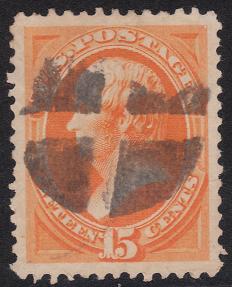
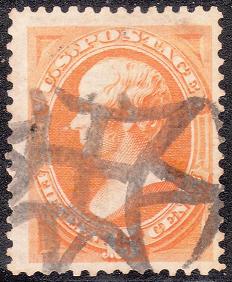
| Author |
 Replies: 13 / Views: 2,605 Replies: 13 / Views: 2,605 |
|
|
Valued Member
United States
131 Posts |
|
|
Starting to work on a few classics, putting the W/F away for a while. Appreciate it if someone could provide some info about these 152,163,163 and 189 (Left to right in the image). Actually the left most stamp is more yellow than the scan shows, at least on my monitor. The paper is white wove on the 1st 3 and the rightmost is soft. I've been searching around a bit and discovered that there is a minor debate as to whether the 152 has a secret mark or not? Some places say just ignore Scotts upper left V theory. Most of these apparently get ID based on color and paper. I believe I have the paper correct, now that I've learned a bit about the differences in a different thread. I guess I'm most concerned about the 152 (since it's more yellow than the others – perhaps it's not a 152)? If fact stamps 2 & 3 I think are 163. I guess the only think I really know id the rightmost is a 189. Can anyone tell me something about the cancellations on the stamps. I understand that the oval letter and Numeral cancels began in 1876 and onward. Killer Canc/Cork/Wood block pre 1876? It has taken me 3 months to get a better grasp of the W/F series, so I'm just trying to get some basic skills with the classics. 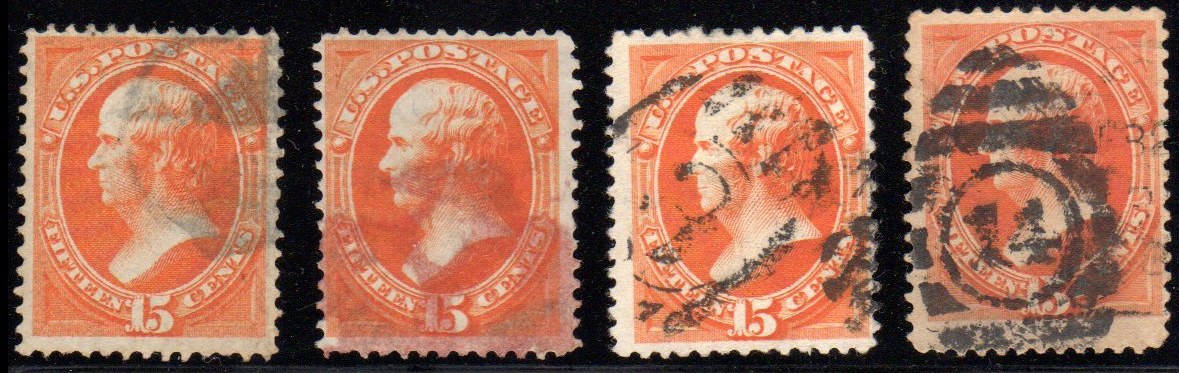 |
|
Send note to Staff
|
| Edited by chaulkdust - 06/02/2015 7:57 pm |
|
|
|
|
Pillar Of The Community
United States
2555 Posts |
|
|
I think you probably have two 163's and two 189's. The 3rd stamp is pretty much guaranteed to be a soft paper stamp. |
Send note to Staff 
|
|
|
Pillar Of The Community
United States
3300 Posts |
|
|
The combination of your scanner and monitor, and my monitor will make identifing the color very difficult. About the best that can be done is to compare them to known Nationals, Continentals, and American bank notes. I'm pretty sure that I have these in order, however they are used ( all I collect ) and so have mave have been faded by the soaking or their storage before I got them. Either way, My scanner, monitor and how your system sees my colors may not tell you much. Essayk and Bill Weiss can tell us a lot more. 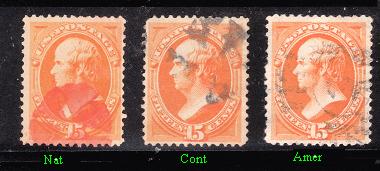 |
|
Send note to Staff
|
| Edited by littleriverphil - 06/02/2015 9:12 pm |
|
|
Pillar Of The Community
United States
1414 Posts |
|
|
The fine lines in the upper and lower triangles are reasonably complete if the stamp is a 152. Some will be missing if the stamp is a 163 unless it was printed on ribbed paper. Ribbed paper can be seen in oblique light. (A "silk" paper variety of 163 also exists with hundreds of tiny black fibers visible in the paper front and back.) The color of a 152 may look more yellow to a casual observer, but the orange, which Scott now calls a "bright orange" is more saturated than the Scott designated "yellow orange" of a 163. Bill Weiss may be able to help with this, since he wrote the book.
Clark |
|
Send note to Staff
|
| Edited by cfrphoto - 06/02/2015 10:40 pm |
|
|
Rest in Peace
United States
763 Posts |
|
|
I've written this often and tried to stress it in my book, but in fact, Scott color designations for #152 vs #163 are very misleading. First, any stamp on soft paper is #189, regardless of color, and #189 comes in many different shades ranging from yellow orange to red orange and everything in between. If on hard paper, than they are best separated by color, with a couple more elements thrown in, and Clark has already noted them;
1. If on ribbed paper, it must be a #163 (way more to that subject then I have time for, but essentially, that is a pretty failsafe rule);
2. If on paper with many short black silk fibers, it must be #163 (again, more can be written, but that is also a good rule);
3. If the so-called "secret mark" **IS** present, even though it is not believed to be a true secret mark in the same sense as all those values with undisputable secret marks (1c,3c,6c,7c,10c,12c) than it is also must be a #163.
4. After that, seperate by color. Contrary to Scott's colors, those that are more yellowish orange are #152 and those that are more "orange" are 163.
Also, Clark's tip about the fine lines is useful too. |
|
Send note to Staff
|
|
|
Valued Member
United States
131 Posts |
|
|
Thanks for all the input. Correctly determining what some of these are is way above my pay grade. I had planned to send some material to Bill anyway , so I'll include some of these for an ID. I'd really like to get them properly identified, so at least I have a good reference to look at. |
|
Send note to Staff
|
|
|
Pillar Of The Community
United States
1946 Posts |
|
|
Putting together a good reference set of known items is a good idea no matter what you are after, but particularly for discriminating stamps by color. That is a way better approach than trying to pin down colors online. As for the paper types, something needs to be said about probability just so you have a better sense of what to expect.
Back in 1995 Bill Weiss self published an exhibit style study of the 15c from material in his personal collection. This is the "book" to which he and Clark refer, and it was intended as an overview of the stamp and not a detailed discussion. In his words, "...primarily a 'coffee-table' book, a pictorial account..." He covers a lot of ground, including secret marks and color, but unfortunately he does not have much discussion of the special papers as a group, though he refers to some of them in other discussions. Ribbed paper is not described or discussed, but it is referenced as a marker for stamps of the Continental BNCo. I did not find a direct reference to silk paper.
You will not have too much difficulty adding a ribbed paper example to your reference set, but they are by no means as common as the ordinary papers used by Continental. Adding a silk paper specimen will be more difficult. These I tend to class as scarce to rare, although the 15c is more available on that paper then many of the other denominations. I have never seen a report of the statistical distribution for the various papers, and my own experience is limited since they have not always been a priority. But in my personal experience the ribbed paper variety seems to show up in about one out of ten stamps examined in unsorted dealer stocks. The silk paper is easily 5 times as rare.
Until your reference set is put together with shades and all, the best test of the types probably will be in looking at the fine lines that Clark brought up. After you get a set back from Bill, or other expert, then color will surely become your first standard.
|
|
Send note to Staff
|
|
|
Pillar Of The Community
United States
3300 Posts |
|
|
Rest in Peace
United States
763 Posts |
|
|
Nice stamps! The top one, if sound, would grade very high. And yes, it is a NYFM, and you would know that for sure if you downloaded the FREE copy of my NYFM booklet on my website (www.stampexpertizing.com). The booklet is useful for quick ID of NYFMs. |
|
Send note to Staff
|
|
|
Valued Member
United States
131 Posts |
|
|
Very useful information - Thanks again! I spent sometime on the USPhila site looking at the 152's,163's and 189's. There was such a wide color variation within each stamp it was quite useless(at least for me). Any places to look for cancellations/references on the classics? I was curious as to what cancellations were on the 4 stamps? I will look at Bill's site. |
|
Send note to Staff
|
|
|
Pillar Of The Community
United States
3300 Posts |
|
|
Quote:
Nice stamps! The top one, if sound, would grade very high. And yes, it is a NYFM, and you would know that for sure if you downloaded the FREE copy of my NYFM booklet Thanks, Bill. The ribbed paper has a tiny perf bend that Ken Srail can see in fluid, I can't see it, upper left corner. Was actually pretty sure it was a NYFM, I did better than the dowmload, I made a deal with you for your 15 cent banknote book and your NYFM book, about 2001-2.  We connected on Richard Frajola's old site. chaulkdust, Have you downloaded Cancellations and Killers of the Banknote Era 1870-1894 By James M. Cole ? 345 pages of almost every type of cancel you'll find. http://www.uspcs.org/resource-cente...nic-library/If you're really interested in cancels there's the U.S. Cancellation Club. Tons of info, ongoing research projects, newletter. http://connection.ebscohost.com/c/a...llation-club |
|
Send note to Staff
|
| Edited by littleriverphil - 06/03/2015 7:25 pm |
|
|
Rest in Peace
United States
763 Posts |
|
|
Quote:
Thanks, Bill. The ribbed paper has a tiny perf bend that Ken Srail can see in fluid, I can't see it, upper left corner.
It sort of looks like there might be a tiny tear at right - at the 6th perf hole up from bottom? Could also just be a random piece of dust! Even with a tiny corner perf crease and a couple short perfs it's at least an 85J (maybe 90J). |
|
Send note to Staff
|
|
|
Pillar Of The Community
United States
3300 Posts |
|
|
Quote:
Could also just be a random piece of dust! It was a stray fiber of some type, and I didn't get it out when I rescaned, it's now down at the bottom right, under the stamp inside the little dealer card, the perf above A is intact, just twisted. 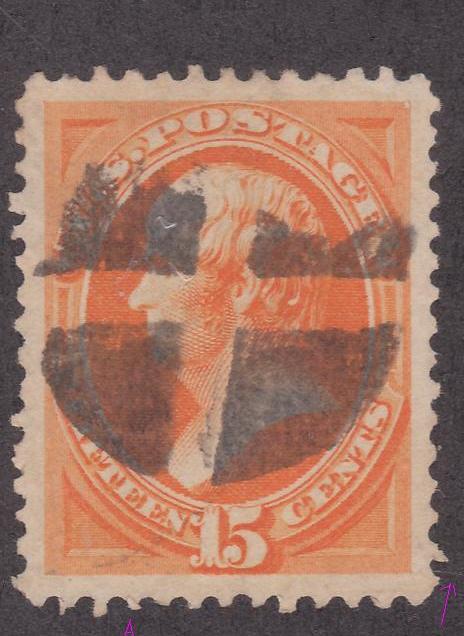 |
|
Send note to Staff
|
|
|
Rest in Peace
United States
763 Posts |
|
| |
Replies: 13 / Views: 2,605 |
|



 Posted 06/02/2015 7:53 pm