| Author |
 Replies: 19 / Views: 4,157 Replies: 19 / Views: 4,157 |
|
Pillar Of The Community
United States
1359 Posts |
|
|
I bought this Type II, #20 on ebay about 6 months ago-- I'm not an expert by any means on the earlier plates (the imperfs or Plate 4), but I'm getting to know the Type V and Va plates pretty well. I had a hunch on this one, because it looked, let's say...hollow...I sent it to Richard Doporto a week or so ago, and he emailed me yesterday with the results, before I get the cert in the mail. Winston-- this one isn't for you......but you'll like the results... let the others try first... :) What do you think this one is? Have fun....Ray  |
|
Send note to Staff
|
|
|
|
|
Pillar Of The Community
United States
2423 Posts |
|
|
Haha! I won't even try!
I'm curious, though. Just how many variations of this stamp are there? |
Send note to Staff 
|
|
|
Pillar Of The Community
United States
2555 Posts |
|
|
If you bought that stamp as a #24, I am sure you did well. I've got my own 1c 1857 stamp that you might be able to appreciate. I will start another thread to show it.
Edit: I see you bought it as a #20. I am sure you still did fairly well. |
|
Send note to Staff
|
| Edited by sinclair2010 - 07/25/2015 8:05 pm |
|
|
Pillar Of The Community
United States
1359 Posts |
|
|
Off-centered and a pulled perf, but Winston is correct that I did pretty well.
I'll give a hint with the plate....one of the older plates was worn, and produced a lot of stamps with the worn, hollow look. It was Plate 1 Late. Again, I don't know this plate well, but I had a hunch and went with it....
Can anyone ID this one? And, it is not a Type II, #20.....Ray |
|
Send note to Staff
|
|
|
Pillar Of The Community
United States
1359 Posts |
|
|
KGB- we're fortunate that printing wasn't an exact science in the 1850s, so there are many major types-- I, Ia, Ic, II, III, IIIa, IV, V and Va, and then many double transfers (and a triple transfer), and then when a hair or filament was stuck to the plate we find the variety of "curls".
All in all, a lot of really expensive stamps, but if one sticks with the Type V, there is a lot to learn, since 200 stamps to a plate, with 5 different plates (5, 7, 8, 9 and 10), and each position could be considered a variety.
It's probably the 2nd most studied stamp in US philately, only behind the 3c stamp in that series. Really interesting stuff. Hope this piques your interest and others'..... Ray |
|
Send note to Staff
|
|
|
Pillar Of The Community
United States
937 Posts |
|
|
91R1L ? I see a few odd marks but nothing that matches my first read through for that plate in Neinken. Lots of white and no blue to the bottom and left side. So bottom leftmost of Plate 1L but which side of the plate? Not 91L1L because it doesn't have the triple transfer. So it's 91R1L. You saw the "hollow" appearance of the cleaned Plate 1 Late. So on a hunch you thought that it wasn't a Type II which it was being sold as? The cat difference between Type II and IV being a factor of 3. |
|
Send note to Staff
|
Ryan = HDNAC = DNA = HDC = Hysterical DNA Collector = Historical DNA Collector = me who just loves stamps :) |
|
|
Pillar Of The Community
United States
1359 Posts |
|
|
Great response, Ryan....actually plated as 95R1L...Type 4 #23, with a recut at top which I of course couldn't see, but was hoping was there...
I'm still using my old 2011 copy of Scott, but it was $10,000 unused. Has a pulled perf and bad centering, but well worth the $123 I spent for it....my first 5-figure CV stamp... :)
Ray |
|
Send note to Staff
|
|
|
Pillar Of The Community
United States
937 Posts |
|
|
At least my vague guess was only 4 positions away. Greater than $10,000 CV? FANTASTIC!!  I've neglected learning about plating due to having only one stamp of this series. Yours and Sinclair's post got me into reading Neinken for the last few hours. Do you mind confirming mine? Type V, D relief, postmarked February 25th of 1859, so plate 5, 7, or 8. The only position that it fits well is 32L5. However it is missing the "Fine" marks at top left. Since mine is a late printing from that plate, does it make sense that the fine lines would have worn away completely? It appears that it takes quite a while to learn how to read the plating diagrams and how they can present as stamps during the production period. 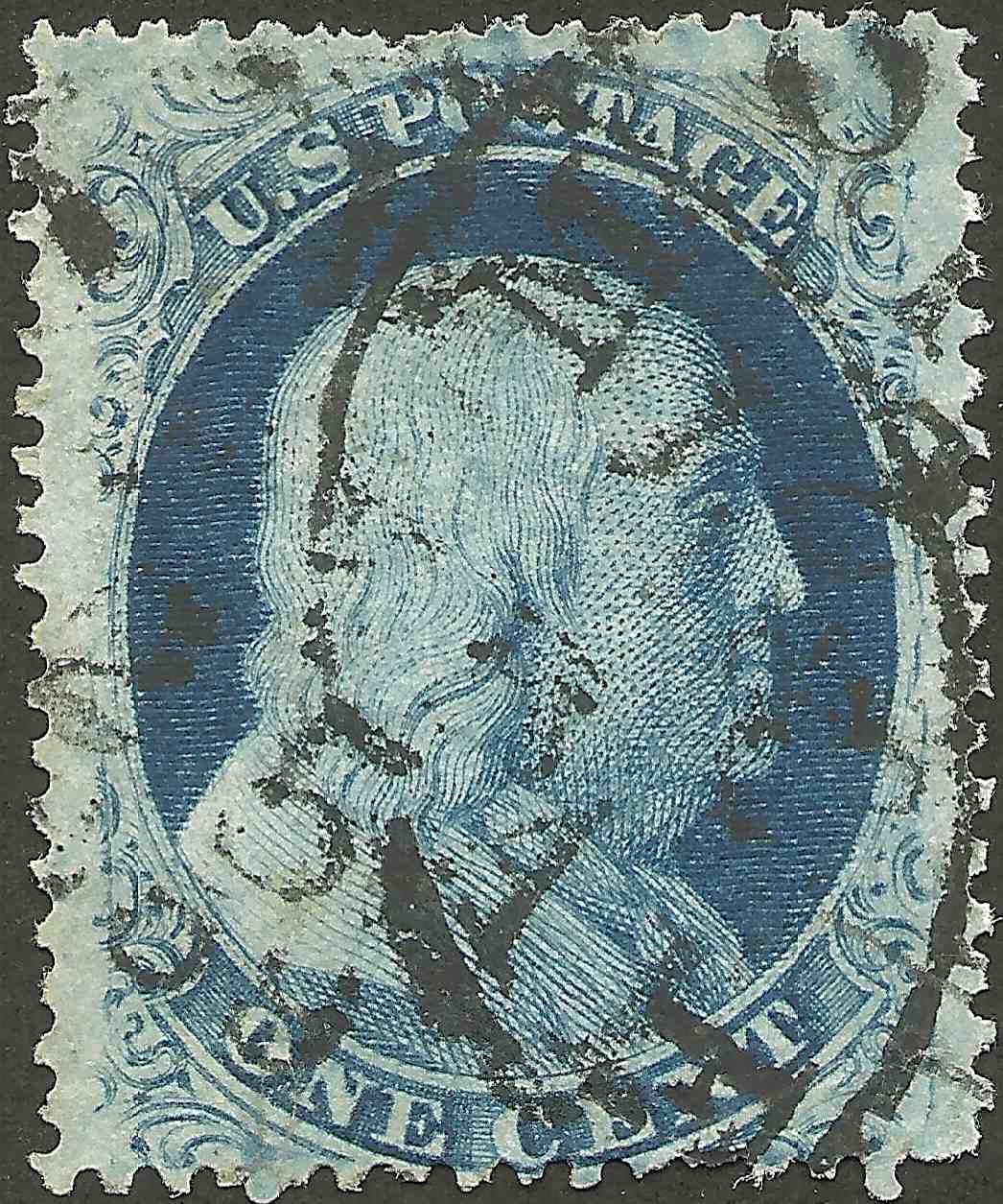 |
|
Send note to Staff
|
Ryan = HDNAC = DNA = HDC = Hysterical DNA Collector = Historical DNA Collector = me who just loves stamps :) |
|
|
Pillar Of The Community
United States
2555 Posts |
|
|
It is hard to tell from the scan what you have. I doubt it is 32L5. 32L5 is a tricky one and I once thought I had one too. Many of the D relief stamps have same blurring in the POS of "POSTAGE", the Neinken book just doesn't show it. Plate 5 did wear, impressions can be found so worn that they bare little resemblance to an early Plate 5 printing. |
|
Send note to Staff
|
|
|
Pillar Of The Community
United States
937 Posts |
|
|
Quote:
...the Neinken book just doesn't show it. What other resources are there for plating diagrams? I already found slingshotvenus. Comparing images on that site to Neinken's book is helping me get a feel for how to read the diagrams. Quote:
Plate 5 did wear, impressions can be found so worn that they bare little resemblance to an early Plate 5 printing. So some stamps can't be plated 100% accurately regardless of ideal centering, unobtrusive cancellations, or both? Also, am I inferring correctly that you believe that it could be from plate 5? I didn't realize that 32L5 was special. I went through all of the possible positions again and ignoring the blurring in the POS of "POSTAGE", I still can't find a better fitting position. Nearly a dozen exist without Plating Marks, but I am of the belief that mine does have some. Here's slingshotvenus's page for the 32L5: http://www.slingshotvenus.com/Frank...Pos32L5.htmlHere's a 2400dpi scan of my stamp: http://i296.photobucket.com/albums/...s6cfad6c.jpgObviously I'm a beginner and may be missing something. Thank you for your help Winston Sinclair. |
|
Send note to Staff
|
Ryan = HDNAC = DNA = HDC = Hysterical DNA Collector = Historical DNA Collector = me who just loves stamps :) |
| Edited by Historical DNA Collector - 07/27/2015 11:27 pm |
|
|
Pillar Of The Community
United States
517 Posts |
|
|
I'm learning myself and just wondering if the left line goes too far down past the left shoulder(looking to the face of stamp) but looks like its the correct height past the curl off shoulder and isn't a lay out dot on the left margin just about eye level say around the 7th perf. also could there be a lay out dot in the top right margin. I know mostly with the dot in this position is A or B relief. I'm trying to learn this myself.
Thanks Newby. |
|
Send note to Staff
|
|
|
Pillar Of The Community
United States
2555 Posts |
|
|
There are no layout dots on D relief stamps.
HDNA,
There aren't any other resources out there. You need a lot of material and practice to plate the Type V plates. Plate 5 stamps are generally easy to plate with the Neinken book. There isn't anything special about 32L5. I think all good Plate 5 stamps are special. It is the only 1c plate that I am reconstructing.
Your 32L5 candidate could be a Plate 5 stamp but I still doubt it. Right now I don't have much time to try to figure out what it really is.
There are loads of unplatable stamps out there. It isn't as easy as everybody thinks.
Don't assume that since the Neinken book says there are no plating marks on certain positions that there aren't. It simply isn't true. Sometimes I think there was a rush to publish the book. |
|
Send note to Staff
|
|
|
Pillar Of The Community
United States
2423 Posts |
|
|
Pillar Of The Community
United States
937 Posts |
|
|
Winston, I understand you and wish you luck in completing your Plate 5 reconstruction. Quote:
Don't assume that since the Neinken book says there are no plating marks on certain positions that there aren't. It simply isn't true. Sometimes I think there was a rush to publish the book. I agree that the book is not all-encompassing, but didn't want to state that myself as I am a beginner. As for the rush, it's understandable to me be because Neinken was 76 years old and probably had more important things in his life that were neglected by the time that it was published. Despite lacking full detail, it is as you say the only compiled resource. It has not been superseded since being published 43 years ago. slinshotvenus seems to be making a serious attempt to gather actual images, data and disseminate it for the greater philatelic good. What are your ideas for how to advance plating identification? I will continue learning and want to thank you for your input, Ryan |
|
Send note to Staff
|
Ryan = HDNAC = DNA = HDC = Hysterical DNA Collector = Historical DNA Collector = me who just loves stamps :) |
|
|
Pillar Of The Community
United States
1359 Posts |
|
|
Hey Ryan...FYI, Richard Doporto's uses a technique that delivers a 4800 dpi sharp scan. The stamp I posted is 4800 from my Epson V500 Perfection. At 2400 you won't be able to see some of the plate marks and it's really difficult sometimes anyways, as Winston mentioned. I just sent 9 others to Doporto other than the one I posted, and I just couldn't ID them....Winston may have been able to but they can be really, really difficult.....
All of mine had less cancel ink than your copy does....some I've known were type Va, bUT jus couldnt find anything definitive..so keep going...plating this issue is the most fascinating philatelic activity I've ever enjoyed, and wait til you find a good one that didn't cost you much! Ray |
|
Send note to Staff
|
|
|
Moderator

United States
12330 Posts |
|
|
Be careful of high resolution scanned images that go beyond the scanners true optical resolution. Once you go beyond the scanners true optical resolution (typically around 300-600 dpi) you are actually looking at a software manipulated image.
Please don't get me wrong, the algorithms used to enhance and enlarge the image at these higher resolutions is pretty good, but if you are examining some highly detailed attribute you might want to drop back to a microscope or high powered magnifying glass to verify the detail.
And in general you want to avoid saving the image in a format which compresses the image. You can always tell if a format is compressing by looking at the resulting file size. Uncompressed TIFF is a good candidate.
Don |
|
Send note to Staff
|
|
|
Replies: 19 / Views: 4,157 |
|




 Posted 07/25/2015 3:05 pm


