| Author |
 Replies: 14 / Views: 3,118 Replies: 14 / Views: 3,118 |
|
|
Pillar Of The Community
United States
1414 Posts |
|
|
Is this variety of the 2¢ Columbian (Scott 231) listed in the US Specialized Catalog? Why or why not? The image was reduced to the meet the 100K size limit. Please give specific answers and avoid guessing or making up facts not in evidence. Clark 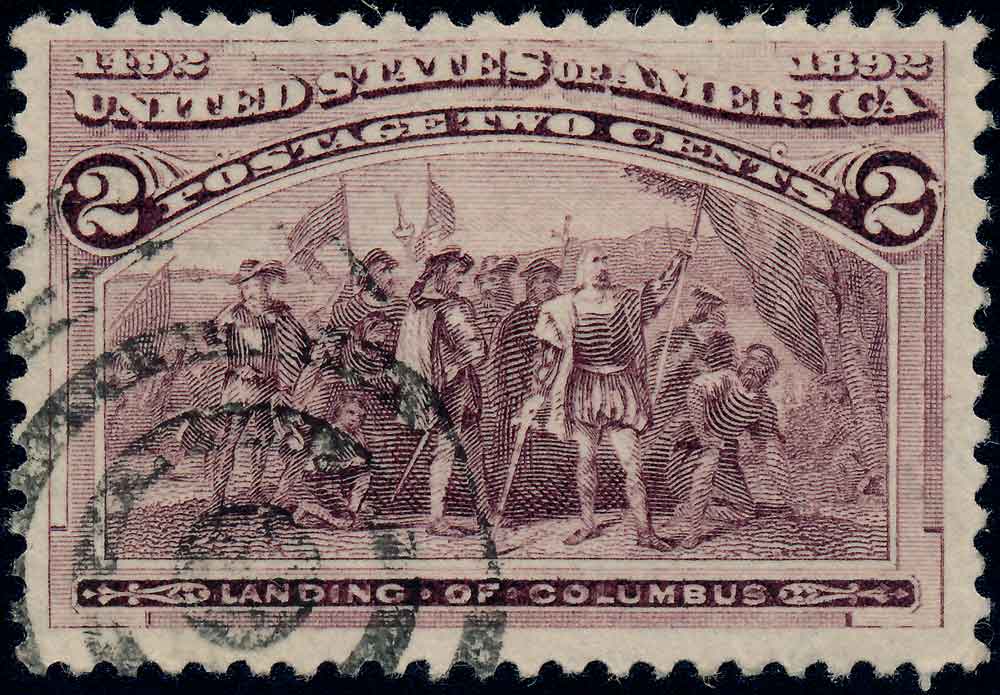 |
|
Send note to Staff
|
|
|
|
|
Pillar Of The Community
United States
937 Posts |
|
|
It appears to be the "Broken Hat" variety which exists in my 2006 Scott Specialized Catalogue. Here's an earlier SCF thread discussing it: https://goscf.com/t/11735However, it seems that you are seeking for an answer that includes more than the "broken hat". I also see many potential areas of frame line breakage, but I haven't read nor studied much about this particular issue. As an aside, the maximum image file size limit was increased to 200kB several months ago. EDIT: I also see many areas of extraneous color in "LANDING OF COLUMBUS" but again cannot extrapolate on their presence due to my lack of research into this issue. |
Send note to Staff 
|
Ryan = HDNAC = DNA = HDC = Hysterical DNA Collector = Historical DNA Collector = me who just loves stamps :) |
| Edited by Historical DNA Collector - 09/11/2015 11:51 pm |
|
|
Pillar Of The Community
United States
1414 Posts |
|
|
Historical DNA Collector, Thank you for the updated image size information. The larger scan below may help clarify. You are correct that the stamp is a broken hat variety variety. Clark 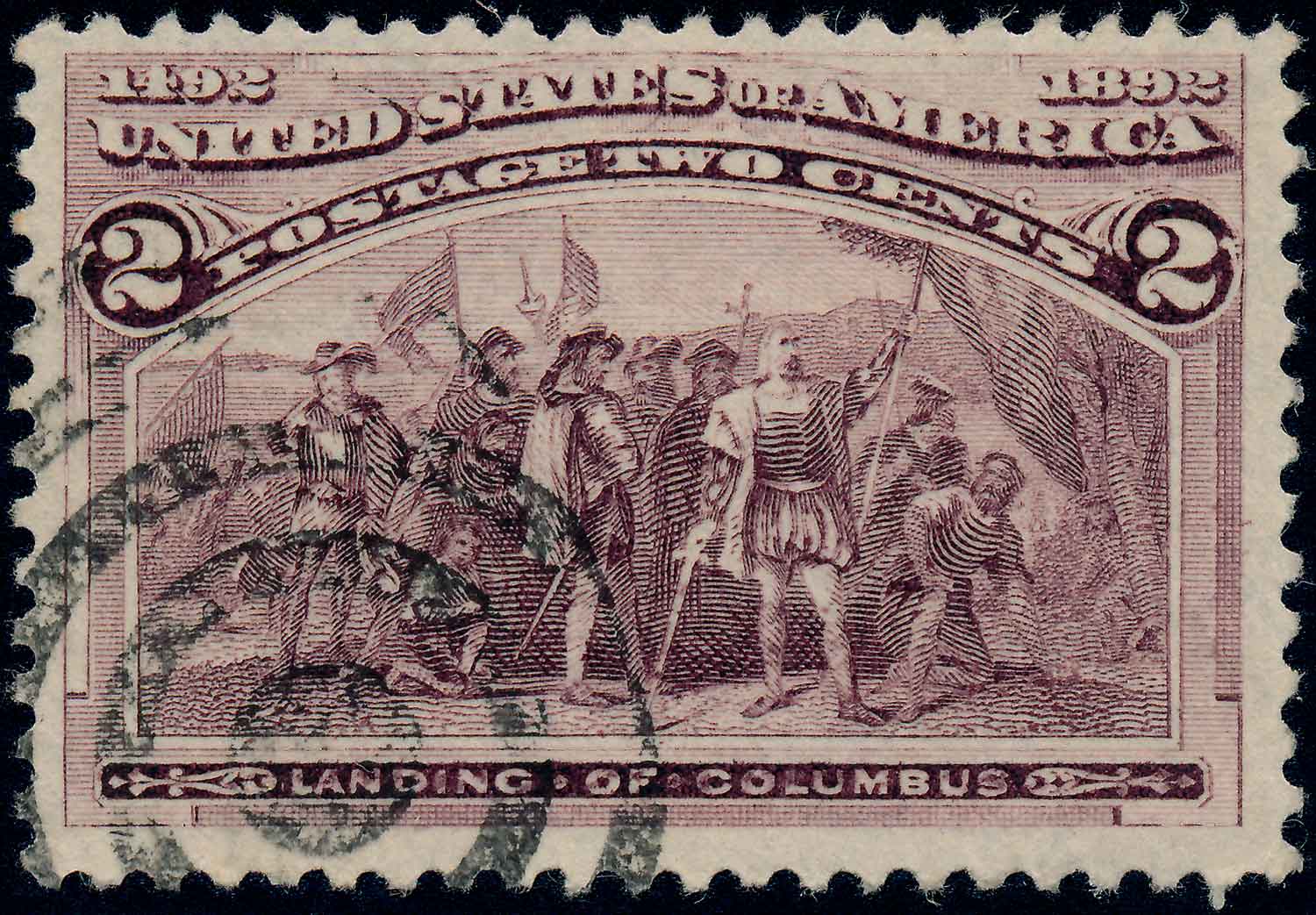 |
|
Send note to Staff
|
| Edited by cfrphoto - 09/11/2015 11:57 pm |
|
|
Pillar Of The Community
United States
937 Posts |
|
|
There are some minor vertical lines impinging into the bottom of "UNITED STATES OF AMERICA". There are also some extremely minor noticeable lines impinging into "2 POSTAGE TWO CENTS 2".
Both of them could be a type of "double transfer" but I just don't know definitively if they are significant or not compared to the "normal" issued stamp. I'll stop here and wait for more knowledgeable persons to imbue a better understanding.
Despite my lack of understanding of what you are trying to highlight, you have certainly elicited my curiosity. I thank you for the challenge.
Ryan |
|
Send note to Staff
|
Ryan = HDNAC = DNA = HDC = Hysterical DNA Collector = Historical DNA Collector = me who just loves stamps :) |
|
|
Pillar Of The Community
United States
1414 Posts |
|
|
Ryan, I don't know how this particular stamp got my attention. I normally sell 2¢ Columbians in groups of 500 on ebay when I have time to collect and weigh them. I don't normally check for varieties because it wouldn't be fair to the buyers. This stamp may have been set aside by some one in a group of broken hats. In any case, when I do have time to check, I always start with the right frame line because of the way the stamp designs were entered on the plate. The Photoshop unsharp filter may have emphasized the lines projecting in to the lettering, but the line extensions are there. I checked a few "clean" copies with a 15 power loupe and didn't see anything projecting into the lettering except for maybe two of about twenty examples. The ones with ink impinging into the lettering had a few other inking anomalies, particularly in the grid by the right frame line. However, check the right frame lines of the design and vignette and compare with other examples. I recommend at least a ten power high quality magnifier like the Peak loupe used by expertizers. Another hint is to think about how a menu is constructed at an Asian restaurant. Clark |
|
Send note to Staff
|
| Edited by cfrphoto - 09/12/2015 01:07 am |
|
|
Pillar Of The Community
United States
1946 Posts |
|
|
Since I don't own proof material for this stamp (and don't collect them) I compared your image to the one in Brookman, vol 3. The impression is a light one, with many fine lines printing faintly or not at all, such as the gradient crosshatching along the left frameline which tails off much sooner than as designed, and the many broken sading lines around the top banner "UNITED STATES OF AMERICA." But because this is due to inking I do not think these are the features you are calling to our attention.
However, I am seeing a lot of extraneous color in the lettering and decorations of the bottom panel, and something like smearing in the fine horizontal lines just above that. This too could be an artifact of irregular wiping, but I do not know how to account for it otherwise. |
|
Send note to Staff
|
|
|
Bedrock Of The Community
United States
10851 Posts |
|
|
This stamp has a myriad of plate varieties, there was even a pamphlet produced on them years ago. Most are fairly small. There are also a few major double transfers that jump out and smack one in the eye, usually affecting the left side, at least on the examples I have seen. |
|
Send note to Staff
|
|
|
Pillar Of The Community
United States
628 Posts |
|
|
that broken hat variety is way more common than it sometimes seems I find them all the time, sometimes on ebay you will see a very few then other times 100's seem to appear. |
|
Send note to Staff
|
|
|
Pillar Of The Community
United States
565 Posts |
|
|
Valued Member
72 Posts |
|
|
I've never really paid a whole lot of attention to this stamp before, apart from checking for the broken hat on the ones that come my way, but I see that Scott lists a "recut frame line" variety, as well as double, triple, and quadruple transfers.
Looking at this stamp, it appears as though the light horizontal lines at the top right extend beyond the dark vertical outer frame line. In addition, other parts of the frame line look like they might have been recut - particularly the bottom line on both the left and right sides of the horizontal grid. This makes me want to say "recut frame line".
However, the right outer frame line is doubled at the bottom, and the inner and outer frame lines around the vignette appear also to be doubled at the bottom right, in addition to the right-side of the frame line around the "LANDING OF COLUMBUS" banner.
So, I would guess that this is a combo-variety - recut frame line, in addition to double transfer. |
|
Send note to Staff
|
| Edited by Moon - 09/12/2015 4:06 pm |
|
|
Pillar Of The Community
United States
1414 Posts |
|
|
Moon, Good observations. The right frame line and vignette border are doubled. While the broken hat is a die variety, the double transfer is a plate variety. The lines extending into the lettering above the vignette suggest that the die was reentered at least once to correct a problem with the vertical position of the design. The broken frame line referred to in Scott would be the vertical piece of the frame line in the lower right corner. It is not broken or recut on this stamp. As far as I know the broken hat and broken frame line variety occurred on different dies. The recut would be a plate variety intended to fix the effects of the broken frame line on the die. However the horizontal frame line at the lower right corner appears to have some breaks. I don't know if this is a die variety or not. Perhaps there is an expert on this stamp in the house who can add more insight. Clark 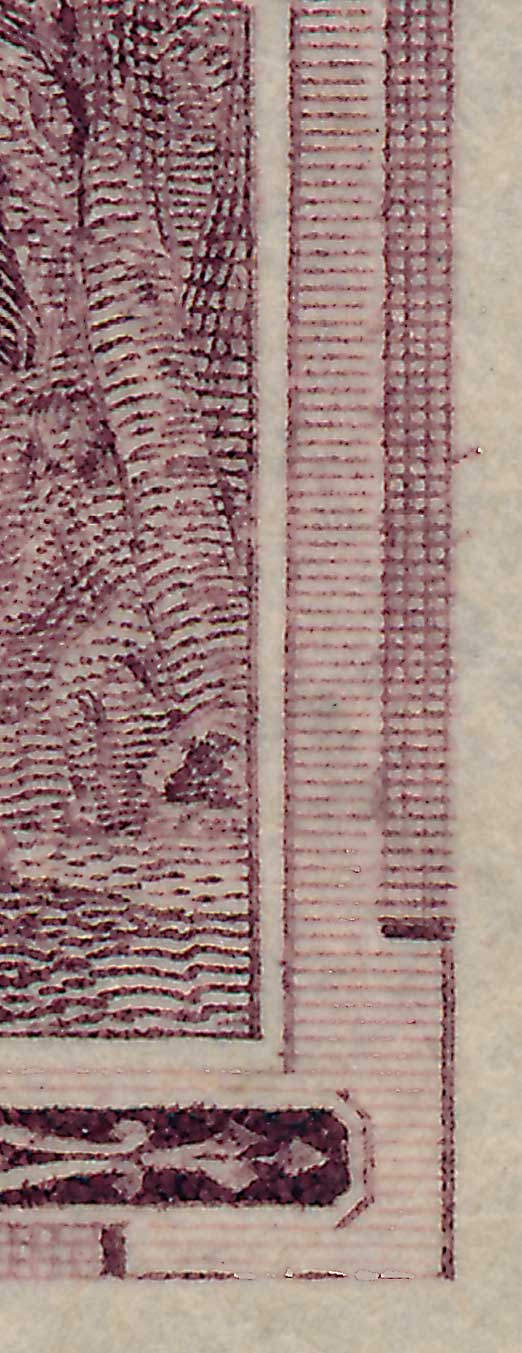 |
|
Send note to Staff
|
| Edited by cfrphoto - 09/12/2015 7:38 pm |
|
|
Valued Member
72 Posts |
|
|
I took a closer look at what I have, and I found these two stamps. I apologize for the quality of the image, but I don't have a scanner, so I had to take a picture with my phone. Keep in mind that these were pulled from a sample of ~50, so it's unlikely that I have a rare variety here. In any event, presumably at least the top stamp (if not both) is of the broken frame line variety, based on the image in Brookman vol. 3. However, while it's difficult to see in the image, under a loupe, the dark (half-height) right-side outer frame line on the top stamp is doubled, as are both vignette frame lines at the bottom right, just like on Clark's stamp (except that the outer frame line on mine is only half-height). On the bottom stamp, the outer frame line is complete, and there's a dark half-height frame line that is noticeably shifted to the left of the lighter frame line. The vignette frames do not appear to be doubled on this one. I'm not sure what to make of this - the darker half-height line diverging from a complete lighter frame line on the bottom stamp makes it look like a recutting variety. However, the top stamp has a darker half-height frame line of exactly the same height (you can see that it ends at the same horizontal line), which also happens to be doubled, along with the vignette frame lines. 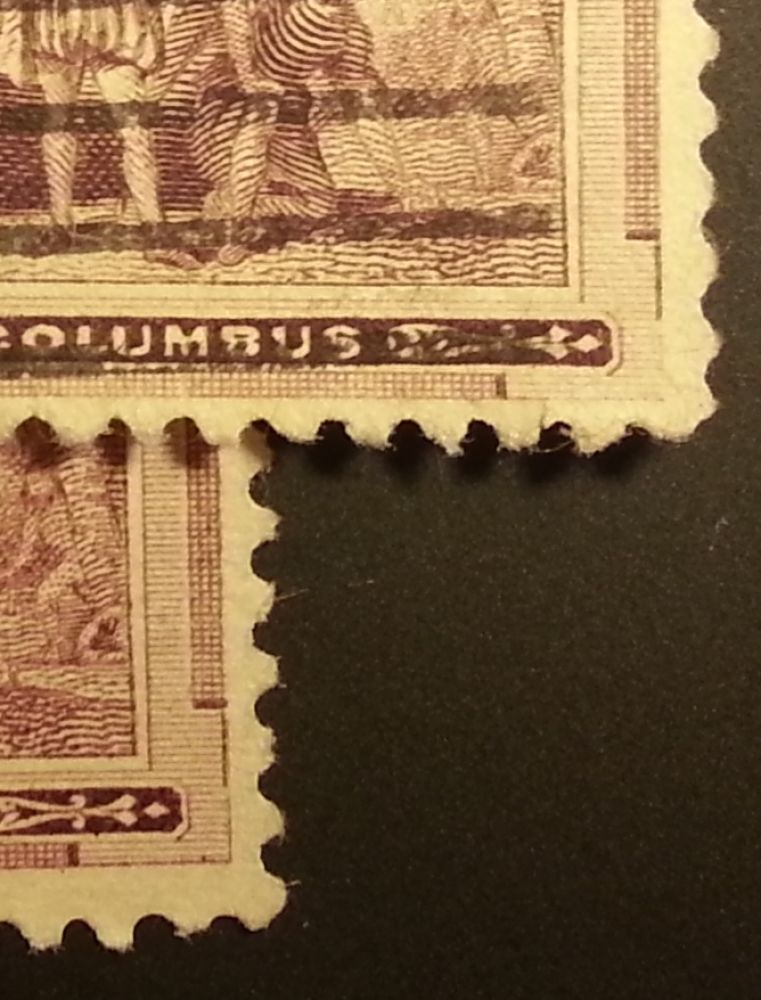 |
|
Send note to Staff
|
|
|
Pillar Of The Community
United States
1946 Posts |
|
|
I have to leave shortly but will be back later to help with this, but I have time for one corrective now. Quote:
While the broken hat is a die variety, the double transfer is a plate variety.
As far as I know the broken hat and broken frame line variety occurred on different dies. If we stick with the established philatelic lexicon, then these statements are not correct. They fail to properly differentiate the "tools" of the stages in the creation of an intaglio image. Only one "die" was ever produced for the 2c Columbian. The differences you are discussing are differences in the various transfer roll reliefs as they deteriorated over time. These created the cliches (entries) on the plates, and were the greatest source of notable engraving differences. I am aware that what philatelists have long called a "transfer roll" is often called a transfer "die" by paper money collectors. I am also aware that parts of the printing industry call it a "die cylinder" or "cylindrical die" to this day. However, I would submit that an 11th hour revision of the literature in philately is too much of a disconnect from a large body of learning, and would contend that the earlier language offers less referential confusion. For example, in his discussion of the "broken hat" variety, Brookman introduces a couple of comparative pictures with the overhead caption, "Damaged Relief on Transfer Roll." This language differentiates the central device for plate making (the transfer roll) from the primary device for design creation (the die block). Quote:
The recut would be a plate variety intended to fix the effects of the broken frame line on the die. Again, no. Since frameline breaks were not due to cutting problems on the die, but resulted from fractures in the reliefs on a transfer roll, any attempts at the "repair" of an entry would have been done on the plate before it was hardened. If this needs more clarification from me, I will be back later. |
|
Send note to Staff
|
| Edited by essayk - 09/13/2015 09:46 am |
|
|
Pillar Of The Community
United States
1414 Posts |
|
|
You are correct. They are transfer roller relief breaks. To many late nights. I would note that I have seen the broken frame line variety on a plate proof.
Clark |
|
Send note to Staff
|
| Edited by cfrphoto - 09/13/2015 10:35 am |
|
|
Pillar Of The Community
6363 Posts |
|
|
Have you seen Thomas Corette's 12 page article "The 2-Cent Columbian Broken Hat: Accidental or Deliberate?" in the 1992 American Philatelic Congress book? It discusses the variety of broken hats and frame lines. |
|
Send note to Staff
|
|
| |
Replies: 14 / Views: 3,118 |
|




 Posted 09/11/2015 11:22 pm


