Identifying grills can be tricky. Here I'm going to demonstrate a method of analysis to assist in identification and also help determine the likelihood that a grill is genuine.
To do so, you're going to need: - An image manipulation program that utilizes layers such as Photoshop or GIMP. PaintDotNET works on Windows, is free, and can be found here:
- A basic knowledge of working with layers and scaling
- An image of an grid with alpha (transparency). Here's a red and a blue one:
How to get the best results: - Scan your stamp at 1200 dpi or higher. Poor quality scans can lead to inaccurate conclusions.
- Highlight the points with graphite. Doing this is not always recommended.
- Rotating the stamp on the scanner by 45 or 90 degrees may show the points better.
- Make a backup of your scan before you begin in case things turn pear shaped.
Okay, so now what? - Place the grid in a layer above your scan.
- Align one row or column with the grill by rotating the grid.
- Scale the grid along the width, the height, or both to match all of the points. Don't worry if the points on the outer edges don't line up.
- Crop the image to just the grill.
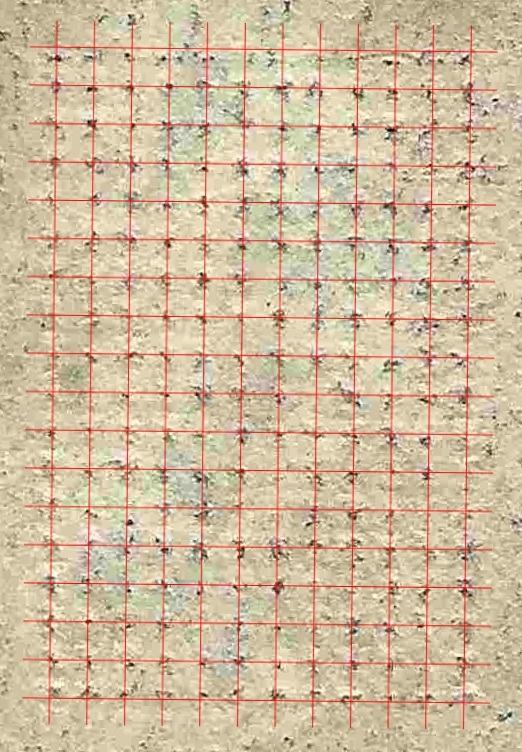
You should now have something like this:
 So what are the general qualities of a genuine grill?
 - Consists of four sided pyramid shapes with tips. Some H and I grills will have a round or square top instead of a point
- Overall it will be aligned with stamp design
- rows and columns are straight and cross at 90 degree angles to each other
- The spacing between rows and columns are consistent
- Matches the point counts listed here: http://www.stampsmarter.com/1847usa/Grills.htm
- May have "Partial rows". (Explained below)
- The overall size of a grill doesn't matter much unless it is much different than listed in the site above.
From our superimposed image we see that it has well aligned and spaced rows and columns. Overall it looks genuine. However it has 12 x 18 points which doesn't match a known grill type. This is where partial rows are significant. Let's take another look at the superimposed image.
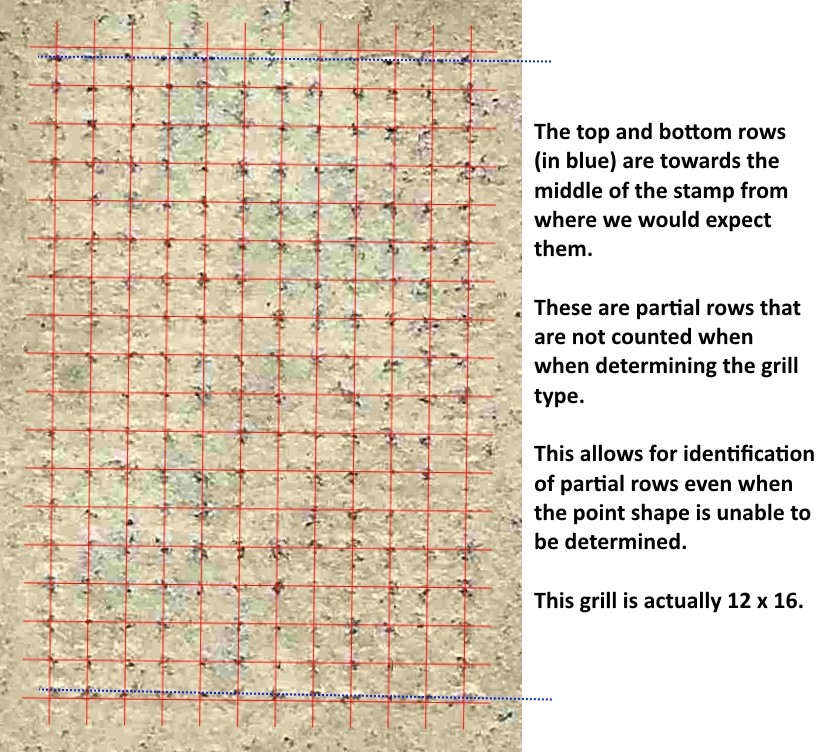
Partial rows are the result of machining a grill roller to a smaller point count. When entire rows or columns of points were not removed, the remaining portion of the pyramid will manifest as points that have shifted towards the middle of the grill.
Going to this level of analysis is pretty much only needed for high value stamps or when a better scan isn't available. However once practiced it is quite quick, easy, and very informative.





 Posted 10/14/2015 5:45 pm


