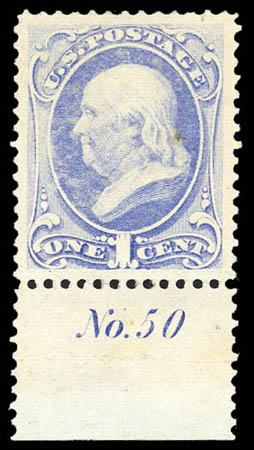
Well I think that everyone that intends to weigh in has done so. Now comes what might be the most controversial part.
Not too many were willing to risk trying their skills as a grader, but of the 22 voters who did, most put it in the middle range of 70-90. That is only slightly skewed toward the top from the kind of Gaussian distribution one might see in a random set of responses. All that says to me is that most of us are not comfortable grading material. Perhaps we are better at responding to the opinions of the professional graders.
So let me tell you how PSE graded this stamp. I have not seen the certificate, nor the actual stamp, but PSE gave this stamp one of the few perfect 100s they have given to any of the Bank Note Issues.
Only one in our survey rated it like that, which says that most of us would not agree. Recognizing that the available scan may not have captured all the charm of the original, or may have exaggerated distracting features, what would you want to point out to PSE about this stamp that you may think they overlooked?
Since a perfect grading score usually translates into a significant price/value increase (as a condition rarity) how many multiples of catalog value would you be willing to pay to have this stamp?
Here is the auction catalog description:
Quote:
1870, 1¢ ultramarine (Scott 145), bottom plate number single, expertly regummed, incredibly well centered example, rarely seen in a quality like this; slight "dry print" caused by the printing process, light crease in selvage, inclusion (mentioned only for perfect accuracy, these are all trivial and do not detract), Superb Gem, with 2012 P.S.E. certificate graded Gem 100J.
SMQ Gem 100J; $630 as no gum 95.
Estimate $1,000 - 1,500
Current start bid is $500.
For those who want to follow it, the stamp will sell as lot 1097 in the Kelleher sale scheduled in about a week.
What do you think? Were they consistent with their own standard or did they bend the rules a bit?





 Posted 11/28/2015 3:59 pm