| Author |
 Replies: 69 / Views: 13,128 Replies: 69 / Views: 13,128 |
|
|
|
Valued Member
22 Posts |
|
|
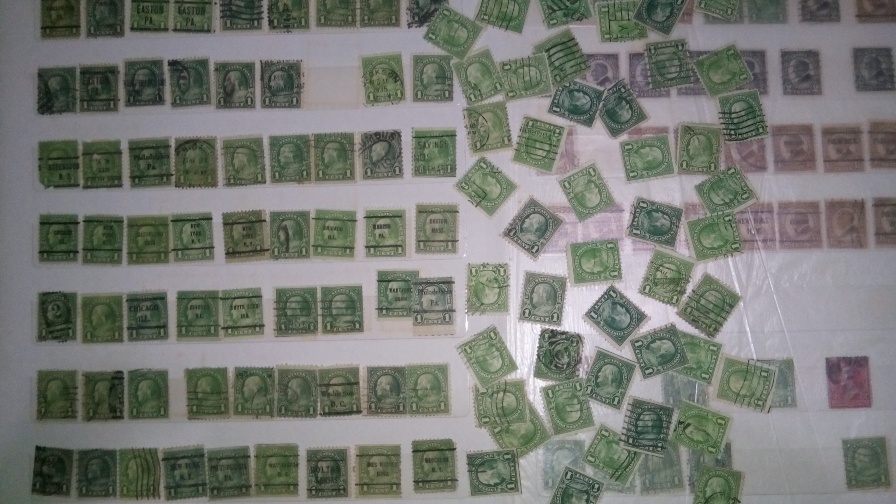
The precancel stamp is a rotary press printing ....the 596 is made from sheet waste
the rotary press stamp is longer than the 596 it is 23 mm long and the 596 is only 22.5 mm
a flat plate printing is 22mm long and my stamp is 22.5 it is too long to be a flat plate printing
and you can clearly see that in the photo
|
Send note to Staff 
|
|
|
Pillar Of The Community
United States
6668 Posts |
|
|
Quote:
The precancel stamp is a rotary press printing ....the 596 is made from sheet waste But the 596 is still a rotary press print. |
|
Send note to Staff
|
| Edited by stallzer - 02/14/2016 12:35 pm |
|
|
Pillar Of The Community
6366 Posts |
|
|
Shelly, As stallzer requested and 51studebaker echoed, please post a hi-resolution scan on the back of the stamp. While you may think their request is useless - there is often more to be learned from the back of a stamp than the front. Try it and see. |
|
Send note to Staff
|
|
|
Valued Member
22 Posts |
|
|
Valued Member
22 Posts |
|
|
As far as I thought the flat plate stamps were 22mm high, rotary press were 23 mm high and the 596 was 22.5 mm I understand the photo I have attached is not very professional looking but it gives you an idea my candidate stamp is longer than the flat plate and not as long as the rotary press so if its not a flat or rotary press and its not a 596 then what is it 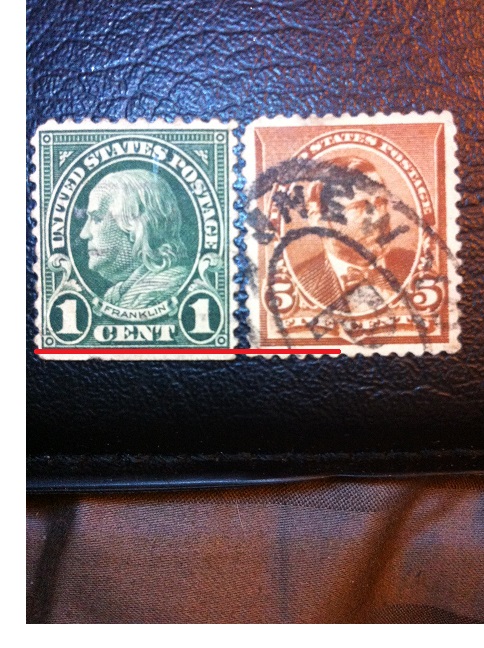 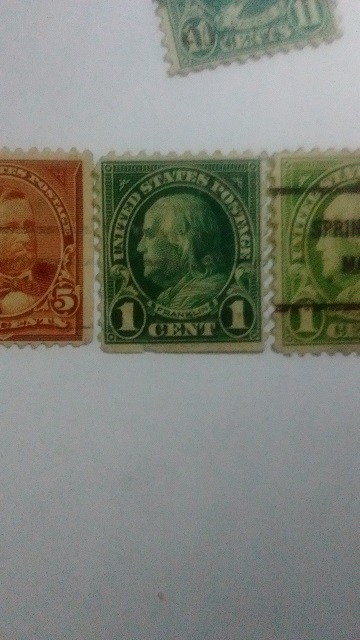 |
|
Send note to Staff
|
|
|
Pillar Of The Community
United States
845 Posts |
|
|
The stamp is a flat plate 552. Posting a scan of the back would probably help you learn why. You can't rely on the Scott catalog measurements for an ID. Instead create a template from a known flat plate stamp (your 552 is a good candidate) and use that to ID rotary stamps. The reply linked below shows you how to create a template and the two stamps look very similar to your flat plate and rotary (the Springfield Mass precancel) you showed in your first post. So you sort of got it right in the first post, your conclusion is wrong though: the reason your candidate stamp is not the same size as the rotary precancel is because its flat plate. https://goscf.com/t/43052#368883 |
|
Send note to Staff
|
|
|
Pillar Of The Community
United States
1414 Posts |
|
|
Enough of this. The original poster is totally clueless or a deliberate troll. At a minimum careful reading of responsive posts is needed before tilting at another windmill. In a previous post the side-by-side image of the 552 and the 596 shows convincing proof that the 552 is not a 596. If the perforation spacing is matched to that of the 596, the stamp will be shorter as any flat plate stamp would be. The poster seems confused about the following issues: 1. Rotary press stamps 581 and 632 are exactly the same height. Scott 596 was made from sheet waste produced when printing the perf 10 Scott 581. The height of 581, 632 and 596 will be the same. The rotary coil 606 would be very slightly taller because the press for vertical coils had a smaller cylinder. 2. Comparing the 552 to the 5 cent Scott 223 was a bad choice. Flat plate stamps exist in two sizes depending on the direction of the paper grain. (Stamps shrink across the grain when drying immediately after printing.) This is why booklet pane singles are slightly wider and shorter than normal sheet stamps. (Higher denomination flat plate stamps were printed on "special paper" originally intended for flat plate booklet panes when production switched to the rotary press.) Higher denominations of small bank note, first and second Bureau issues were printed on 200 subject plates with the result that the paper had horizontal grain. It is easy enough to identify horizontal First and Second Bureau as well as a few Washington/Franklin stamps by the vertical (sideways) watermark instead of the normal horizontal watermark where the letters are aligned with the design. Please read this and my previous post carefully. It may be necessary to ask others about some of the details or join the United States Stamp Society and pay your dues like the rest of us. The attached file shows the effect of paper grain on flat plate stamps. The "coil" that is too short and too wide is trimmed from a booklet pane single. Clark 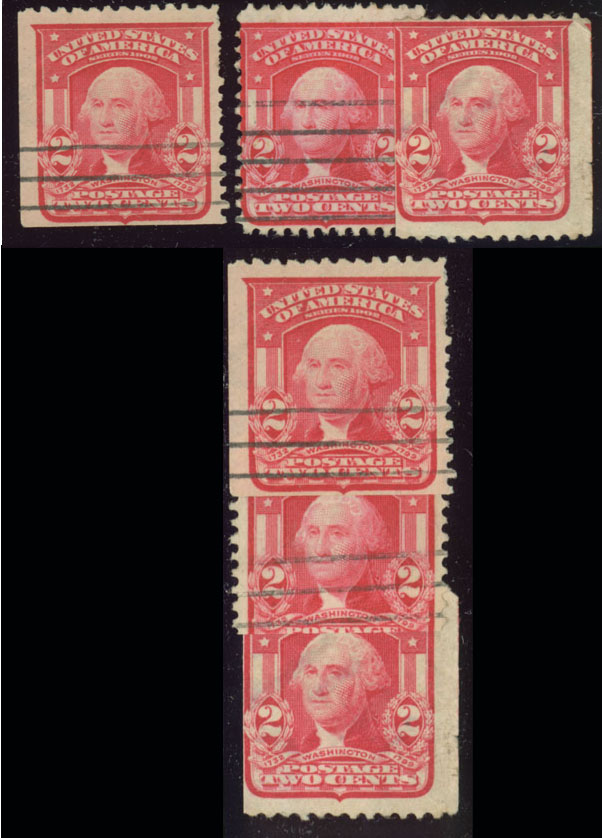 |
|
Send note to Staff
|
| Edited by cfrphoto - 02/15/2016 12:53 am |
|
|
Valued Member
22 Posts |
|
|
I put my candidate stamp between a flat plate and a rotary printing and my stamp is longer than the flat plate i thought flat plate printings were supposed to be 22mm at the most isnt 22 3/4 too long to be a flat plate printing I am not trying to be difficult im just trying to figure out why the scott cat rexplanation is different so who should I go with ...ya know what I mean 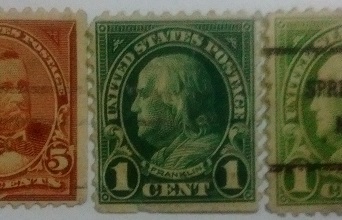 |
|
Send note to Staff
|
|
|
Pillar Of The Community
United States
6668 Posts |
|
|
Quote:
I am not trying to be difficult im just trying to figure out why the scott cat rexplanation is different so who should I go with *Facepalm* You have been asked numerous times to show a scan of the back of the stamp. By doing this we can SHOW YOU that your stamp is a flat plate print. You ignore the excellent information provided in the responses from members with an incredible amount of information that have studied these things for years. It's not a 596 and sadly I think you will never believe us or send it in for certification but instead we'll see it on ebay listed as a fraudulent 596. |
|
Send note to Staff
|
|
|
Moderator

United States
12330 Posts |
|
|
The dimensions in Scott are estimates AT BEST (I wish they would remove them). Then add in the fact that hobbyists do not have the equipment, or skill, to measure a stamp design properly. Digital calipers don't help.
Clark and others showed you how to make this determination by teaching you about the manufacturing process of the stamps. <- This is what you need, stop trying to measure the stamp and work on understanding what is being offered to you. Lastly, ALWAYS work from the perspective that you do NOT have a rare stamp. If you always think you have one of the most common stamps, your understanding will not be influenced by greed.
Don
|
|
Send note to Staff
|
|
|
Moderator

United States
5109 Posts |
|
|
I think we just need that Back-Scan which has been asked multiple times. The OP seems to have plenty of time to show Front-Scan analysis, but no time to show one scan of the back. Interesting ... |
|
Send note to Staff
|
|
|
Pillar Of The Community
571 Posts |
|
|
Hello everyone. I am reading how you all respond to this topic in the forum..please take a deep breath, relax. Shelly should feel welcomed as a new person who interested in learning.
It may be frustrating for the experience posters, but none of you were born an expert.Please lighten up and be more positive!
It would be wonderful news for Shelly or others to come across a 596 with a finding. I would hope the best for her and not be discourage with certain responses...Remember may be someone will surprise all of you one day and show in the forum of ownership of that specific stamp.
Shelly..keep your spirits up!
Sincerely,
Blazenstar
i |
|
Send note to Staff
|
|
|
Pillar Of The Community
United States
2948 Posts |
|
|
As new/inexperienced collectors, we tend to approach stamps like this backwards. What I mean is, we try to prove it's a a rare stamp, when we should be first, trying to disprove it's a common stamp. We should begin with examining the simplest clues of the most common version of the stamp in question. In the case of this stamp, we start at... it's common flat plate 552. The simplest clue, offset ink on the back. If none, then you proceed maybe to print quality, then maybe color/shade and then to measurement etc etc etc. Until we have enough evidence that eliminates the possibility of it being a 552. It can be a difficult discipline. I haven't mastered it yet, ie my recent Scott #83 thread.  |
|
Send note to Staff
|
| Edited by stampcrow - 02/15/2016 4:53 pm |
|
|
Valued Member
35 Posts |
|
|
Pillar Of The Community
1849 Posts |
|
|
Replies: 69 / Views: 13,128 |
|




 Posted 02/14/2016 02:09 am