The standard reference for censorship of civilian mails by the US during WW One is edited by Theo. van Dam,
The Postal History of the AEF, 1917-1923 published by the War Cover Club in 1990 (A revised edition is in the works). A small part of Chapter 10 deals with the civilian censorship.
The Censorship Board allocated censorship (examiner) numbers to the various stations. Here is the list published there.
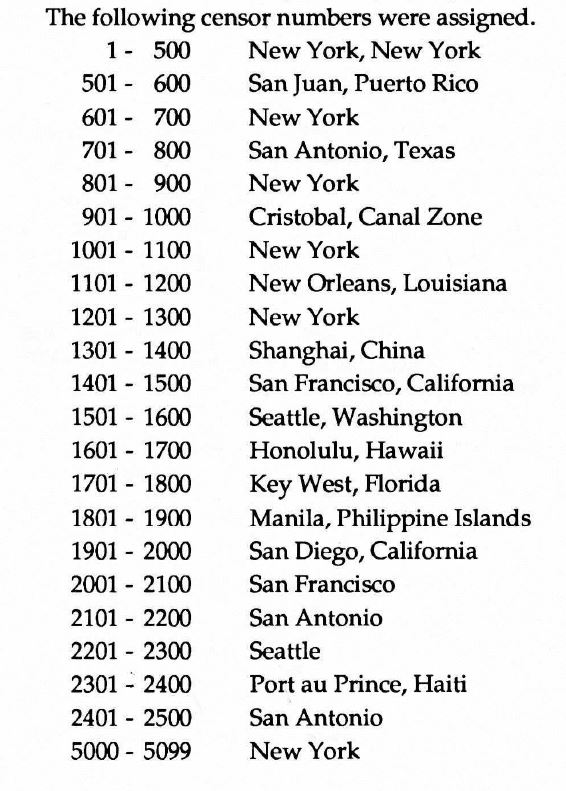 Not all of these numbers were actually assigned, especially at the smaller censorship stations.
As can be seen, examiner numbers in the 1601-1700 range were assigned to Honolulu, HI, which makes even less sense than Canada or Great Britain.
The only labels used by the US censorship office with the examiner number actually printed on the label were those used at Cristobal, CZ. At all other offices, a distinctive hand-stamp with the examiner number was issued to each examiner, and these were tightly controlled (The censorship supervisor took them all up each evening and returned them to the examiners the following morning.)
For the most part, each office had a hand stamp design which was unique and distinctive from all other offices. The exception was that a few offices used simply 3 or 4 digit numeral stamps for a while.
As
Jenny2U pointed out, names of examiners was a closely held secret, and censors were also admonished not to reveal their job or procedures followed or anything that they did. The lists of names associated with examiner numbers which I have seen were in reports of examiner testing and the results, and lists of which examinesr were skilled in which languages.
Several of the instructional circulars and orders I've seen discuss the dismissal of examiners who "talked too much".
The Censorship board compiled lists of businesses, individuals, and publications that were to be singled out for censorship. Many publications, particularly from Mexico were on these lists. These were maintained in card files, I gather of the 3x5 card type. From what I have read, there were clerks who pre-processed the mail looking for these names, and those letters then passed to the examiners. If an examiner had questions, the letters were passed up to a supervisor.
My primary interest are those items censored at the station at San Antonio, Texas, and the other sub-stations along the US[Texas, Arizona,California] border with Mexico, all under the control of the San Antonio office.
I also have a small collection of letters examined at most of the other US censorship offices. If these is some interest in these markings, I can start a new thread and post some examples of them.
Mike





 Posted 04/02/2016 7:10 pm


