| Author |
 Replies: 11 / Views: 2,870 Replies: 11 / Views: 2,870 |
|
|
Valued Member
United States
54 Posts |
|
|
|
Hi, I am new to the W/F series and have a collection that I am now going through authenticating. I have been through a lot of the sites and also have a copy of the The Experts Book. One of the main indicators is height or width of the stamp - e.g., 25mm +/-.3mm, or 21.5mm +/-.3mm. My question is if a coil is outside of those bounds, say 24mm or even 24.5mm (or 20.5mm/21mm) is there any point to looking at the edges, perforations, etc? None of the references I have found say that is enough to prove it a fake but my assumption that if it is outside the range there is almost no possibility of it being authentic. Would love to know other's opinions.
Thanks!
|
|
Send note to Staff
|
|
|
|
|
Pillar Of The Community
United Kingdom
8622 Posts |
|
|
Pillar Of The Community
United States
8956 Posts |
|
|
Besides going to the website GeoffHa gave you, a scan would help a lot!
Peter |
Send note to Staff 
|
|
|
Pillar Of The Community

United States
1273 Posts |
|
|
There are numerous articles regarding W/F coil identification and their production process that are very helpful in assisting you in identification on the United States Stamp Society data base for past and current issues of their published journals. http://usstamps.orgThere is a nominal fee of $25 to join that's well worth doing to access a lot of useful information. W/F coils, especially the early perf. 12s are fraught with forgeries. |
|
Send note to Staff
|
|
|
Valued Member
United States
54 Posts |
|
|
Thanks for the info. Actually, my question was not about a specific stamp and I do have a lot of the reference material. it was more a question of the authentication process others go through. One can look at perfs, edges, etc., as well as the coil height or width. I am just wondering if the height or width is off my more than half a mm or so does the stamp warrant any further investigation - e.g. ,does it even make sense to look at the other attribute and simply discard the stamp. Or do others look at the other attributes as well and is there enough possibility of finding enough evidence at that point to conclude the stamp genuine?
Tjamls |
|
Send note to Staff
|
|
|
Pillar Of The Community
United States
8956 Posts |
|
|
You ought to use the search function here and read some of the previous posts on the subject. I have read some of these and remember that the size of the coil is very important because the roll of stamps has to fit in the machine that applies the stamps. It seems to me that a stamp that is a bit outside the measurements could cause quite some problems.
Peter |
|
Send note to Staff
|
|
|
Valued Member
United States
54 Posts |
|
|
Thanks - I did search but had problems narrowing the results to something that was useful (most were specific examples). Your reply makes sense and seems to confirm my thinking - anything off on the width/height is almost certainly a fake regardless of the other attributes.
Thanks |
|
Send note to Staff
|
|
|
Pillar Of The Community
United States
8956 Posts |
|
|
Well, and since you can not post a scan, another clue would of course be the cut itself. If it is not perfectly straight you may have a problem also! And a good rule to remember is that there are a flood of fakes out there!
Peter |
|
Send note to Staff
|
|
|
Pillar Of The Community
United States
930 Posts |
|
|
The answer to your question is to determine what stamps exist that can be modified to fake a more expensive stamp. This is one of the very valuable aspects of the expert's book is it makes you look for what could have been used to fake the stamp. |
|
Send note to Staff
|
|
|
Valued Member
324 Posts |
|
|
Michael,
Welcome to the forum! I personally love the Wash-Franks (and have a fondness for the p12 flat coils...partly because I get suckered in by the challenge). I've looked a lot of sources, many of which are mentioned above.
Certainly the 25mm and 21.5mm sizes are ideal, but apparently there are a LOT of genuine coils that fail to reach that size. A general rule of thumb (based on sizes from certified examples and from very experienced people here--not myself) seems to be that 0.5mm deviation can still be considered a serious contender for authenticity. In fact, I remember at least one source stating that for some--like #354, #355--that the majority of real coils do NOT reach the ideal sizes. So, if it's <24.5mm or <21.0mm, the likelihood of being real (which, unless you can trace the history of the stamp, really means the likelihood of being authenticated by PSE, APEX, or PF) is really small (a possible exception would be a long strip or presence of a paste up joint, which would raise the likelihood of authenticity).
If it is a size of 24.5mm or 21.0mm for the respective coil types, I would consider checking edges/perfs/etc to be worthwhile. |
|
Send note to Staff
|
|
|
Valued Member
United States
54 Posts |
|
|
Thanks Lukusw. That really helps a lot, especially with the stamps that may vary. I will modify my approach especially on those scott numbers (and probably others as well). I do have a couple that I will scan and post once that are close once I do a more thorough investigation - of course I want to see how well I can do on my own first! |
|
Send note to Staff
|
|
|
Moderator

United States
12330 Posts |
|
|
The Washington/Franklin coils are often faked, some experts say that > 80% found online are bogus; having 'The Experts book' is a good start for learning what to look for. With the large amount of faked material floating around for decades, it is common to find collections full of these faked coils. One good thing to remember on Washington/Franklin coils; flat plate coils rarely (if ever) have perf holes which are parallel to each other while rotary press coil perf holes are parallel to each other. So when trying to identify these coils, look closely at the perf hole alignment (side-to-side or top-to-bottom). Here is a faked #385, note how perf holes are parallel to each other... 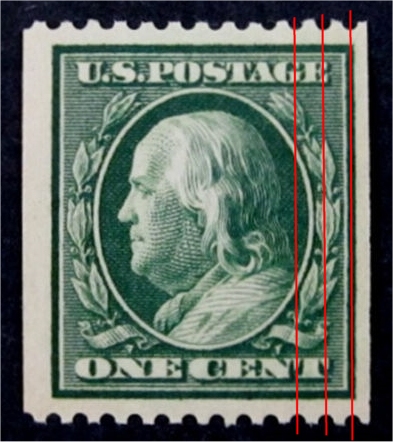 Additionally the cut edges of coil stamps should be parallel. Also keep in mind that the cut edges, originally done by sharp stripper blades, should be very clean and not have any rough edges. You might want to visit Stamp Smarter and use the filter option in the Listing Review section and study those listings identified as containing faked coils. Don APS #094826 |
|
Send note to Staff
|
|
| Edited by 51studebaker - 07/07/2016 04:10 am |
|
| |
Replies: 11 / Views: 2,870 |
|




 Posted 07/05/2016 10:46 am


