| Author |
 Replies: 15 / Views: 2,244 Replies: 15 / Views: 2,244 |
|
|
Valued Member
United States
40 Posts |
|
|
I've had this nice US #25 cover for many years. When I looked to see what they were going for on ebay I discovered that 25 is now 25 and 25A, apparently based on which plates were involved. Can someone help an old-timer out by telling me (a) when this split took place and (b) if it is necessary to do a complete plating to determine which is which. If (b) is true then It seems a little odd to me that when fewer kids are taking up stamp collecting, Scott would make things more difficult for beginners by forcing this level of detail on them just to know where to place a stamp in their album. Separating the 1-cent Franklins is about as far into flyspecking as most folks want to go. Is this a sign that casual stamp collecting is a thing of the past and has become a hobby just for the expert/postal historian? Or am I just being reactionary? 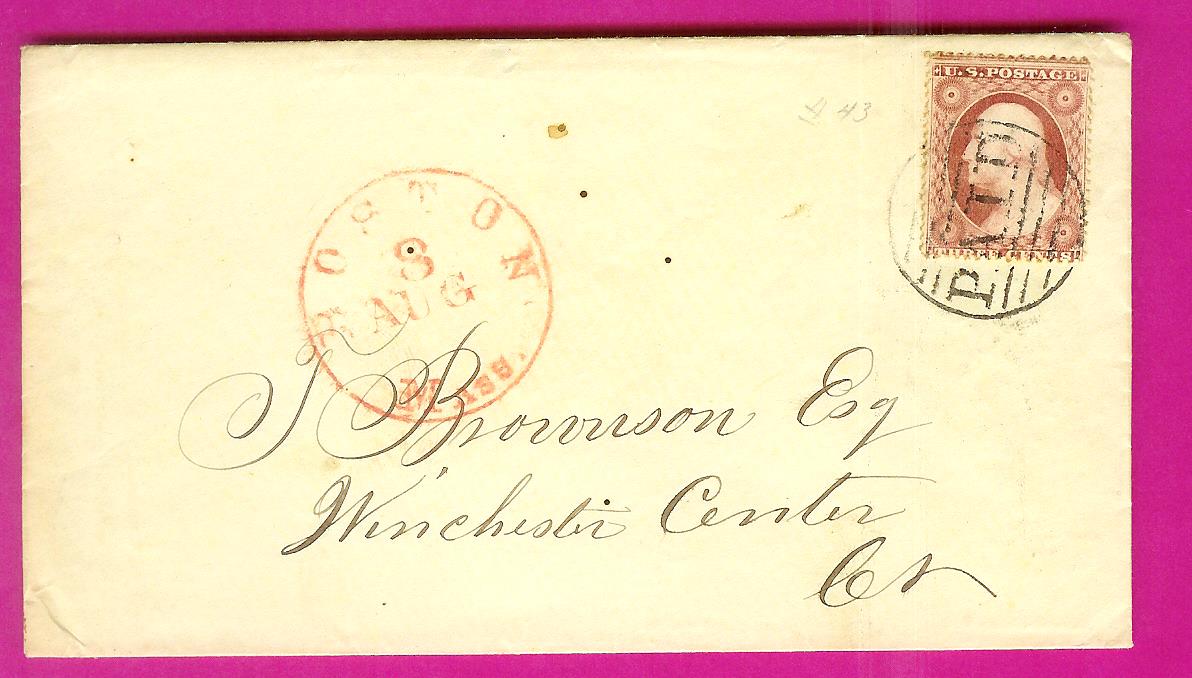 |
|
Send note to Staff
|
|
|
|
|
Pillar Of The Community

United States
1499 Posts |
|
|
From my reading of Scott, 25 is type I while 25A is type II. I think your stamp is type I. Type II appears to have an additional inner frame line while yours only has the outer frame line. Hopefully someone more knowledgeable will chime in to confirm or correct.
Added: Not only is it a very nice cover, but it is postmarked on my birthday! Of course, I don't think I was around when this item hit the mail stream.
Added: Suppose I should have mentioned that this is not type III (26) or type IV (26A) due to the presence of a frame line at top & bottom. |
Send note to Staff 
|
| Edited by JLLebbert - 08/18/2016 2:40 pm |
|
|
Moderator

United States
12330 Posts |
|
|
Pillar Of The Community
United States
939 Posts |
|
|
I was very down on "flyspeck" philately at first. Then I got caught up in the history it represents. It is a real pain to separate the Wash/franklin's, and I'm not great at it. But the represent a tremendous change in printing technology. Each of those changes is the post office trying something new. So there are all those perforations as they find the size that works best for coils. Or the changes in the size of the design as they change from flat plate to rotary.
This early US material is interesting as you can actually follow the printings and the plates wearing down and being fixed.
It would be nice if album makers made simple albums, with a place for each basic design and then albums for advance with all the variants too. |
|
Send note to Staff
|
|
|
Pillar Of The Community
United States
1360 Posts |
|
|
Hi Rephil, Funny I was in the same boat you were about four years ago but the 25 that I had in my album turned out to be the type II 25A and I didn't know about it. Pretty elusive stamp, but I have found another 2 or 3 on ebay which were not labeled as 25A. So they are out there.... The Type I stamps in my opinion, are overvalued because there's a lot of them out there. The Type IV, 26A is more difficult. Either way, welcome and good luck. Stick around here and you'll learn a lot about the stamps a lot of others where there are plenty of varieties...Ray |
|
Send note to Staff
|
|
|
Pillar Of The Community
United States
8956 Posts |
|
|
Rephil, nice cover and great stamp. If you could post a close up scan of the stamp by itself, someone might give you a hand in deciding which it is!
Peter |
|
Send note to Staff
|
|
|
Pillar Of The Community
United States
532 Posts |
|
|
Pillar Of The Community
United States
2555 Posts |
|
|
I can't remember exactly when the changes were made. I think it was around 10 years ago. It is quite easy to tell the Type I, Scott 25 from the Type II, Scott 25A. The Type I stamps have no inner lines and are from plates 4, 6, 7, and 8. The Type II stamps are from plates 2L, 3, and 5L and have inner lines. Some positions on Plate 5L have an inner line on only one side. Plating is not required for identification.
Food for thought: If the catalogue never changes, would you or any other collector or dealer need to buy a new one? |
|
Send note to Staff
|
| Edited by sinclair2010 - 08/18/2016 10:05 pm |
|
|
Pillar Of The Community
United States
2555 Posts |
|
|
Valued Member
United States
174 Posts |
|
|
Alub, I appreciate your reminding us of the historical context that these variations often reflect. I often get caught up in my own personal drama of struggling to identify a particular stamp and lose sight of the fact that this is all part of something much larger. |
|
Send note to Staff
|
|
|
Valued Member
United States
40 Posts |
|
|
Thanks guys. I think I misinterpreted what I saw on ebay to conclude that 25 and 25A were both type I. Given that this is wrong, I agree that this is 25. Sinclair2010 brings up a point that I was sort of suggesting, namely that there may be some politics and business considerations involved in Scott designations. Guess we can't fault them for that. I think my most recent Specialized is the 1982 edition so they aren't getting rich from me. Here is a closeup of the stamp as requested. 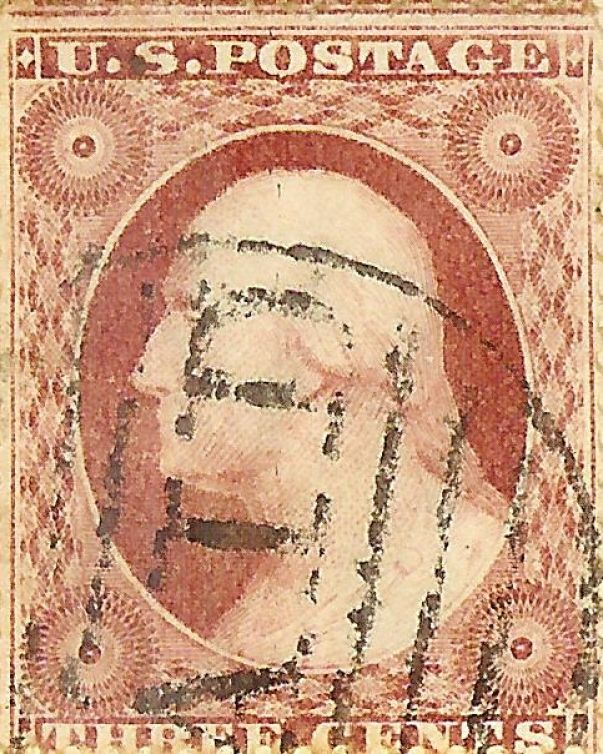 |
|
Send note to Staff
|
|
|
Valued Member
United States
80 Posts |
|
|
Just in case you wanted to know--though I can't tell you the position, I think it's safe to say that your stamp is from Plate 8. Note the huge gaps where the frame lines should connect in the corners, and the heavily recut bottom frame line on the impression above yours. |
|
Send note to Staff
|
|
|
Valued Member
United States
254 Posts |
|
|
A few months ago I was inspecting these stamps (a few that I have)...please kindly let me share what I found online at the time I evaluated my stamps (you may not need it, but maybe someone is looking for this info). * On July 1, 1851, the U.S. Post Office issued a 3-cent postage stamp. Because of die recuts, double transfers from die to plate and different paper used for its printing, this issue comes in numerous varieties. The authoritative book on the issue, 'Classic U.S. Stamps 1845–1869' was written by Carroll Chase, published in 1962. Engraving of image taken from a sculpture by Jean Antoine Houdon. The Post Office did not produce perforated versions of this stamp until 1857. * extremely informative article about this stamp: http://rosenstamps.com/the-3-cent-stamp-of-1851/Very few stamps, if any, have received as much study as the 3¢ issue of 1851. The first person to systematically study this stamp was Dr. Carroll Chase. The stamp became an important part of his life's work and legacy. His book about the stamp, The 3¢ Stamp of the United States 1851-1857 Issue issued in 1929, revised in 1942, then reprinted with a new forward in 1975 is still the standard in use today. Anyone wanting to study this stamp in depth must look to that book as this article offers only an overview of the issue. Much useful research has been done since then, but it has all been accomplished on the foundation laid by Dr. Chase. Read more: http://rosenstamps.com/the-3-cent-stamp-of-1851/*** 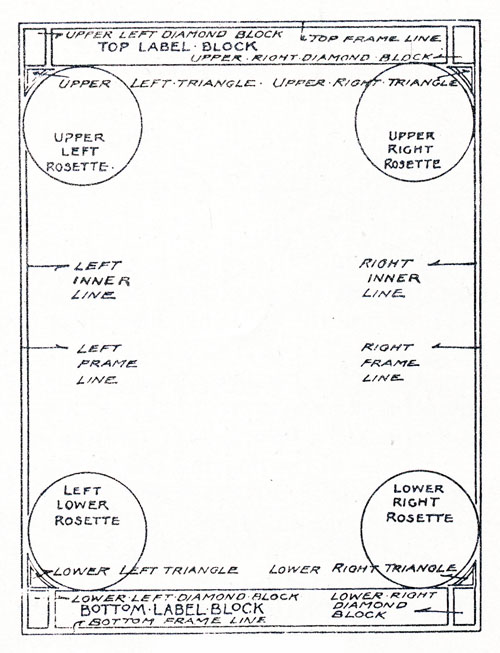 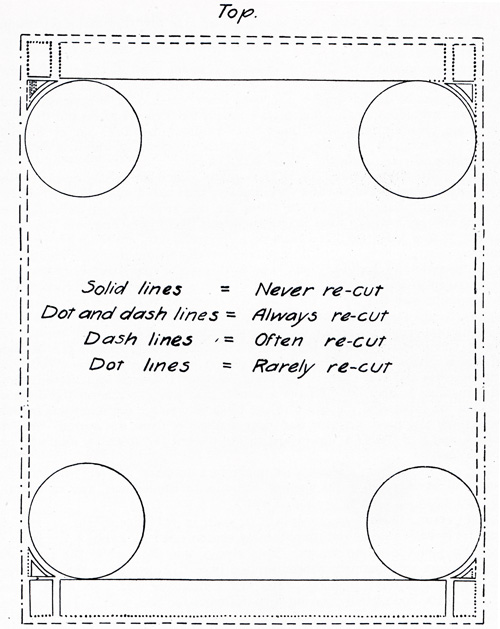 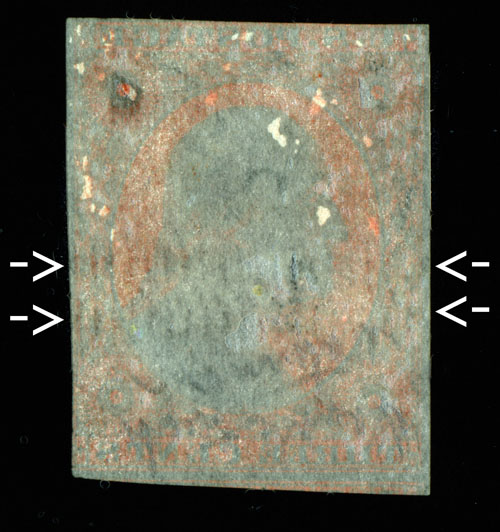 |
|
Send note to Staff
|
| Edited by Aurora - 08/22/2016 08:07 am |
|
|
Pillar Of The Community
United States
8956 Posts |
|
|
Aurora, very interesting and clear. Thank you. But what does the bottom scan show?
Peter |
|
Send note to Staff
|
|
|
Moderator
United States
12330 Posts |
|
|
Bedrock Of The Community
United States
10882 Posts |
|
|
Looks like a stitch watermark, from where the dandy rolls were stitched together. Part of the papermaking process rather then the stamp process.
|
|
Send note to Staff
|
|
| |
Replies: 15 / Views: 2,244 |
|




 Posted 08/18/2016 1:11 pm


