| Author |
 Replies: 20 / Views: 3,186 Replies: 20 / Views: 3,186 |
|
New Member
United States
2 Posts |
|
|
I have inherited my dad's stamp and coin collections, which he first started collecting as a kid of the 30's and 40's and kept collecting through most of his life. Having discussed them many times with him I am under no illusion that he had high numbers of valuable stamps, and have already confirmed I would be lucky to get 60% of face value as bulk postage for those from the last 75 years. This still leaves me with at least some thousands of stamps prior to that starting about 1900, the vast majority of which appear MNH. I have purchased a copy of the EZSTAMP program to attempt to catalog what he had, and have already come to appreciate some of the many fine details that collectors love about their stamps. Though I have learned to use a Perforation Tester and enough to be dangerous regarding the differences between the flat and rotary press printing processes, I am having difficulty with minute color variations (violet vs. bright violet, carmine vs. carmine lake)and other small differences between Scott Catalog varieties of the same stamp. As an example of the details that are giving me the most grief fairly cataloging the collection see the below scan of two Harrison 13 cent stamps. Do stamp collectors consider these differences insignificant variations of the same stamp? In other words should I catalog as two copies of Scott 694. Though the 1979 Leuchtturm album it is mounted in has the darker one with two stray green marks to the left of Harrison's head as blue green Scott 694b, neither the EZSTAMP program, my 1992 Scott Pocket Catalog, or my 2000 Lin World Stamp Almanac references a 694b. What about the small green line bottom left of the yellow green variety. Is this on the majority of stamps? Is there a more comprehensive updated catalog that I should purchase? How often have the various Scott sub classifications been added or deleted over time? As another item I am grading most of the stamps that look similar to these as MNH VF not yet comfortable enough with factors that might allow some to grade XF. Am I being conservative enough, or are stamps like these obviously less than VF? 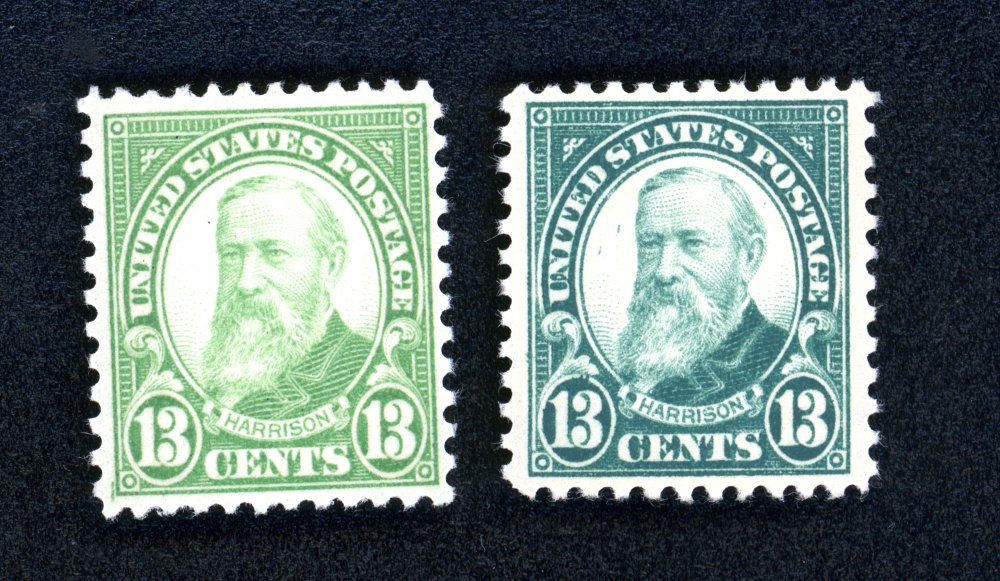 Thanks if you made it this far through my long first post. Any tips that you might have are much appreciated. I am certain the more I learn the more fun I will have during my cataloging process, and hopefully I will ultimately be able to pass the collection on to the next generation in better shape than I found it. |
|
Send note to Staff
|
| Edited by dbruess - 10/15/2016 1:37 pm |
|
|
|
|
Pillar Of The Community
United Kingdom
8636 Posts |
|
|
Pillar Of The Community
United States
1820 Posts |
|
|
Hello, dbruess and welcome to the Forum.
Color terminology can drive even veteran collectors crazy, so you are not alone. In the examples you show, my older Scott catalog has both listed as #694 (assuming they are rotary press), with the blue green version listed as a variety under the main yellow green heading. So these varieties are not insignificant (since they are both listed), but they are in fact the same Scott number unless the new Scott catalog has changed listings. The ink marks in the blue green example appear to be stray and random. Not sure about the line at LL of the other one, though. Guide mark? Specialists in these issues (of which I am not one) may know.
ETA: Regarding grading. This is a very subjective judgment, although the Scott catalog makes an effort to apply some level of standard. I think most collectors would agree that both of these are at least VF. The blue-green example might even be considered XF, although I personally would stop a little short of that because the top and bottom margins seem a little smaller than the side margins. Dealers fudge this by using the term VF-XF. In actual practice grading according to centering is a continuum based on the size and evenness of the margins that is subject to interpretation. |
Send note to Staff 
|
| Edited by dudley - 10/15/2016 2:02 pm |
|
|
Pillar Of The Community

United States
1951 Posts |
|
|
You might want to consider purchasing an EZStamp package. Marios usually offers a sizable discount during the month of November. The package is a tool for cataloging and pricing out your stamps. http://ezstamp.com/Jack Kelley |
|
Send note to Staff
|
|
|
Rest in Peace
United States
920 Posts |
|
|
dbruess, my 2016 Scott specialized catalogue lists three shades for this issue - yellow green, light yellow green and blue green (all valued the same).
Though each collector is drawn to different facets of stamp collecting I enjoy occasionally filling in the minor color differences even on less valuable stamps as a small challenge. The stamp on the R is in my opinion the blue green but without a comparison I wouldn't venture a guess shade the other is. Nice stamps!
Cataloging stamps is a very enjoyable and satisfying part of collecting. This forum is a great place to start...so much help from 'real' experts! |
|
Send note to Staff
|
|
|
Pillar Of The Community
United States
1946 Posts |
|
|
Quote:
Is there a more comprehensive updated catalog that I should purchase? Quote:
Any tips that you might have are much appreciated. I am certain the more I learn the more fun I will have during my cataloging process, and hopefully I will ultimately be able to pass the collection on to the next generation in better shape than I found it. It sounds like you might be in it for the long haul. In that case, for US material, without qualification I suggest you would do well to purchase a current Scott US Specialized Catalog. They are updated every year and the 2017 cat is about to hit the market, which means you can get a new 2016 catalog at a significant discount. The catalog is not cheap, costing between 85-100 for the current edition. But it is a key reference for doing precisely what you are doing now. There can be a learning curve for understanding the layout and special features of the catalog, but for general quick reference it is pretty straightforward. |
|
Send note to Staff
|
|
|
Valued Member
169 Posts |
|
|
The light yellow green & the blue green are FOOTNOTED in Scott's & are not given a unique cat #. Values are the same for both shades. Re grading,I took your images & graded them with EzGrader. I never purchase a stamp unless I put it through EzGrader first. The Yellow green eGrades a 60 & the blue green eGrades an 87. Images are below. Hope this helps Marios 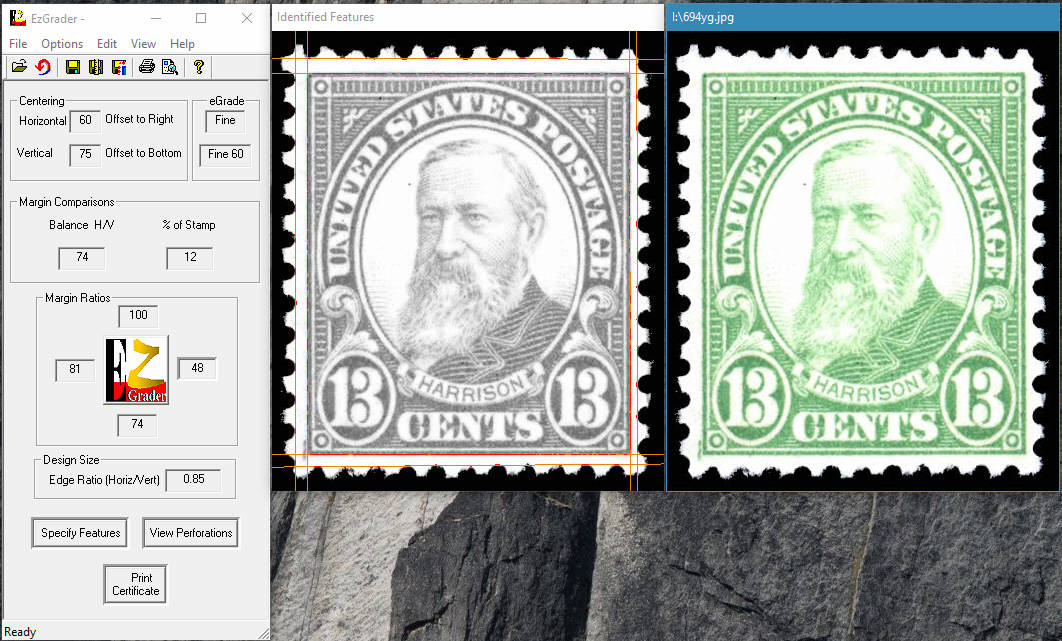 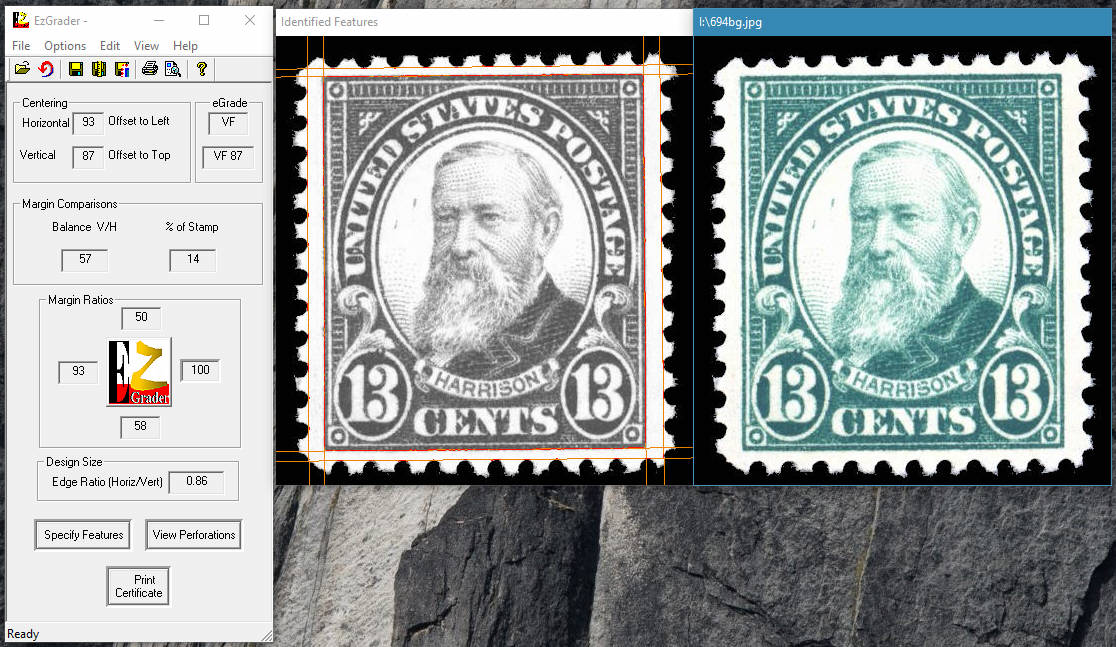 |
|
Send note to Staff
|
| Edited by soft-pro - 10/15/2016 5:08 pm |
|
|
Moderator

United States
12330 Posts |
|
|
Hi Marios,
Does EZ grader include any faults (thins, crease, regum, etc.) that the stamp might have?
Don |
|
Send note to Staff
|
|
|
Valued Member
169 Posts |
|
|
Hi Don,
no. EzGrader measures the stamp & figures out the grade (to put it simply- much more going on in the background). It's not possible to measure those things from an image. I am working on EzGrader v2.0 to allow the user to account for those things & points can be deducted for faults etc. Still a ways to go & a couple of new features.
Marios |
|
Send note to Staff
|
|
|
New Member
United States
2 Posts |
|
|
Thanks for all of the great information. I think it makes sense that each variation would only be noted in the catalog, and not be a separate Scott # a,b etc. when each of the color variations is of roughly the same value.
Marios I will say that I think I made a wise first choice selecting your EZSTAMP software to tackle my cataloging project. My imagination does not like the idea of tackling that much data input without a program such as yours. The Power Search coupled with being able to display decent size thumbnails has already saved lots of time flipping back and forth through catalog pages, and this starting with the stamps in Leuchtturn albums, which I would have thought were more in strict Scott # order than I have found the first book to be. The time saving when I get to the many thousands of extras in various books, envelops, and small boxes should be immense. Thanks also for the EZGrader demo, as primarily a life long comic collector with no prior experience with stamps, I did not consider the degree that centering can affect a stamps grade.
Essayk I do think that buying a recent copy of the Scott US Specialized Catalog is needed to further my stamp collecting education.
I will try to pop in here every now and then if I find anything I cannot identify, come up with other questions that might be interesting to other collectors, or see where I might be able to help others even less experienced than I am.
Thanks again to all. I think I have embarked on a fun project. I may even turn into a stamp collector.
Dave
|
|
Send note to Staff
|
|
|
Rest in Peace
United States
4052 Posts |
|
|
Quote:
... I do think that buying a recent copy of the Scott US Specialized Catalog is needed to further my stamp collecting education ... dbruess: Welcome to SCF. What essayk (and many more of us) have learned is that the brand new catalog will be, sooner than you can imagine, five years old. It is an 'investment' that depreciates, fully & quickly, so most/all of us will recommend that newbies start with the fully-depreciated version ... and put that same money towards memberships & subscriptions, which also support the hobby. Cheers, /s/ ikeyPikey |
|
Send note to Staff
|
| Edited by ikeyPikey - 10/16/2016 10:00 am |
|
|
Pillar Of The Community
United States
4189 Posts |
|
|
Quote:
The light yellow green & the blue green are FOOTNOTED in Scott's & are not given a unique cat #. Values are the same for both shades.
Re grading,I took your images & graded them with EzGrader. I never purchase a stamp unless I put it through EzGrader first. The Yellow green eGrades a 60 & the blue green eGrades an 87.
No, the shades are listed as varieties under the main listing, not a footnote (a footnote is a separate note below the listing, such as the footnote on Bureau Precancel below the 701 listing). a grade of only 60 is brutal on the yellow green stamp. |
|
Send note to Staff
|
|
|
Pillar Of The Community
United States
4189 Posts |
|
|
Quote:
I did not consider the degree that centering can affect a stamps grade Grading starts with the centering and then gets adjusted down for any faualts (personally I don't like that idea because everyone has their personal idea on how much a particular type of fault bugs them, and faults come in varying degrees yet get asigned the same deduction - so I'd rather just see a centering grade and then a list of any faults) |
|
Send note to Staff
|
|
|
Pillar Of The Community
United Kingdom
8636 Posts |
|
|
Or, as on the other thread about the pernicious effects of grading, just a good old description - well-centred etc. I really hope that this numerical system doesn't spread beyond the US. |
|
Send note to Staff
|
|
|
Pillar Of The Community
United States
1820 Posts |
|
|
Quote:
a grade of only 60 is brutal on the yellow green stamp.  This would be considered a VF stamp by any measures that I am familiar with. |
|
Send note to Staff
|
|
|
Pillar Of The Community
United States
1043 Posts |
|
|
Agree grade of 60 is brutal on yellow green.
I would say fine 70 or even 75 (f-vf)
To be even more controversial, the other stamp to me is an 85. If grader happy, and rounds up versus down
Price of stamp changes by 50 percent! Yikes |
|
Send note to Staff
|
|
|
Replies: 20 / Views: 3,186 |
|




 Posted 10/15/2016 1:27 pm


