Stamp Community Family of Web Sites
Thousands of stamps, consistently graded, competitively priced and hundreds of in-depth blog posts to read


Stamp Community Forum
 
Username:
Password:
Save Password
Forgot your Password?

This page may contain links that result in small commissions to keep this free site up and running.

Welcome Guest! Registering and/or logging in will remove the anchor (bottom) ads. It's Free!

Foxing/Rust On Stamps

Next Page    
 
To participate in the forum you must log in or register.
Author Previous TopicReplies: 35 / Views: 22,806Next Topic
Page: of 3
Valued Member
New Zealand
68 Posts
Posted 12/10/2009   04:09 am  Show Profile Bookmark this topic Add Bruce Webber to your friends list Get a Link to this Message
I get lots of stamps given to me that have gone / going / have small spots of "rust", "foxing" etc. Sometimes I even buy them as I need that stamp for my collection. I'm told it is a fungus of some sorts. I also have these two bottles of fluid. One turns the stamp purple all over and the other turns the stamp back to the usual colour without the foxing! Wonderful stuff!

a) In the long term does this treatment damage the stamp or cause problems a few years later? I know not to keep the stamp too long in the purple fluid as the stamp come out pale.

b) Mint stamps will loose their gum of course and probably should be soaked in water first before going into the purple fluid. A mint stamp with foxing doesn't look good in an exhibit but an unused stamp i.e. without gum but without cancellation at least will look better even though point may be knocked off.

c) Is there any other way to get foxing off stamps. I'm hoping that there might be some sort of laser treatment that might bleach out the foxing colour but retain the gum ??? I think I live in hope - is there something else I can do with my mint foxed stamps?
Send note to Staff

Pillar Of The Community
2664 Posts
Posted 12/11/2009   12:21 am  Show Profile Bookmark this reply Add spock1k to your friends list  Get a Link to this Reply
yo K,

Come here quick and share your insights.
Send note to Staff  Go to Top of Page
Pillar Of The Community
United States
6756 Posts
Posted 12/11/2009   01:43 am  Show Profile Bookmark this reply Add khj to your friends list  Get a Link to this Reply
I'll try to see if I can scan some examples and post later. I'll have to tweak the settings quite a bit, as the light yellow/brown doesn't scan well at all.

The term foxing/foxing/rusting (as I use it, anyway) refers to the stamp paper turning yellowish/brownish in certain areas, almost always starting from the edges. When these stains appear to the visible eye, they usually have permeated the paper so that they can be seen on BOTH sides of the paper. This is basically caused by moisture reacting with acid in paper. When combined with improper storage, this occasionally occurs in stamps older than 50 years of certain countries (US included), because of the types of stamp paper used back then. The only way to stop this is to either spray an archival acid neutralizer on the stamp, or to keep the stamp in a mount. I do not use the acid neutralizers, so I cannot attest to how it might affect the ink on stamps. In general, this problem DOES NOT spread from stamp to stamp, even though it may often appear all the stamps on an album page have foxing (it is simply they were all printed from the same era and stored under the same conditions). Stamps that have foxing are considered "Major Defect". I know of no way to remove these stains without resulting in obvious damage to the stamp -- once a major defect, always a major defect (yes, a repair is also considered nothing better than a major defect).

[EDIT: Some collectors also refer to mildew stains described below as foxing. I distinguish between the two, because the mildew can spread from stamp to stamp, whereas the acidic reaction described above does not spread from stamp to stamp.]
Brownish/yellowish splotches/circles/patches on stamps may also be due to mildew. These commonly occur on stamp collections in tropical environments, and so are also sometimes called tropical stains. However, I've seen this happen in non-tropical environments as well. All it takes is a couple of weeks in relatively humid conditions and a few spores... This CAN be spread from stamp to stamp. That is why I ALWAYS scan incoming stamps with a UV lamp -- which can detect the stains easier than with the naked eye.

Without the UV lamp, you can still detect mildew. It is different from foxing in that it can appear ANYWHERE on the stamp. Also, it usually does not permeate the stamp, so you will see it on one side, but not necessarily at the same spot on the other side, or not on the other side at all. I have heard of several ways of treating the mildew, none of which I have any confidence in. These methods include vinegar, ammonia, very dilute bleach... followed by rinse in a neutralizing solution and then water rinse. All of which will adversely affect any gum.

If you detect an infection, treat it like leprosy and isolate it immediately if you have to keep it for some reason (like, waiting until you can get a replacement, or extremely high value). It is better to discard the stamp than try to recover it, because it's hard to be certain you've killed off all the germs -- why risk infecting the rest of your collection?

ALL the methods used to remove any of the stains mentioned above will adversely affect any gum and will leave tell-tale signs on the paper surface (though some signs may not be visible to the unaided eye). ANYTHING you do to remove any of those stains can be detected using the proper equipment, and will be notated by any competent expertizer.

I'm sorry, but as a matter of policy, I do not post instructions nor suggestions on how to remove stains. Thank you in advance for understanding. However, I can tell you that the information is readily available on the internet as well as in some out-of-print books. It's also not too difficult to meet someone else who will provide you with the information. If those 2 bottles you mentioned are the same as the ones I am aware of, they aren't cheap (actually, it's one of them that's expensive, but they are sold together). But maybe you have something else.

Good luck! I'm sure your exhibits are/(will be) great! Hopefully you can post some pics of past exhibits!

k

Send note to Staff  Go to Top of Page
Edited by khj - 12/11/2009 02:35 am
Pillar Of The Community
United States
6756 Posts
Posted 12/11/2009   02:29 am  Show Profile Bookmark this reply Add khj to your friends list  Get a Link to this Reply
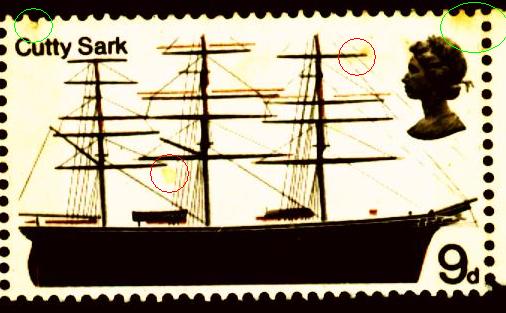
Below is an example of foxing.

I have rotated the backside image 180 degrees, so that the bottom perfs will align properly. Circled in green, you can see an example of the foxing. See how it propagates from the edge of the stamp. Circled in red is an exception. Here you see foxing due to the excess moisture that was provided by attaching the hinge. In general, you will only see this if you also see the foxing along the edges.

Below is an example of mildew from my archives.

Circled in green is actually mildew along the edge, not foxing. It shows up different under UV light. But even without the UV light, you can determine it is mildew based on the spots circled in red. These are MNH stamps. The presence of these spots away from any edges or perforation holes, are indicative of mildew stains. I don't have a scan of the backside. It was either clean, or there were mildew stain but at a different location that did not match the stains on the frontside.
Send note to Staff  Go to Top of Page
Valued Member
United States
127 Posts
Posted 12/11/2009   09:33 am  Show Profile Bookmark this reply Add abutt1 to your friends list  Get a Link to this Reply
Recently I was given a very "brief" album,like a kid's album. Almost all the stamps had a rust-like stain obviously from the hinges. I've never seen that before. I'm not sure just soaking them in water will help. Any suggestions?
Allan
Send note to Staff  Go to Top of Page
Pillar Of The Community
2664 Posts
Posted 12/11/2009   10:24 am  Show Profile Bookmark this reply Add spock1k to your friends list  Get a Link to this Reply
pics please so K can continue with the class :)
Send note to Staff  Go to Top of Page
Pillar Of The Community
2664 Posts
Posted 12/11/2009   10:26 am  Show Profile Bookmark this reply Add spock1k to your friends list  Get a Link to this Reply
there should be a rule against him not finishing his posts. have you ever seen an oscar winning movie that does not have an ending. here we see it all the time
Send note to Staff  Go to Top of Page
Pillar Of The Community
2664 Posts
Posted 12/11/2009   10:35 am  Show Profile Bookmark this reply Add spock1k to your friends list  Get a Link to this Reply
in case you are wondering professor please dont hesitate to speak some more on

the UV process
the cleaning process ( or why you choose not to speak on it)
other ways to distinguish between the two -foxing and mildew
some more pics preferably on the back of the stamp so some of us with not soo good eyes can see it better and what ar you doing with leper stamps and if you found a way of stopping the disease from spreading

if moisture is eliminated ( humidity) through eva dry and dehumidifiers can we say bye bye mildew and foxing

what about toning is it the same as foxing or mildew or is it something else. what happens with brown spots of toning that is neither mildew nor foxing.


Thanks :)


Send note to Staff  Go to Top of Page
Pillar Of The Community
United States
6756 Posts
Posted 12/11/2009   11:59 am  Show Profile Bookmark this reply Add khj to your friends list  Get a Link to this Reply

Quote:
other ways to distinguish between the two -foxing and mildew
some more pics preferably on the back of the stamp so some of us with not soo good eyes can see it better and what ar you doing with leper stamps and if you found a way of stopping the disease from spreading

There are different types of mildew stains that will slightly different characteristics under filtered long wavelength UV. But in general, foxing will appear brighter than the surrounding paper. Mildew stains usually (but not always) will appear slightly darker than the surrounding paper. This is very a generalized/relative statement, as different paper types will glow with different intensity under UV. I'm rather hesitant about scanning mildewed stamps because I don't want to contaminate my scanner plate and I'm too lazy to clean the plate afterwards. Whether the mildew stains appear on the front or back side or both, the characteristics are the same.

Any stamp with mildew, I either throw away, or use up for postage if it's mint US. If it's something I have to keep for some reason, I keep in a glassine/collector card and isolate it in a sealed box. That's the only way I know to keep it from spreading.


Quote:
the cleaning process ( or why you choose not to speak on it)

I don't dicuss this for the following reasons:

There are several online and printed sources (philatelic and non-philatelic) that discuss these issues quite thoroughly. Just do some googling.

The cleaning process can also greatly damage the stamp if not done properly. Also, some stamps will react adversely to the cleaningly process (just like aniline/fugitive inks in water). I don't want to be responsible when someone destroys a $100 stamp and then asks me "Why didn't you tell me that BLAH BLAH BLAH...:

While I'm not worried about the Forum members here, there are a number of "others" who use the information to alter a stamp or sell the stamp as "completely sound" and don't disclose the restoration.


Quote:
if moisture is eliminated ( humidity) through eva dry and dehumidifiers can we say bye bye mildew and foxing

It should stop the foxing. It will only slow down the mildew.


Quote:
what about toning is it the same as foxing or mildew or is it something else. what happens with brown spots of toning that is neither mildew nor foxing.

Many collectors use the 3 terms interchangeably, especially since there really isn't an agreed upon definition. I'm a little tied down right now. A discussion on toning (based on how I use the term) is really going to distract from Bruce's original thread topic. I will try to continue this discussion in another thread later and post the link here.

k
Send note to Staff  Go to Top of Page
Pillar Of The Community
2664 Posts
Posted 12/11/2009   11:34 pm  Show Profile Bookmark this reply Add spock1k to your friends list  Get a Link to this Reply
ok thats great so we have you marked down for a toning thread and a little more on the moisture elimination please. if there is no toning foxing mildew on the stamp and you eliminate moisture, why will it only slow down the mildew I mean where will it come from if isnt already there and there is no moisture to bring it? Thanks
Send note to Staff  Go to Top of Page
Pillar Of The Community
United States
6756 Posts
Posted 12/12/2009   02:11 am  Show Profile Bookmark this reply Add khj to your friends list  Get a Link to this Reply

Quote:
you eliminate moisture, why will it only slow down the mildew I mean where will it come from if isn't already there and there is no moisture to bring it?

It's very hard to completely eliminate moisture in a humid environment. There's always going to be some moisture, enough to keep the mildew alive, and growing very very slowly. You'll never be as dry as the desert. The mildew can also lie dormant for extended periods.
Send note to Staff  Go to Top of Page
Pillar Of The Community
2664 Posts
Posted 12/12/2009   02:48 am  Show Profile Bookmark this reply Add spock1k to your friends list  Get a Link to this Reply
ah you may be right. I dont know why the eva dry has not shown up. I certainly hope it does otherwise my 100% moisture elimination just took a very hard knock
Send note to Staff  Go to Top of Page
Valued Member
New Zealand
68 Posts
Posted 12/14/2009   03:35 am  Show Profile Bookmark this reply Add Bruce Webber to your friends list  Get a Link to this Reply
Thanks for all the good info will be getting out my UV light.
Send note to Staff  Go to Top of Page
Pillar Of The Community
2664 Posts
Posted 12/14/2009   03:53 am  Show Profile Bookmark this reply Add spock1k to your friends list  Get a Link to this Reply
k,

please dont forget to talk about the UV light. I might try to buy one in the future.
Send note to Staff  Go to Top of Page
Valued Member
New Zealand
10 Posts
Posted 01/01/2010   10:38 pm  Show Profile Bookmark this reply Add KiwiStamp to your friends list  Get a Link to this Reply
Hi Bruce, Gerard here also from good old NZ, great info on foxing etc, or rust spots, I have some like most of us on some mint stamps and am reluctant to put any liquid on them as I don't want to damage them any further, so hopefully one day some one will invent something to get rid of this problem.
Enjoyed all the comments from others as well.
Send note to Staff  Go to Top of Page
Pillar Of The Community
2664 Posts
Posted 01/01/2010   11:57 pm  Show Profile Bookmark this reply Add spock1k to your friends list  Get a Link to this Reply
well I can invent anything in my lab its just that the sponsors are not interested.
Send note to Staff  Go to Top of Page
Page: of 3 Previous TopicReplies: 35 / Views: 22,806Next Topic  
Next Page
 
To participate in the forum you must log in or register.

Go to Top of Page

Disclaimer: While a tremendous amount of effort goes into ensuring the accuracy of the information contained in this site, Stamp Community assumes no liability for errors. Copyright 2005 - 2026 Stamp Community Family - All rights reserved worldwide. Use of any images or content on this website without prior written permission of Stamp Community or the original lender is strictly prohibited.
Privacy Policy / Terms of Use    Advertise Here
Stamp Community Forum © 2007 - 2026 Stamp Community Forums
It took 0.36 seconds to lick this stamp. Powered By: Snitz Forums 2000 Version 3.4.05