| Author |
 Replies: 17 / Views: 24,325 Replies: 17 / Views: 24,325 |
|
Pillar Of The Community
United States
1947 Posts |
|
|
|
In all the photos, images, etc I have seen of the Washington/Franklins and the 1909 Lincoln commemorative, I have yet to convince myself that I am seeing a difference between the bluish paper stamps and the ordinary paper.
Just how subtle is the difference? Should it be obvious?
|
|
Send note to Staff
|
|
|
|
|
Moderator

United States
4788 Posts |
|
|
Take two Viagra. You'll see it...  Sorry, couldn't resist. I'm in a silly mood this morning. On a serious note, I don't know the answer, but I'm glad you asked the question. I've had the same experience. I can't tell the difference either. I had a similar learning curve dealing with some early US Official stamps - thin hard paper vs. soft porous paper. I think I finally learned the difference in the feel of the flick, but I'm never 100% sure. I look forward to the expert opinions... Kirk |
Send note to Staff 
|
|
|
Pillar Of The Community
United States
1947 Posts |
|
|
Yes, I finally learned the "flick" technique. Another way is to hold the stamp infront of a bright light. The soft paper has a mottled look while the thin hard paper does not. The motivation for the bluish paper question was one I saw for sale on ebay. Looked like white paper to me. |
|
Send note to Staff
|
|
|
Pillar Of The Community
United States
752 Posts |
|
|
the "blue" paper is related to rag content of the pulp. Examine a "blue" issue vs a non blue issue under UV light |
|
Send note to Staff
|
|
|
Pillar Of The Community
Guatemala
1500 Posts |
|
|
I've never seen blue and non blue paper side by side. I did notice on theswedishtiger web site that the color is actually grayish rather than blueish. I believe that would make it even more difficult to distinguish from an aged non blueish paper. |
|
Send note to Staff
|
|
|
Pillar Of The Community
United States
1947 Posts |
|
|
Valued Member
Canada
45 Posts |
|
|
To my eye, the blue paper actually looks grey. It is very distinctive and easily separated from ordinary paper. Once you have seen one, you'll know what to look for. Next time you're at a stamp show, visit a U.S. dealer or two and ask to see one. They're fairly expensive, but major dealers will often have either the 2c W-F or the Lincoln stamp in stock. |
|
Send note to Staff
|
|
|
Pillar Of The Community
United States
6756 Posts |
|
|
Quote:
I did notice on theswedishtiger web site that the color is actually grayish rather than blueish The term bluish paper that is commonly used for these stamps is a slight misnomer. Scott notes that the paper is actually grayish blue. That is why many of you mentioned it looked grayish. Scans of these stamps for sale are pretty meaningless to me, since the paper color can be easily tinted. The only value of the scan would be centering and flaws. Unless you are confident you can distinguish the bluish paper variety, you should not buy these bluish paper stamps without certification. |
|
Send note to Staff
|
|
|
Valued Member
67 Posts |
|
|
Pillar Of The Community
United States
2547 Posts |
|
|
Jcstamp, Sorry but no blue paper. The blue paper is really more of a slate gray. Below is my favorite image for the blue papers. It is from a cover (not mine) that is Scott 332 (regular paper) on the left and Scott 358 (blue paper) on the right. Since they were exposed to the same environment and the same scan it does a great job of showing the difference. The best way to tell the blue paper is from the back side on used stamps, they will show the distictive slate color. 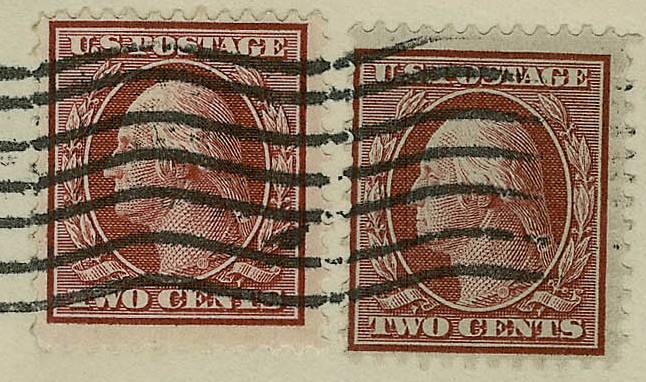 |
|
Send note to Staff
|
| Edited by Russ - 06/15/2011 12:09 am |
|
|
Pillar Of The Community
United States
1357 Posts |
|
|
Hi rohumpy-- It's a little more obvious than your examples, at least I think you'll see here (my 357 and 358 vs. 331):  The best way, I've been told, and have tried this, to see the blue, is to put the stamp up against an orange background. It did not work for me, but then, I'm as color blind as you'll ever see! Hope this helps-- Ray |
|
Send note to Staff
|
|
|
Pillar Of The Community
United States
1357 Posts |
|
|
Not quite as evident from the front-- best as Russ said, to use the back of the stamp: 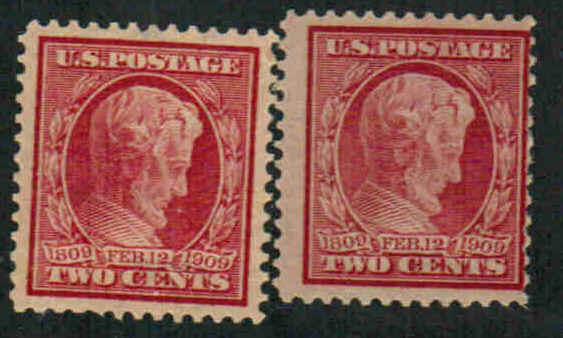 BTW, first time I've ever noticed that my 369 is probably reperfed on the right side-- what a bummer. Look how they don't line up? I'm not imagining things am I? Ray |
|
Send note to Staff
|
|
|
Valued Member
67 Posts |
|
|
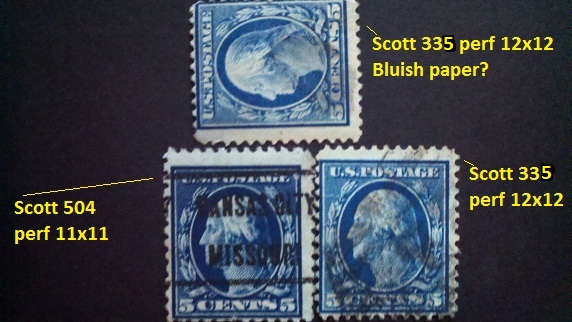
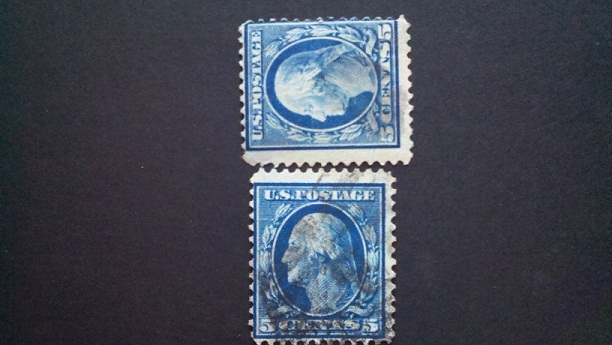
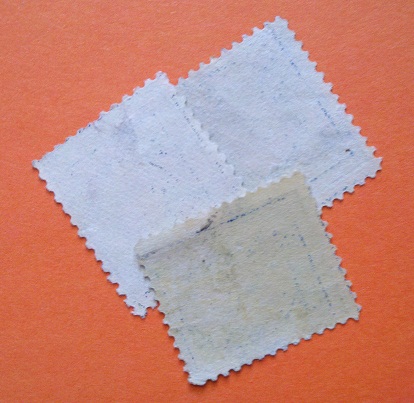
Thank you for all the information. (the three blue stamps are in the same environment, as I took the pic with my phone) Why is it grayish? Does it look far off from your comparisons.....? Looks to me as if each different denomination or color ink has a different tone to the bluish paper....the three big stamps are Scott 358,361, and 363 all three bluish paper pics from theswedishtiger.com. I appreciate any thoughts. 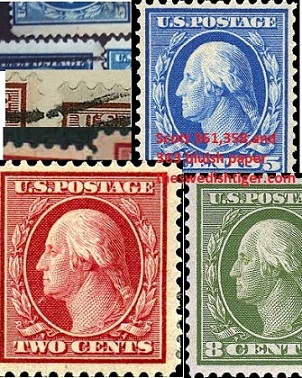 |
|
Send note to Staff
|
| Edited by Jcstamp - 06/15/2011 04:54 am |
|
|
Pillar Of The Community
United States
1947 Posts |
|
|
ray.mac, I am not sure that the vertical perfs line up on the left stamp. So perhaps that is normal?? I can see what you are referring to that the perfs do not line up from right to left, although without the stamp in hand, maybe I (we) are just seeing things. |
|
Send note to Staff
|
|
|
Rest in Peace
United States
7097 Posts |
|
|
Also referred to as "security paper". Has a blue tint. Any attempt to remove a cancellation will discolor the paper as well as possibly wipe off the design. Used by Great Britain on 4d stamp of 1855. See also the Venezuela 1932 Airport issue.
(Para phrased from the Stamp Collectors Handbook by Samuel Grossman circ.1978 16Th printing) |
|
Send note to Staff
|
|
|
Valued Member
67 Posts |
|
|
Replies: 17 / Views: 24,325 |
|




 Posted 02/02/2010 06:55 am