| Author |
 Replies: 55 / Views: 12,291 Replies: 55 / Views: 12,291 |
|
Valued Member
Germany
42 Posts |
|
|
|
Hi,
I recently read a bit about PNCs, back numbers etc. Since I am collecting back numbers on used German stamps, I would like to do the same with US stamps. However, I don't really know if this will work. The self-adhesive stamps sometimes seem to defy any means to get them off the postcards/letters.
With most German/Swiss coil stamps, you can check against a bright source of light if there is a worthwhile back number on the stamp. If you find one, you can use stuff like a 1/20-1/25 mixture of detergent/water or something like "UHU/Prinz Stamp Remover" applied to the back of the envelope etc., wait a little and pull the stamp off - leaving most of the gum intact including the "precious" back number.
Would this method work with used US stamps or is there no way to get the back number safely off the paper?
I realize that many back numbers are not on the stamp itself. However, I suppose there are some series where the number is printed on the stamp, correct? Which ones would that be - i.e. which years should I look at?
Regards,
George
|
|
Send note to Staff
|
|
|
|
|
Valued Member
United States
107 Posts |
|
|
George,
Your question has been up for a couple of hours, so I believe
that some such as myself, are perplexed by your question.
And please don't misunderstand, as I'm not educated on everything
about US stamps, but I have never seen any numbers physically
on the stamps themselves, other than the year of issue, usually
located on the lower portion of the stamp, and I do not believe any self adhesive stamp is made with a watermark or marking. ??
|
Send note to Staff 
|
|
|
Pillar Of The Community
United States
6756 Posts |
|
|
 Welcome to Stamp Community Forum, George! I believe the "back numbers" that George is referring to are the counting numbers that appear on the back of water-activated coil rolls of US stamps in the 1990s. They were printed every tenth stamp, so that the clerk doing inventory would know how many stamps were left in a partial roll without actually having to unwind and count the entire roll. Some of us PNC collectors would like to collect the back number coinciding with the plate number stamp. A few PNC collectors liked to collect the back numbers 2 stamps away from the edge of their strip, so that they could fold the stamp over and be able to see both the plate number and the back number at the same time. To each, his/her own. I don't remember if back numbers appeared on self-adhesive coils, I'll have to go check my archived PNC collection. However, even if they did, they would have been on the liner, so the number would NOT appear on the back of the actual stamp. Secondly, for the water-activated stamps, I was under the impression that the back number was sprayed onto the back of the stamp AFTER the gum was applied. I don't think it was actually printed on. So my guess is that it would come off with the gum? Don't hold me to that, it is from memory and I have not confirmed and could very well be wrong. I've never actually seen a used coil stamp with the back number on it. I guess I could pull out a coil with back number and see if I can "lick" the back number off of it!   k |
|
Send note to Staff
|
|
|
Pillar Of The Community
United States
6756 Posts |
|
|
Quote:
...numbers physically
on the stamps themselves, other than the year of issue, usually
located on the lower portion of the stamp I should have clarified first. Starting in the 1980's, plate numbers appeared at selected intervals at the bottom of US coils. Then in the 1990's, they began appearing on 1 stamp in the self-adhesive booklet pane -- but NOT for all issues, only some issues (I no longer collect modern US, but I believe this practice has been discontinued for booklet panes; it is now only on the liner fold?). The back numbers are a different creature, and ONLY appear on the backs of coil rolls, also at selected intervals. I believe this practice has also been discontinued? So we are talking about 2 different types (front/back) for 2 different purposes (plateID/inventory). k |
|
Send note to Staff
|
|
|
Bedrock Of The Community
Australia
38679 Posts |
|
|
I cannot comment on US, but have seen back numbers (plate numbers) on european stamps/coils. They all disappear with soaking, so they are indeed on the gum, well, the ones I have met with. Here is one from Sweden. 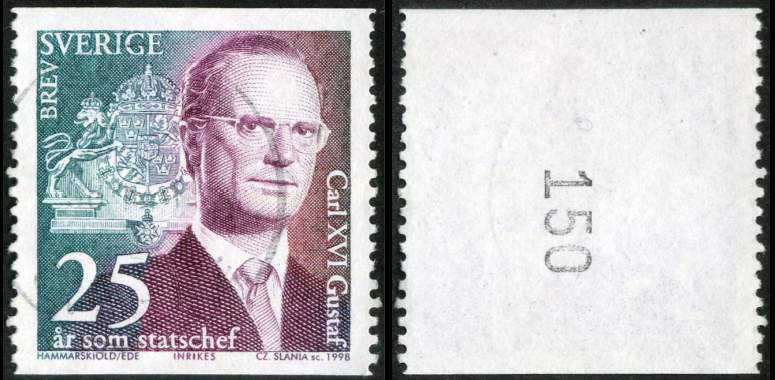 |
|
Send note to Staff
|
|
|
Valued Member
Germany
42 Posts |
|
|
Hi,
rod222 is showing a nice European example. There are quite a lot of people here in Europe collecting those back numbers, even on used stamps. However - you can't soak those stamps normally as this would dissolve the back number together with the gum. What you do is use a few drops of the detergent/water mixture or even better (and more expensive) the UHU/Prinz/Lindner stamp remover fluid on the back of the envelope/postcard/whatever. Let it sit for a little while and you can pull off the used stamp with most of it's gum intact, including the back number.
I have my doubts that this would work with self-adhesive stamps, tho.
I know that most US stamps should have the back number on the liner, although I thought I read something about a few series of stamps that were produced with the numbers right on the stamps ... there is a little more info on pnc3.org, however I could not find anything on used stamps.
Regards - and thanks for the warm welcome,
George |
|
Send note to Staff
|
|
|
Bedrock Of The Community
Australia
38679 Posts |
|
|
Pillar Of The Community
Australia
1658 Posts |
|
|
Pillar Of The Community
United States
6756 Posts |
|
|
Quote:
although I thought I read something about a few series of stamps that were produced with the numbers right on the stamps Is this statement in reference to the FRONT (plate number) or the BACK (inventory counting number) of the stamp? The FRONT numbers are pretty well documented. The ones with back counting numbers, I can probably make a very rough and very incomplete list by Scott number for you (give me a couple of days to find my PNC collection). |
|
Send note to Staff
|
|
|
Bedrock Of The Community
Australia
38679 Posts |
|
|
I remember jumping up and down with joy, when I found my first control number on the back of a Spanish stamp with 000000, I thought I had found the Holy Grail.
Then someone deflated my tyres suggesting whole sheets of stamps had the same control number on the back.
Hrmphh
|
|
Send note to Staff
|
|
|
Pillar Of The Community
United States
6756 Posts |
|
|
Quote:
suggesting whole sheets of stamps had the same control number on the back Yes, many of those issues exist only with control numbers on the back. Yeah, I know the feeling. When I got my first imperf, I thought I had found a rarity. Turns out that stamp was only issued imperforate. But the feeling was good while it lasted! |
|
Send note to Staff
|
|
|
Valued Member
Germany
42 Posts |
|
|
Hello khj and all others,
again, thank you. Yes, I am talking about the "back numbers", not the PNC's up front. I found out enough about those PNC's up front - I guess I don't have a problem getting those sorted out.
The back numbers - i.e. position of stamp on the coil - are the ones that interest me. However, if there were no issues at all with those back numbers on the stamp itself, this is of no importance to me since I normally only collect used stamps. From what I read on the web, at least a major part of those coil numbers were printed on the liner. However, from what I recollect (can't find the website at the moment - it was probably somewhere on pnc3.org) there was a reference to some US back numbers on the stamps themselves, too. Now - I might have gotten that wrong.
I don't expect to collect any riches (been a collector for that too long, since the early Sixties)within those back numbers. But then again, I have a lot of unsoaked US stamps (several pounds) and I don't want to destroy anything nice to have. I soaked too many European stamps already washing off those back numbers I would have preferred to have now :-)
Regards,
George |
|
Send note to Staff
|
|
|
Pillar Of The Community
Guatemala
1501 Posts |
|
|
Most back numbers I have come across had the number printed on the adhesive which meant soaking them resulted in a total loss of the numbers. Consequently, it is very difficult to obtain used US coils with back numbers. Most of my used ones have been CAREFULLY peeled off an envelope but that often leaves envelope residue on the stamps as the example below. USA back numbers I have come in 3 positions: printed on the top, middle and bottom. Also at least 3 colors: red, purple and black. 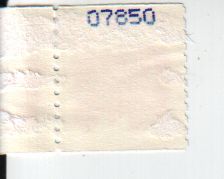 This stamp, although it never was mailed, was applied to an envelope. I do have a number of back numbered coils, both used and mint but they are in storage and I'm not sure exactly where. If I ever find them, I will post them. But don't hold your breath.  marty |
|
Send note to Staff
|
|
|
Pillar Of The Community
Guatemala
1501 Posts |
|
|
I forgot to mention that I have successfully soaked some of these by hovering over the soaking tray and try to peel a wet stamp off the paper. I attempt it about every 10 seconds. It works best with dry gum but I did obtain a few glossy gum examples.
The photo in my previous post came from a reply envelope pre-stamped by the sender. His "licking machine" only wet three narrow (or sometimes two) strips of moisture to adhere the stamp. These were relatively easy to peel off the envelope. A tongue licked stamp won't peel off easily.
marty |
|
Send note to Staff
|
|
|
Valued Member
Germany
42 Posts |
|
|
Hi Marty, that is highly interesting. BTW, you might want to try the European method for the lick-and-stick ones: use either 1/20-1/25 solution of dish washing detergent or UHU stamp remover (available through ebay) and put a few drops of the liquid on the back of the envelope right behind where the stamp is sitting. Wait for a little while and pull the stamp off. However, I doubt that this will work with the self-adhesive ones ... I'll give it a try when I have enough time with some regular self-adhesive. I have checked several hundred stamps yesterday and I have 2 or 3 possible back numbers ... I did not yet try to remove them. Marty, do you by any chance know when those stamps with the printed-on back number were released in the US? I.e. approximately which time frame? I'm asking because there probably isn't much sense in checking all the self-adhesive coil stamps since I suppose those would have the back number on the liner. Regards, George |
|
Send note to Staff
|
|
|
Pillar Of The Community
United States
6756 Posts |
|
|
Quote:
Now - I might have gotten that wrong. No, you did not get that wrong. You had it RIGHT!! Marty has already shown you some examples. As I mentioned earlier, they first appeared in the 1990s on both first-class coils and also bulk rate coils. Thanks for posting the pic, Marty! |
|
Send note to Staff
|
|
|
Replies: 55 / Views: 12,291 |
|



 Posted 03/09/2010 2:02 pm


 with Rod also

