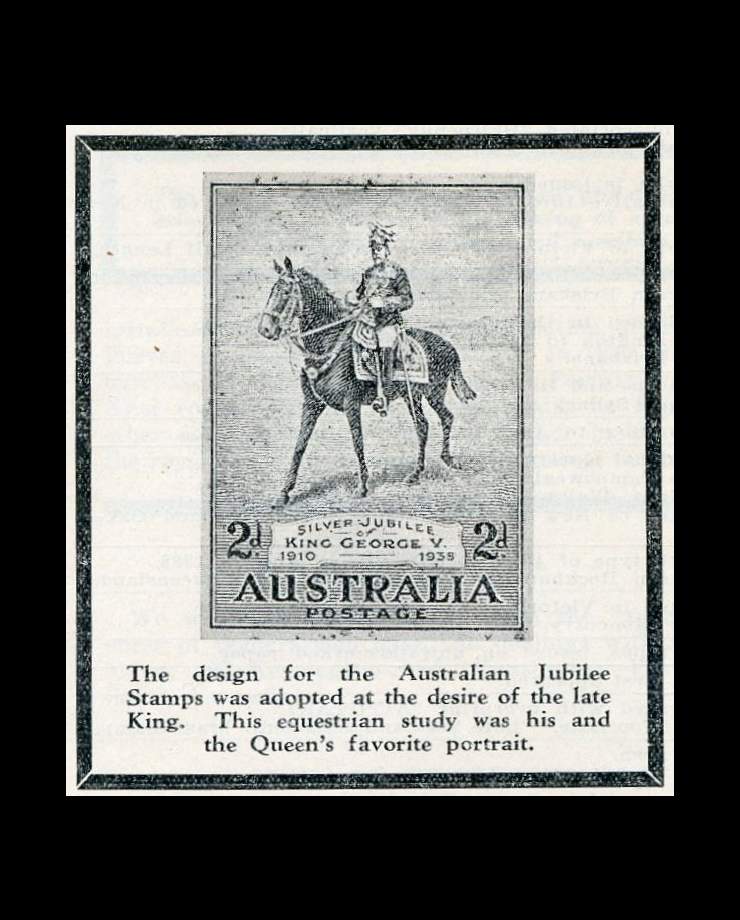
The king aboard his horse "ANZAC"
KING AND PHILATELIST
A GREAT LIFE HAS CLOSED
THE EMPIRE MOURNS THE PASSING OF A BELOVED MONARCH,
one who had endeared himself to his subjects of every walk of life. He was a great king,
yet a simple English gentleman, who lived the life of his people, identifying himself with
their daily tasks, their ambitions, their hardships and, above all, their rights as citizens of
the greatest Empire the world has ever seen.
No one who has read the story of his full and useful life can fail to be impressed with his
insight into the duties and responsibilities of his royal office, of his genuine sympathy and
understanding, and his real personification of the national ideals of the British people.
But a few short months ago philatelists, in common with other sections of the community,
celebrated the 25th anniversary of his accession to the throne, an occasion which was
productive of philatelic commemoration never before equalled in the Empire.
To-day, philatelists mourn with their fellow-citizens; they pay tribute to the memory of a
great King, who was also a great philatelist.
The late King's keen interest in stamp collecting did a vast deal for the hobby; how much,
will never be known-. Under his gracious patronage it was raised to heights never before
attained, dignified and, in truth, established as a royal pastime.
Only a few weeks ago, in October 1935, His late Majesty, in accordance with custom,
provided the exhibit at the opening of the new session of the Royal Philatelic Society,
London, of which he was Honorary Patron. The wonderful range of stamps then shown,
many annotated in the late King's own handwriting, was a visible indication of his wide
knowledge and' continued interest in philately.
He first became attracted to stamp collecting in his midshipman days, when he made a
world cruise on the H.M.S. "Bacchante," and it is recorded that many of his finest
Australian stamps were obtained in Sydney during this period (1879-82).
A subsequent cruise (1890-91) on the "Thrush," of which he was commander, afforded
him further opportunities of acquiring many valuable stamps, particularly West Indies
issues, and on his return to England he became a member of the Philatelic Society (later
the Royal Philatelic-Society, London). He was elected president of the society in 1896, a
position he retained until 1910, and during these years contributed many displays and
learned papers, which indicated much careful and original philatelic research.
It will be remembered that the late King was Patron of the Sixth Australasian Philatelic
Exhibition (VICVI), and his royal patronage also extended to the Sydney Philatelic Club,
and to the Swedish Philatelic Union. His signature is the first on the Roll of Distinguished
Philatelists, and he has always been identified with organised philatelic efforts to assist
national causes, particularly during the dark years of the Great War.
The royal collection is the most complete of its kind in existence. Confined only to the
issues of the British Empire and Egypt, it is of immense proportions, and necessitates the
constant care of its eminent Curator, Sir Edward Denny Bacon, K.C.V.O., who has held
the position since 1913.
It contains numerous rarities, such as the Id. and 2d. "Post Office" Mauritius, the only
used copy of the 2d. "Tyrian Plum" of Great Britain, the recently discovered "10
Centimes" instead of"10 Centimos" error of the Morocco Agencies Jubilee series;
the rare types of the Fiji "V.R." overprints in great variety, scarce South Australian
Departmentals, a setting of 25 stamps of the 1 value, N.W. Pacific Islands (5th setting,
1919- 23), and numerous other valuable and, in some instances, unique items. The
acquisition of the Purves' collection of Commonwealth in 1930, the purchase of
numerous items from the Ferrary and Hind collections, and numerous additions from
other sources in recent years further built up the royal collection, and at no time, except
during periods of illness, did he fail to keep in touch with all developments and new
discoveries in philately.
The late King's real interest in the hobby was £further shown by the valued assistance he
has so frequently rendered to other philatelists, many of whom mourn for him, not as their
monarch but as a personal friend. Philately has, in truth, lost its greatest friend and Patron,
but the strong stimulus he gave to the hobby will live on in last-ing tribute to a great
King, who was also, in every meaning of the term, a great philatelist.
The Editor and Staff join with all philatelists of the Empire and with all subjects of our late beloved King in mourning the passing of a great monarch and extend our deepest sympathy to Her Majesty the Queen and members of the Royal Family in their bereavement.





 Posted 06/16/2010 10:12 am


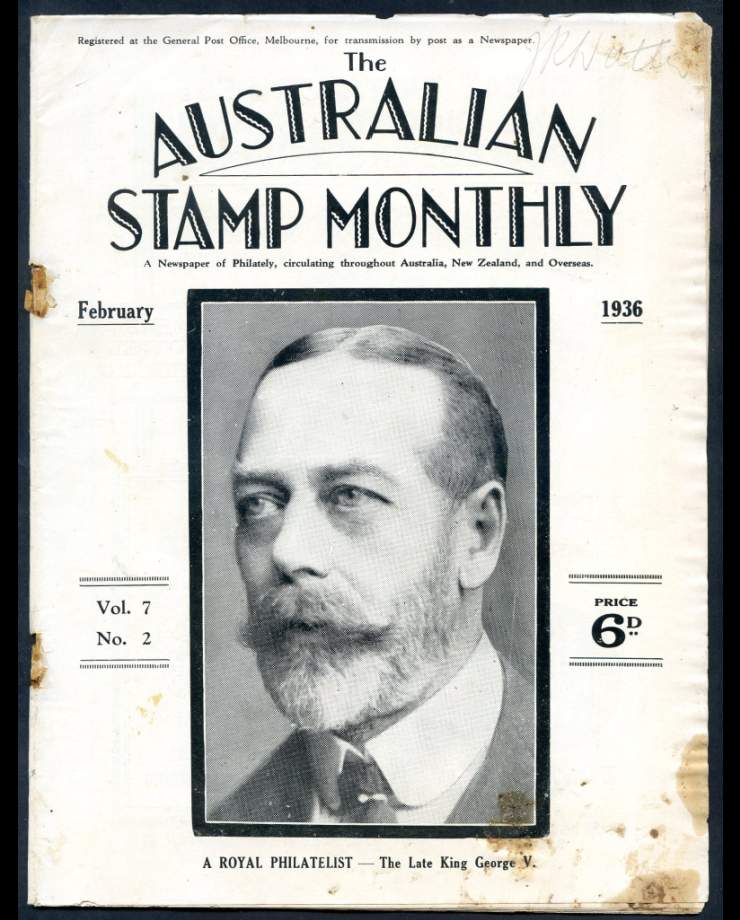

 , but assuming that there's an article backing up the cover photo, any chance it is headed for the old Epson?


