| Author |
 Replies: 14 / Views: 1,940 Replies: 14 / Views: 1,940 |
|
|
New Member
United Kingdom
3 Posts |
|
|
|
hello, I have an old scrap book I use to write lyrics in. the book is very old abd there are on some pages collection of stamps. they are the markings of a rubber stamp, not the kind you lick. they start from 1802 and go through to 1932. they are round and look like they have been cut from envelopes. there are hundreds of them. how do I add a picture of one of them? can anyone shed some light on them?
AN EXAMPLE IS D
B E
5
8 0
0
but in a circle?
anyhelp would be great.
lawry
|
|
Send note to Staff
|
|
|
|
|
Pillar Of The Community
United States
2782 Posts |
|
|
Hello,
If you have access to a scanner please scan them and post them here. There should be instructions on the site for posting pictures.
Will |
Send note to Staff 
|
|
|
Bedrock Of The Community
Australia
38679 Posts |
|
|
If you really have probs, email me the image you have,
and I'll post it for you.
|
|
Send note to Staff
|
|
|
Pillar Of The Community
Australia
1658 Posts |
|
|
G'Day Lawry and  to the forum, I use a digital camera upload to the computer then upload to www.photobucket.com and down load to this site,it's easy once you get the hang of it,hope this helps. regards Harry down under. |
|
Send note to Staff
|
|
|
Rest in Peace
Canada
6750 Posts |
|
|
Welcome!
Postmarks is probably what your round stamps are. They usually have a place name (city, town, etc) and a date in the form or month, day, year or many combinations of this depending on which country and era they are from.
Sometimes they have a time of day somehow as part of the stamping. Sometimes a number or such is an indication of the postal clerk whose stamp it was.
Some are posting marks, some transit marks, some receiving marks, and others have different functions usually to do with transporting the mails from one place to another. For example, there are sea post stampings and railway stampings.
Older ones may not have all the information in them as indicated above.
All of them are ways to indicate the mail has been processed through a certain place or person or for the older ones, before postage stamps came along, are indications that the carriage fee has been paid.
We all like to see pictures here and that would be the best way to show your find also. Libraries usually have a scanner (hopefully) that you can use to scan photos of stamps if necessary. The more detailed the better but there is a size limit on this board so if they go over 90 KB in file size then nuggethill's suggestion is the way to go. |
|
Send note to Staff
|
|
|
New Member
United Kingdom
3 Posts |
|
|
New Member
United Kingdom
3 Posts |
|
|
  these are said posting marks. any info on them would be much appreciated. lawry |
|
Send note to Staff
|
|
|
Rest in Peace
Canada
6750 Posts |
|
|
I myself have never seen these types of markings before. However, if they are as old as I am assuming them to be that is not remarkable. To me, my opinion without knowing any other history about them, is that they are circular date stamps. When you arrange one to have the numbers readable left to right, then the top two letters are abbreviations for the month (ex. FE = February), the center number in an inner circle is the day of the month, the bottom three numbers are the year, or the last three numbers of the year. The letter A, B, or C off to the left side could be a time of day indicator, where A means a certain time between certain agreed upon hours, or perhaps an indicator of a clerk or person or even an office. Are these from the UK? and if so, where in the UK? Do you know anything else about them? I know you want someone to say exactly what these are. I do not know. I have not delved into postal history that far back. That is if these are indeed some form of postal history. What was marked in the scrapbook or on it? Anything like a company name or city or town or area? Thanks for posting them by the way. I await more knowledgeable person's opinions.  |
|
Send note to Staff
|
|
|
Pillar Of The Community
United States
2782 Posts |
|
|
I've never seen them either and I tried googling them without any luck. However, my search led me to this book "Collect British Postmarks" which I just ordered from Amazon.uk - don't try to U.S. Amazon as the prices are astronomically higher than the U.K. ones even when shipping is taken in account. Will |
|
Send note to Staff
|
|
|
Rest in Peace
Canada
6750 Posts |
|
|
I began looking around on the web and found this cover with a similar but not the same marking. Just to show that this type of date stamp was in use in 1810-1811. This one is from France. 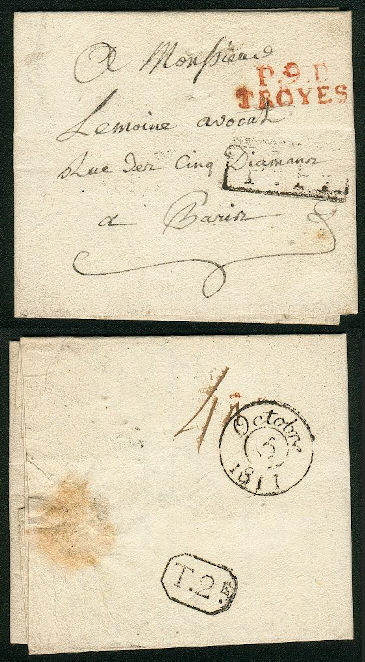 |
|
Send note to Staff
|
|
|
Rest in Peace
Canada
6750 Posts |
|
|
Another thought, if you wanted to remove these from the page they are affixed to, there is writing on the reverse, seen through the paper. However, I would examine the scrapbook itself first for any clues as to place of origin etc. |
|
Send note to Staff
|
|
|
Rest in Peace
Canada
6750 Posts |
|
|
Actually, having to check my French before posting, the names of most of the months would be abbreviated very likely in the same way as I am used to in English. These could be French postmarks.
Can you lift up one or two of the pieces of paper to see what language the writing is on reverse?
|
|
Send note to Staff
|
|
|
Rest in Peace
Canada
5701 Posts |
|
|
Puzzler, the French abbreviations are pretty well the same as English. Full they are:
Janvier, Fevrier, Mars, Avril, Mai, Juin, Juliette, Aout, Septembre, Octobre, Novembre, Decembre.
The cancels do look french - somewhere along the line great covers were destroyed :( |
|
Send note to Staff
|
|
|
|
Rest in Peace
Canada
6750 Posts |
|
|
Thanks Bee See.
These are really neat. With the writing on the reverse that would make these letters that had been folded and sealed and then addressed and stamped on their outsides. No envelope was used. |
|
Send note to Staff
|
|
|
Rest in Peace
Canada
6750 Posts |
|
|
Be careful that the pieces of paper may stick to the pages and tear or rip if lifted. Go slowly.
I would not remove the little hinges (yellowish pieces of paper tape) that hold them down, if they indeed do that and those hinges I see are left overs from stamps or other things being attached to the page. |
|
Send note to Staff
|
|
| |
Replies: 14 / Views: 1,940 |
|




 Posted 07/08/2010 1:56 pm


