| Author |
 Replies: 28 / Views: 3,394 Replies: 28 / Views: 3,394 |
|
Pillar Of The Community
2664 Posts |
|
|
|
|
Pillar Of The Community
2664 Posts |
|
|
Bedrock Of The Community
Australia
38679 Posts |
|
|
Pillar Of The Community
2664 Posts |
|
|
Rest in Peace
Canada
6750 Posts |
|
|
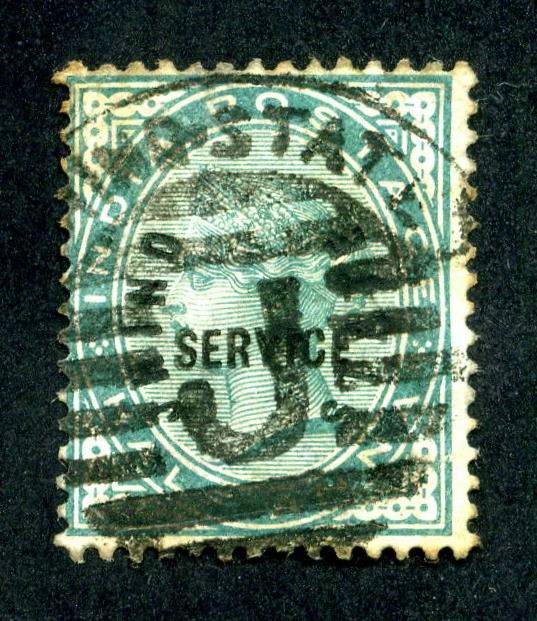
The 'killer' is the second part of a duplex (two part) cancel.
The first part is the circular date stamp postmark and the second is some kind of killer or obliterating device, bars or wavey lines or something that will 'kill' the stamp or the possibility of the stamp being reused.
Also called killer because it can rather hide the nice stamp from an enjoyable viewing.
|
Send note to Staff 
|
|
|
Pillar Of The Community
2664 Posts |
|
|
Pillar Of The Community
United States
7103 Posts |
|
|
Bedrock Of The Community
Australia
38679 Posts |
|
|
I wouldn't know Collin, (but well spotted  ) I have no other examples, usually India has rectangle geometry in their Lettered cancels,but going on Tony Mac's Jind hooded CDS's, I would think it probable the eight bar is a hooded design also. As the cancel identifies "Jind" or "Jhind" then I guess it is not strictly a "killer", but it's pretty busy and covers a lot of design, hence my adoption of the term. Ask Phil: Cancellation, Killer: cancel that shows no place, date or time of mailing. BTW: from Tony Mac's link to the Poonch pages, I learn that this area also has barred "T" cancels, (Travelling Post Office) I have never seen or heard of those before, and begs the question what was travelling ?  |
|
Send note to Staff
|
| Edited by rod222 - 07/13/2010 12:30 pm |
|
|
Pillar Of The Community
2664 Posts |
|
|
Pillar Of The Community
2664 Posts |
|
|
the middle sheet is the travelling post office as the name suggest it was a post office that travlled from one place ot another int he older days of the british raj
Army Post Office Corps - Anglo-Boer War (1899-1902)
On the outbreak of war, the Army Post Office Corps (M Company 24th Middlesex Volunteers) under the command of Major Treble, was appointed as Army Postmaster were mobilised and set sail for Cape Town on 14 September 1899 aboard the Dunnotar Castle. On arrival in Cape Town the Base Army Post Office was established in the newly built Cape Town Post Office building.
The original plan was that the Army Post Office Corps staff be deployed at the Base Army Post Office in Cape Town and establish Field Post Offices along the Lines of communication (LofC), however, this did not materialise because General Buller, the Commander in Chief, decided to adopt a two pronged attack; one from Cape Province, the other from Natal. Therefore the resources of the service had to be split to support the two prongs and a second Base Army Post Office responsible for servicing the troops in Natal was established at Pietermaritzburg.
Mails were sent weekly from Britain to Cape Town. The transit time was 14 days. Once in Cape Town the mails were resorted and forwarded to the Field Post Offices attached to formations in the field via the civilian postal services. Mails for the Natal Force were sent to East London and hence by a small steamer to Durban and by rail to Pietermaritzburg. This service was disrupted by the Boers advance into Natal and down to Stormberg.
During the sieges of Ladysmith, Mafeking and Kimberley, mail addressed to the troops contained in the besiege towns mounted up and could not be distributed to the addressees until after the sieges had been broken.
The re-organisation of troops and the subsequent renumbering of units for the different phases of the war caused sortation and location difficulties. However, the Army Post Office Corps devised a location method (which is still used today) and became invaluable to both the postal services as well as the Headquarters. Due to indifference by units there were difficulties in handling causalities' mail as a letter to the Press bears out:
"When General Methuen's column was camped at Jacobsdal, ...one of our Company [Imperial Yeomanry ] walked over the site, picked up a mail bag containing a good many letters, so he shouldered the bag and ran to give it to the departing Regiment. The only remark they made was 'Oh, they are only letters for the men away sick".[16]
To solve this problem civilians were employed to maintain lists of military hospital patients so that mail could be extracted for them at the Base Army Post Offices.
During the invasion phase of the war, in accordance with orders from Lord Kitchener's instructions mail from the Base Army Post Offices was forwarded to troops through the rail network, it accumulated at stations awaiting onward carriage.
This practice was the result of an unfortunate incident at Roodewal Station. Lieutenant Preece APOC and seventeen Army Post Office Corps soldiers were at the station when the Boers under General De Wet attacked it on 7 June 1900. The 2000 mail bags on site along with stores were used to build ramparts in defence of the station. After six hours of bitter fighting and the death of the station commander, Captain Gale - Railway Pioneer Corps, the defenders were forced to surrendered to General De Wet. During the fighting Private Tuffin and Goble of the Army Post Office Corps were killed and the remaining APOC men were taken prisoner.
After the surrender the mail bags were looted by the Boers. Stock (postage stamps, postal orders etc. ) valued at £ 5099 0s 41/2d were stolen. Sergeant Chapman APOC reported the aftermath of the action as follows:
"The Boers on their arrival began to loot. Every- thing was taken, the mail bags giving them excellent opportunities ...I made an attempt to save loose cash in my till when I was interrupted by a Boer coming into the room. I made the pretence of looking for some papers and closed the box...A grave had to be dug for poor Tuffin and the last rites performed over our late comrade. Mr Preece read the burial service and before the grave was covered in, the order was given to get kits together andfall in.& We were immediately marched off to the Boer laager ...The work of destruction on the Station then commenced. The Station-Master was apparently in league with the enemy as they allowed him to take all his furniture etc to a place of safety on the veldt before starting to blow up the place ...On the following day we were marched off pass Rhenoster[the scene of the Derby's disaster] to a position on De Wet ' s farm a distance of 9 miles. We stayed in this place for the night and the following day 9th June Mr Preece was taken suddenly ill and was removed to the Yeomanry Hospital. I had hopes of being taken also but no opportunity occurred (there being no transport) so I had to trudge on with the others for about 8 miles the next day ..." [17]
Chapman was finally released in Kroonstad on the 25th June after being held captive for 17 days. The others were release in August 1900. As late as 1909 attempts were made in Britain to cash postal orders looted from the station and when De Wet's house was search in 1914 over 3,000 unused British stamps, souvenirs of the attack, were found there.
By August 1900 the war moved from a fluid one to garrisoning the territory that had been gained. Conse- quently the Field Post Offices were converted into Stationary Army Post Offices and were issued with a new series of date stamps, which included the name of the town where the office was based. To service these Stationary Offices five Travelling Post Offices (TPO - Post Offices operating from a railway carriage) were set up and were operated by the APOC. The TPO vans were improvised from large box trucks fitted out with sorting frames, tables etc. by the Royal Engineers.
Working the TPOs could be dangerous as a APOC sergeant's report of the 19 June 1901 illustrates:
"... after leaving Machavie en route for Kokemoer and Klerkdrop [on a branch line running out of and to the west of Johannesburg], the mail train was derailed and attacked by the Boers. It occurred at about 3.45 p.m. Immediately the train was at a standstill, it was riddled from end to end with bullets. ..before I could realise my position, I was surrounded by Boers some pointing their Mausers at me...By the time I got to the counter everything was removed. Two Boers were filling their pockets with registered letters. I was ordered out of the coach..." [18]
By the end of the war the Army Post Office Corps was providing the mail service to both military and civilians alike in the Transvaal and Orange River Colony. To ensure the continuity of this postal service to the civilian population, personnel of the Army Post Office Corps were transferred to the colonial Post Office and remained in South Africa.
When the war began 111 all ranks of the Army Post Office Corps were deployed. At the end of the war there were 400 Army Post Office Corps soldiers deployed. During the war about 500,000 letters and newspapers and 12,000 parcels were delivered to the troops each week. £ 2 million of postal orders and £ 110,000 of stamps were sold. They also assisted in the handling of mails for the troops from Australia, Canada, India and New Zealand.
In October 1902 the last Army Post Office was closed, but it was not until February 1903 that the last detachment of the Army Post Office Corps left South Africa. After the Army Post Office Corps returned to Britain, its staff return to their peacetime duties with the GPO. They kept up their military skills by participating in army manoeuvers every September from 1903-13.
|
|
Send note to Staff
|
|
|
Pillar Of The Community
2664 Posts |
|
|
you also want ot read
The Traveling Post Office: History And Incidents Of The Railway Mail Service |
|
Send note to Staff
|
|
|
Bedrock Of The Community
Australia
38679 Posts |
|
|
Thank you Spock, very interesting and valuable material, which I shall snaffle. What I meant to convey with my TPO query, was the barred "T" on a Poonch card. I couldn't imagine what was tavelling (to my mind , up in the hills) This stuff is so involved I need to revist Tony's link and re read the discourse and try and identify the rail lines going up to Peshawar. I have a headache and will retire  |
|
Send note to Staff
|
|
|
Pillar Of The Community
2664 Posts |
|
|
you are welcome
well for lack of better knowledge I would say t was abbreviation for tpo since it was always moving they couldnt cancel the stamp with a place.
you are right the stuff is invlolving
there is a very specific reason I dont collect used india. I want to finish my collection in my life time with all the different postmarks it can be very interesting but also a very difficult journey.
and please dont retire. I really need my CIC :) |
|
Send note to Staff
|
|
|
Pillar Of The Community
Australia
3547 Posts |
|
|
Here's a rather fuller example of the Jind killer:  used on a Jind (Feudatory era) SG J19, the ½ Anna on thin wove paper of 1882 Jind later settled for a more civilized hooded CDS:  And (I'm sure I've posted it here before, but it might as well have another outing)  SG 136 - the 25 Rupee of 1941 |
|
Send note to Staff
|
|
|
Bedrock Of The Community
Australia
38679 Posts |
|
|
Tony, I gotta say, that hooded killer is just magnificent, you really dug up the goods there. Bravo  I think I prefer it to the CDS, but of course you don't get a date. A superb illustration why not to soak stamps off paper. |
|
Send note to Staff
|
|
|
Pillar Of The Community
Australia
3547 Posts |
|
|
Replies: 28 / Views: 3,394 |
|




 Posted 07/13/2010 07:34 am