Hi Gannd07 and welcome to this forum.
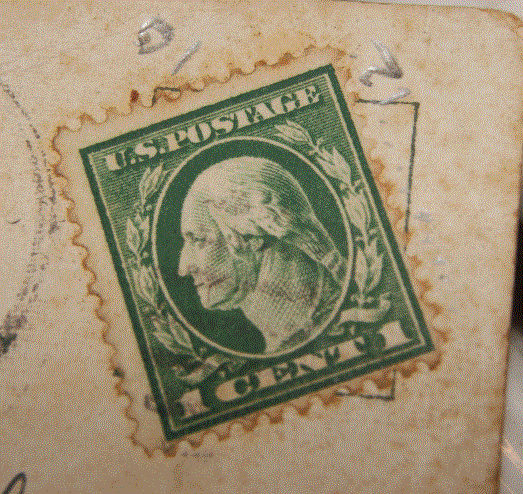
The Washington-Franklin series, of which your stamp is an example, is one of the most interesting series of stamps the US has issued. There is a lot of fun in these stamps.
The 1 Cent Washington was issued during the period running from 1912 to 1921. Being issued over this very long time period, this resulted in a large number of varieties which total around 25. These varieties have different watermarks, printing process and perforation.
Now, is it possible when you see that there are 10 perforation on the top and 12 on the sides that this lines up with the description of the 423D, which is perforated 11x12?
Unfortunately, that is not how we describe perforations. Perforations are measured over a 2 centimeter distance and the number of perforations over that distance is used as the perf number. Now, because this stamp is higher than it is wide, it is natural that there would be more perfs on the side than the top. But the rate of perfs over a given distance is what counts, not the number of perfs on a side. That is probably the same here.
Now, my guess is that your stamp is actually 11 perf, all round, But I could be wrong since I cannot measure it. Also, I am not sure what printing process was used here.
Lets go back to the entire series. These stamps (which look identical to the uninitiated) were issued in the billions. Back in 1912, 1 cent was money and you could send a letter for either 2 or 3 cents during the lifetime of this stamp.
423D: 41 used examples are known. The probability yours is a 423D is somewhat small. My best suggestion would be to take this stamp to a local stamp club (check the website of the APS
http://www.stamps.org for a location) and ask for their help.
Alternatively, there are gauges, easily available that can measure the perfs and tell if these were flat or rotary press stamps.
Just my 2 cents.
-Larry





 Posted 07/20/2010 4:34 pm



 to the forum,


