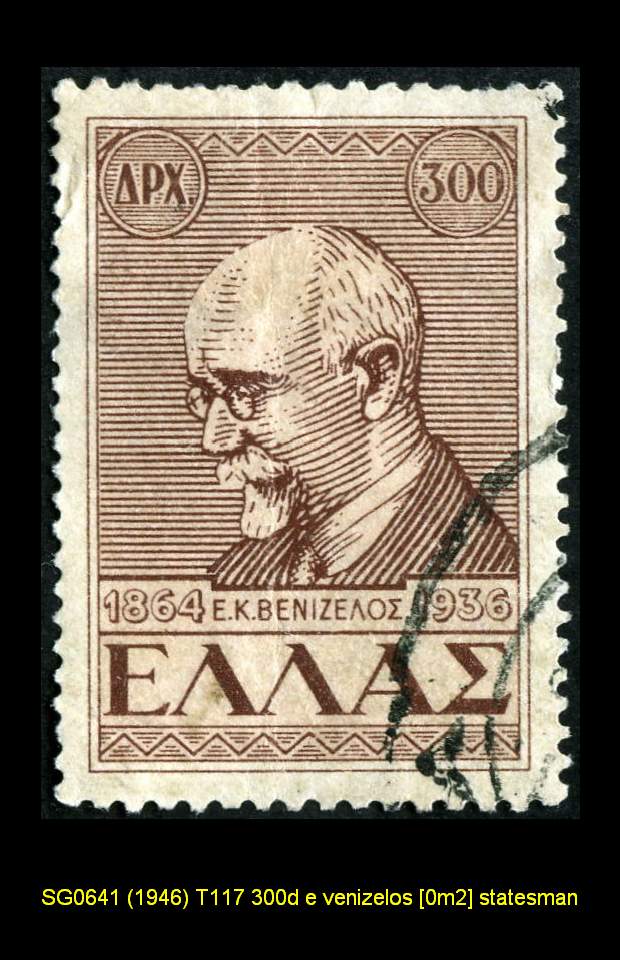
64 Years ago there passed away one of the most dynamic personalities of modern Greece—Eleutherios
Venizelos, patriot, revolutionary and statesman. His country issued two stamps upon which is portrayed his
bearded likeness.
Venizelos was born, in 1864 and took a leading part in the revolution in Crete (1897) and was made head of the
Cretan government.
At this particular time Crete was a province of the Turkish Empire, although most of the inhabitants were of the
Greek race.
Turkish stamps were in use prior to 1880, but during 1881-82 Greece established several post offices on the
island, these being rendered necessary by the outbreak of an earlier revolution and the impossibility of Greek
nationals having their mails despatched.
The second revolution, in which Venizelos was a leading figure, occurred in 1897 and Greece sent a fleet to assist
the insurgents. Later, the island was formally annexed by Greece.
However, this plan did not then meet with the approval of the powers and after much bickering the island was
apportioned between Great Britain, France, Italy and Russia.
Each of these powers issued special stamps for their respected areas of control.
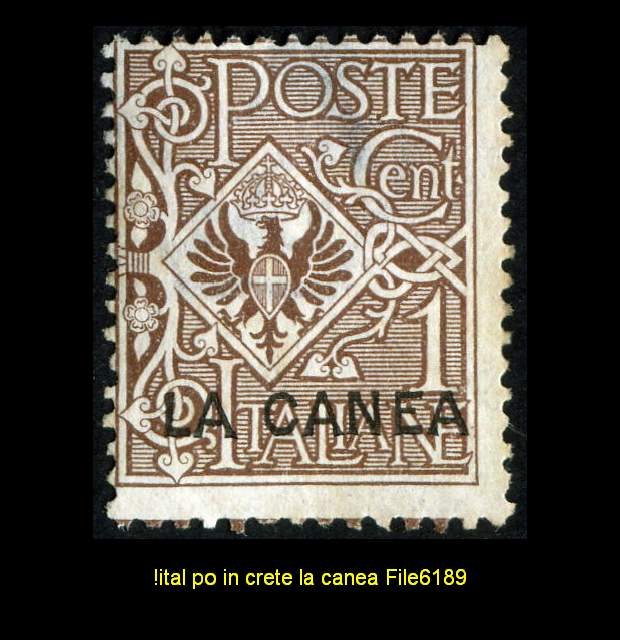
Italy held Canea, France obtained
the province of Lasithion, British forces occupied Candia, and the Russian sphere comprised Rethymo.
ITALIAN OCCUP CRETE
Venizelos was naturally against this partition of the island, although he was nominal head of the Cretan-Greek
government and succeeded in obtaining a withdrawal of most of the occupying forces. Crete then issued distinctive
stamps (1900), but any plans for Cretan independence was quashed by the appointment of Prince George of Greece
as, High Commissioner when the island was formally annexed by Greece in 1908.
Venizelos stirred up revolution again, but following agreement with the Athens government he proceeded to
Greece when in 190'9 he became Prime Minister.
Venizelos showed his statesmanlike qualities by a revival of constitutional government. He
brought about many reforms and upon the outbreak of the World War in 1914 leaned heavily on the side of the
Allies.
King Constantine was a supporter of the Central Powers, and in the national crisis which resulted, the country was
split into two factions, Venizelos set up a separate provisional government with headquarters in Salonica, which
government issued its own stamps.
The king was dethroned in 1917, and Venizelos became the real leader of all Greece. The king returned in 1920,
and for a time the Royal party held power. Two- years later, however, Venizelos was swept back into power by the
popular resolution of the people. The king was forced to flee the country.
Provisional stamps provided for the first few months of the new administration consisted of various earlier issues
of Greece and Crete overprinted with an inscription signifying "Revolution of 1922,""
The stormy petrel of Greek politics died in 1936 after a full and vigorous life. He saw Greece develop again into a
fully independent nation, and his vigorous leadership did much to unite the different provinces into one country
with one united outlook.
THE ERROR STAMPS
Many stamp issues of Crete and Greece are intimately associated with Eleutherios Venizelos, yet he was also
responsible, as one of the members of the Executive Council of Crete (1908), for the destruction of all papers and
documents connected with an interesting "error" oni the first general issue of 1909, the substitution of the British
"St. George and Dragon" design for the Cretan design of Bellerophon, mounted upon Pegasus, battling with
Chimaera.
Somehow, the designs became confused in London, but, unfortunately, we shall never learn exactly how this
happened, but it would seem that the Executive Council of Crete knew sufficient to have all records destroyed.
Author: "K.E" June 1st 1946





 Posted 08/15/2010 02:27 am


