Stamp Community Family of Web Sites
Thousands of stamps, consistently graded, competitively priced and hundreds of in-depth blog posts to read


Stamp Community Forum
 
Username:
Password:
Save Password
Forgot your Password?

This page may contain links that result in small commissions to keep this free site up and running.

Welcome Guest! Registering and/or logging in will remove the anchor (bottom) ads. It's Free!

I.d. For Cuban Airmail Not Listed In Scott?

 
To participate in the forum you must log in or register.
Author Previous TopicReplies: 13 / Views: 4,722Next Topic  
Pillar Of The Community
United States
7072 Posts
Posted 09/21/2010   12:46 am  Show Profile Bookmark this topic Add Cjd to your friends list Get a Link to this Message
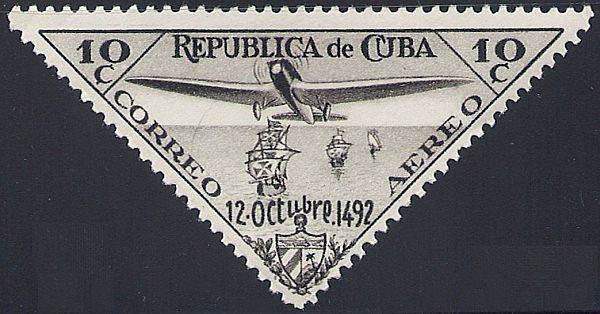
Any guess as to what this is? I don't think it is listed in Scott, and it wasn't in Sanabria (but mine tops out at 1948). Rod, check out the rigging...


Send note to Staff

Pillar Of The Community
United Kingdom
3211 Posts
Posted 09/21/2010   01:23 am  Show Profile Bookmark this reply Add nigelc to your friends list  Get a Link to this Reply
Hi Cjd,

There was a Cuban set commemorating Columbus that was prepared in 1935 but not issued. I've not seen them but I guess this may be one from that set.
Send note to Staff  Go to Top of Page
Bedrock Of The Community
Australia
38679 Posts
Posted 09/21/2010   02:26 am  Show Profile Bookmark this reply Add rod222 to your friends list  Get a Link to this Reply
Something about that triangular that screams Cinderella,
Perhaps the Santa Maria Flags or the Pinta's Lateen
sail on the bow
Maybe the aircraft wings.
Maybe the flags flying 90 degrees to the wind Hehehe.

The Pinta is in the correct location, as she lagged behind
before the Canaries, she lost her rudder, the kind of thing
you need when off to discover the new world.
There was suspicion the lads threw it off in an attempt
not to go into the unknown with Colombus.

I checked a list of all the plate proofs 1905--1960
No evidence there.

I think this is just a weed, and best you send it to me for destruction.


Send note to Staff  Go to Top of Page
Pillar Of The Community
United Kingdom
1356 Posts
Posted 09/21/2010   02:50 am  Show Profile Bookmark this reply Add stampgal to your friends list  Get a Link to this Reply

Quote:
I think this is just a weed

"A weed is a plant whose virtues we have not yet discovered",
(Ralph Waldo Emerson).
Send note to Staff  Go to Top of Page
Bedrock Of The Community
Australia
38679 Posts
Posted 09/21/2010   04:01 am  Show Profile Bookmark this reply Add rod222 to your friends list  Get a Link to this Reply
Yes, very true.
Thank you Ralph.
Send note to Staff  Go to Top of Page
Pillar Of The Community
United States
7072 Posts
Posted 09/22/2010   12:46 am  Show Profile Bookmark this reply Add Cjd to your friends list  Get a Link to this Reply
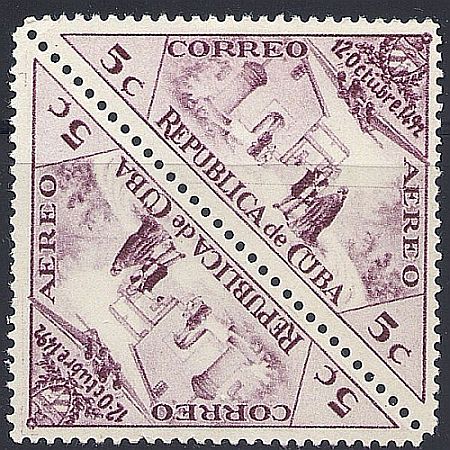
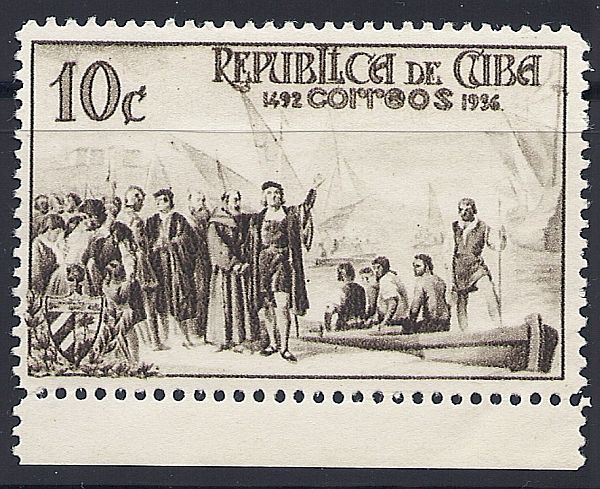
Okay, one more that appears to be part of the same set, and another that might not be...


Rod, the rigging on this last one is just for you...

Sorry for the overly-obvious mylar strip.
Send note to Staff  Go to Top of Page
Bedrock Of The Community
Australia
38679 Posts
Posted 09/22/2010   01:24 am  Show Profile Bookmark this reply Add rod222 to your friends list  Get a Link to this Reply
They will have to remain a mystery for now,
really nice examples though.

The last rigging looks fine, one would expect
to see a majority of lateen rigged ships, for close coastal
work.

JH Parry explains..........

In general, the sailing ship of western Europe, by 1400, was still a clumsy and primitive affair, it could carry large
numbers of men or a bulky cargo for comparatively short passages with a fair wind. It was wholly unsuitable for
following the windings of strange coasts, exploring estuaries, meeting the dangers of shoals, lee shores and head
winds. The square-rigged ship—the nau—played no considerable part in the early discoveries. The Portuguese
preferred a borrowed alternative, the lateen caravel—a highly individual craft which betrayed Asiatic influence in
its every line. Here, too, the Arabs were their teachers.

The deep-water trade of the Indian Ocean from Suez to Malabar was in the fifteenth century almost an Arab
monopoly. Taking advantage of the alternating monsoons, Arab shipmasters maintained a regular seasonal trade
then, as they do today. The ships now engaged in the trade, especially the largest type, the Persian Gulf baghlas,
show unmistakable European influence in the transom stern, with its elaborate carved ornament, and in the method
of fastening the hull with iron spikes. In the fifteenth century all Arab ships were probably double-ended, and their
planks were sewn edge to edge with coir fibre. The characteristic features of design—the 'grab' bow, the deep keel,
the absence of raised fo'c'sle, the long poop —are pure Arab and were much the same then as now. The hulls were
stoutly built, and then as now constructed mainly of Malabar teak, a more durable material than European oak.

In rig, as in hull design, the larger Arab ships have probably changed little since the fifteenth century. They have
usually two masts with a pronounced forward rake. Each mast carries a single lateen sail; a triangular or nearly
triangular sail, the leading edge of which is bent on a long yard hoisted obliquely to the mast. The lateen sail is the
special contribution of the Arabs to the development of the world's shipping; it is as characteristic of Islam as the
crescent itself. It is also a very efficient general-purpose rig. The qualities of any sail when beating to windward
depend largely on its having the leading edge as long and as taut as possible; these qualities are supplied in the
lateen sail by the long yard, and by simple adjustments the set of the sail can be altered to suit almost any wind
conditions.

The Arab lateen rig has two serious disadvantages. One is the difficulty of going about; the yard has to be carried
over the masthead, a complicated and awkward manoeuvre. Under Indian ocean wind conditions it is rarely
necessary to go about; and if he must alter course, the Arab ship-master will usually wear round. The other
disadvantage is more fundamental: the size and weight of the spars. The design of the lateen sail is such that only
one sail can be carried on each mast. The sails must therefore be large ones, and very long spars are needed to carry
them.
Send note to Staff  Go to Top of Page
Pillar Of The Community
United States
978 Posts
Posted 09/22/2010   08:37 am  Show Profile Bookmark this reply Add jbcev80 to your friends list  Get a Link to this Reply
Hi Cjd,

Some Latin American countries issued a Columbus commemorative set which, in most cases, was not issued. This stamp and the others shown looks like it might be the Cuban version of these stamps sets.

I looked in my 1945 Sanabria and they are not listed. Quoting from the Sanabria Ecuador section:


Quote:
"Issued by an official decree to celebrate Columbus Day, October 12, 1935. Prepared by the Columbian Society in a set of five. Printed by rotogravure process in Belgium."


Dogpiling, www.dogpile.com, on 'Columbian Society' did not help very much. If someone has more information about these sets I would appreciate reading more about them, especially the countries involved.

Jerry B

Send note to Staff  Go to Top of Page
Pillar Of The Community
United States
7072 Posts
Posted 09/22/2010   10:18 am  Show Profile Bookmark this reply Add Cjd to your friends list  Get a Link to this Reply
Thanks, Jerry. I agree, I'd like to know more.

Rod, if this was intended to represent Columbus in or around 1492, I'm thinking the lateen rigs wouldn't have been reinstalled once the ocean crossing was complete, would they? It is my guess that he shouldn't have been able to have lateen rigs back again without refitting. Or is my limited understanding of this showing through? Inquiring minds want to know...
Send note to Staff  Go to Top of Page
Bedrock Of The Community
Australia
38679 Posts
Posted 09/22/2010   10:30 am  Show Profile Bookmark this reply Add rod222 to your friends list  Get a Link to this Reply
When I see these types of images, I just assume they
represent Columbus leaving Spain Collin.
The Caravel Pinta IIRC had two Lateen, the front mast was
changed to a square rigger, and a small lateen remained aft.
This was done in the Canaries whilst the rudder was refastened.
I don't think they would have refitted on return to Spain,
my knowledge dosn't go that far.
I have a hazy memory that the Pinta was in bad shape even at the start.
I have Columbus' extensive story on my hard drive, I'll need to revisit.
I also had a genuine image from his log book, but I seem to have lost that.


Send note to Staff  Go to Top of Page
Pillar Of The Community
United States
7072 Posts
Posted 09/22/2010   11:02 am  Show Profile Bookmark this reply Add Cjd to your friends list  Get a Link to this Reply
I was mistakenly assuming it depicted an arrival, but on closer inspection, perhaps it depicts a departure. (?)
Send note to Staff  Go to Top of Page
Bedrock Of The Community
Australia
38679 Posts
Posted 09/22/2010   11:23 am  Show Profile Bookmark this reply Add rod222 to your friends list  Get a Link to this Reply
Yep, I'd go for departure, priests blessing etc,
he looks fit and well waving (he was knackered when he arrived back)
and he may have had the indigenous natives alongside on return.

Do you think the image is a miniature from a painting? looks like it to me,
the triangular looks like there is a monk in the background with a pushbike :)
pictures can play tricks. :)
Send note to Staff  Go to Top of Page
Pillar Of The Community
United States
978 Posts
Posted 09/22/2010   4:42 pm  Show Profile Bookmark this reply Add jbcev80 to your friends list  Get a Link to this Reply
Hi,

After many years the Ecuador set is now listed in the 2011 Scott catalog. I don't have an entire set of catalogs so I cannot check but I wonder if the sets are listed for other countries, if they had a set. Next time at the library I am going to check.

Rodney: I haven't had any Oz dictionary updates since RCSD. What is a "pushbike" and what is "knackered"

Jerry B
Send note to Staff  Go to Top of Page
Bedrock Of The Community
Australia
38679 Posts
Posted 09/22/2010   9:40 pm  Show Profile Bookmark this reply Add rod222 to your friends list  Get a Link to this Reply
Hi Jerry,
pushbike=bicycle,
knackered=worn out, spent, excessively tired.

A few other things:

The Fate of the Santa Maria
The Santa Maria never left the "new world". She ran aground and became hopelessly
stuck on Christmas Day 1492 on the island of Isla Espanola (modern-day Haiti).
Columbus had the Santa Maria disassembled and used the timbers to build a fortress
in what Columbus called La Navidad, the first Spanish settlement. Because of the loss
of the Santa Maria, Columbus was forced to leave 39 men and supplies at La Navidad
to await for his return.

Now to address Collin's orig query, I was searching for my
large file on Colombus (looks like I have lost it )
when I came across this snippet from a Mr. Bob Watson
from a long time ago.

I wonder if it relates to Collin's issues

Talking of the Santa Maria...

There is a Spanish stamp that always gives me a tickle:
http://www3.sympatico.ca/bobwatson1...a_Maria.JPG.

I wrote a little bit about it for our club newsletter which I quote
below and would welcome any additional information.

Incidentally, the same image appears to have been used for 25¢ St Lucia
issued in Jan. 1960 which I don't have and so can't post a picture.

Quote:

This Spanish stamp (Scott# E8) caught my eye recently and could well
find a place in my "Now, hang on a minute…" collection! The point being,
of course, that most "urgente" or "express post" stamps have a design
implying speed, vigour, and determination to get the mail through just
as quickly as possible. So, I realize this is an overprint rather than a
special design, but have you ever seen a more non-urgent looking stamp
than this? Maybe its use was reserved for income tax refund cheques.

Actually the stamp was part of a rather odd series issued in 1930 to
commemorate Columbus crossing the Atlantic in 1492. According to Scott,
the series was designed and printed privately which would normally mean
they would relegated to the status of cinderellas. However, a portion of
the printing were presented to the Spanish Post Office who sold them and
allowed them to be used for postage for a period of three days. This had
the effect of converting them from "labels" to "postage stamps" and
would have significantly increased the marketability of the stocks
remaining in the hands of the promoters.

I have no knowledge as to whether the deal between Post Office and
promoter was legitimate or resulted in heads rolling, but I have never
heard of this practice being followed elsewhere and can see major
security problems with trying to be sure that money paying for stamps
used for postage went to the Post Office rather than the printers.



Send note to Staff  Go to Top of Page
  Previous TopicReplies: 13 / Views: 4,722Next Topic  
 
To participate in the forum you must log in or register.

Go to Top of Page

Disclaimer: While a tremendous amount of effort goes into ensuring the accuracy of the information contained in this site, Stamp Community assumes no liability for errors. Copyright 2005 - 2026 Stamp Community Family - All rights reserved worldwide. Use of any images or content on this website without prior written permission of Stamp Community or the original lender is strictly prohibited.
Privacy Policy / Terms of Use    Advertise Here
Stamp Community Forum © 2007 - 2026 Stamp Community Forums
It took 0.2 seconds to lick this stamp. Powered By: Snitz Forums 2000 Version 3.4.05