| Author |
 Replies: 24 / Views: 9,233 Replies: 24 / Views: 9,233 |
|
Valued Member
United States
11 Posts |
|
|
|
I've gotten increasingly into the earlier US issues, from the bank notes back. I notice in some auction and show listings, a clean stamp may be listed as mint, no gum when it could just as easily be used, but escaped a cancel (or a light cancel was removed) and the stamp was just soaked off its cover. I understand NGAI and various proofs never having having gum in the first place, but there are pricing differences between mint no gum and used. I have always worked from the used price in these cases, simply considering the stamp to be more attractive given its clean appearance, but not attributing the mint no gum price. But the price category exists in Scott Specialized for a reason. Were stamps in this era commonly issued without gum, often enough to justify the proportion of stamps portrayed as such in the market? I have seen some very clean examples from this period with very little indication of wear on the surface or perfs, but how does one clearly differentiate used from MNG? Or is it mainly just a dealer's scam to manipulate price? Thanks.
|
|
Send note to Staff
|
|
|
|
|
Pillar Of The Community
703 Posts |
|
|
My opinion when dealing with US revenues, particularly the reds and greens, is all no gum stamps (unless issued without gum) are simply used. End of discussion. Sadly, a quick spin through the ebay US revenues section will reveal hundreds of "MNG" listings. Wishful thinking at best. "Dealer's scam" at worst, particularly when a canx is visible and pointed out to the dealer, who refuses to "see" the canx, even when software enhanced pics are shown to the dealer... |
Send note to Staff 
|
| Edited by StateRevs - 10/07/2017 12:55 pm |
|
|
Valued Member
United States
11 Posts |
|
|
Just as an example, I'm looking at a listing for Scott #165, the 30 cent gray black Hamilton. Let's call it F/VF. In the U.S. Specialized by Grade, the Unused NG price is $925, and the Used price is $87.50. So there is roughly a 10x premium, if you accept that the stamp is Unused, NG. That's crazy. Who pays that? |
|
Send note to Staff
|
|
|
Pillar Of The Community
703 Posts |
|
|
Pillar Of The Community
United Kingdom
8636 Posts |
|
|
The GB term for this is "unused". I don't collect US stamps, but perhaps Scott's pricing reflects the fact that relatively few early stamps have survived with gum, and that many of those offered may, in fact, be regummed.
In the past, collectors often removed gum from stamps, whether because of the local climate or in anticipation of later damage to the stamp from the gum. And stamps may be soaked from old albums where the gum was licked to position the stamp. Of course, I assume that any modern stamp without gum has been through the postal system, where cancellations now seem to be the exception. |
|
Send note to Staff
|
|
|
Pillar Of The Community
United States
1121 Posts |
|
|
In my opinion, You have, basically, MINT (uncancelled, with original undisturbed gum), UNUSED (uncancelled, with either disturbed gum, hinged gum or no gum), and USED (cancelled, either postally, or fiscally, CTO, etc..), with probable exceptions to all of these.
There is no way to tell if a stamp was placed on a letter, missed being cancelled and the stamp removed, so cannot qualify as MINT, whether it's got gum or no gum.
So, to answer the question from the OP, it becomes USED, when it has been cancelled in some way.
Again, just my opinion.
BTW, I have no problem buying unused stamps without gum. Many stamps had the gum removed long ago to SAVE the stamp from future damage. |
|
Send note to Staff
|
|
|
Valued Member
Canada
19 Posts |
|
|
As far as I know, within first half of 20th century, there were collectors removing the gum from older mint stamps as this was cracking and affecting the stamp. At that time, this was not seen as affecting the stamp value. Moreover, this was done as many stamps were hold in bulk, in boxes, and this gum removal was avoiding them to stick to each other. This is a common way to get a genuine mint/no gum stamp. |
|
Send note to Staff
|
|
|
Pillar Of The Community
United States
1043 Posts |
|
|
When I came back to this hobby a few years ago after a very long hiatus, I decided that collecting 19th century US stamps with original gum, especially "never hinged" was just too complicated and risky. My inspection of stamps for regum versus original gum versus redistributed gum versus part original gum was just too much for my brain to handle and required too much expertise that I do not have. Serious investment would have to be made by me into original gum stamps with certification to truly understand the difference between a good regum job and a true original gum stamp from the 1800s. I still believe that many stamps today certified as never hinged or just original gum from the 19th century have managed to get certificates that have passed through the hands of experts undetected. I believe many of the stamps have been regummed expertly or the gum redistributed to make them appear never hinged. Its my opinion that I know others do not share. But back to the OP question. This one up for auction by Kelleher. What is the right stamp after this thing gets cut up for a 98 grade? Its advertised as a used pair that is barely cancelled. Is there any cancel on right stamp? Is the right stamp unused or used? 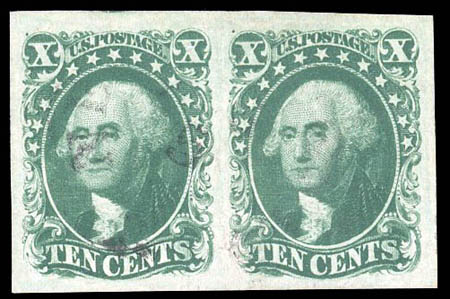 |
|
Send note to Staff
|
|
|
Pillar Of The Community
United Kingdom
8636 Posts |
|
|
Pillar Of The Community
United States
1043 Posts |
|
|
Geoff,
Maybe, but imagine there isn't a cancel on the stamp. I was just trying to post an example to create debate.
It was an example I recently saw that I thought would be good for this thread |
|
Send note to Staff
|
|
|
Rest in Peace
United States
652 Posts |
|
|
Your question is interesting. Louise Boyd Dale, when she was chairman of The Philatelic Foundation's Expert Committee, would issue certificates from time to time with the wording "uncancelled, but not unused". The expert committees in this day and age have gotten away from that wording. There are stamps that are unused because they did not receive a cancel and there are unused, no gum stamps which are that way for preservation reasons. The gum can be acidic and tone the paper with the passage of time. Earlier collectors would soak the gum off to preserve the freshness and whiteness of the paper. I have seen unused stamps with gum so disturbed that the gum affects the appearance of the stamp.
As to what an unused, no gum stamp is worth is up to the buyer. It is your money and you are entitled to spend it any way you want. |
|
Send note to Staff
|
|
|
Valued Member
United States
160 Posts |
|
|
when considering the status of (usually) an early, ie pre-1920 stamp I also consider the condition of the reverse. Is it relatively clean/blemish-free? Would a prospective buyer view it as within reasonable belief it has not merely been washed and perhaps chemically enhanced in some way?
I know there are ways to scan and view the image negatively and readjust settings to attempt to detect any cancellation or inkpen remains. Of course there is always the lighter fluid to help, especially to identify invisible tears, repairs, etc.
Just seems to me if a stamp is offered or otherwise identified as "unused" there should NOT be much on the reverse....ie pencil marks, multiple hinge remains, suspicious "whited out" patches, tell-tale signs of repair attemps, and the like (obviously this applies only to stamps worth considerably more "unused" than used!)
I know collectors used to (and still do, some of them..SHAME! SHAME!) use pencil marks or other attempts to identify or otherwise mark their UNUSED stamps but the closer a stamp reverse OR obverse is to its original "post office fresh" state, the more I would consider an uncancelled stamp a MNG (mint, no gum).
Just my three cents worth,
--Jim
stampguyaps177-681 |
|
Send note to Staff
|
| Edited by jimwentzell - 10/08/2017 11:10 am |
|
|
Valued Member
United States
160 Posts |
|
|
For more recent stamps that have no gum (I usually consider them "skips" as they are likely to have been soaked from uncancelled, but postally used, covers).
I recently purchased quite a few recent sets and stamps from Switzerland from a good collector-friend who is liquidating (or attempting to) his entire WW collection. I had a wantlist, and we went through his collection and the majority of stamps and sets were NH as they were from the modern era.....1980's through 2010 issues.
There was no need, or so I thought, to check the backs of every stamp; the vast majority were indeed NH. But days later as I mounted the stamps into my Lindner hingeless album I notice maybe eight or ten stamps had NO gum, and a couple had the occasional light hingemark.
What to do? As I generally don't really care or worship NH material, I still continued to fill my album holes with the ungummed "skips" But I put a tiny PostIt note (they make them about an inch wide by 1/3 inch) indicating they were MNG or LH.
I figure future consignees of my collection would appreciate the fact I noted which stamps were less than optimum It IS, afterall, a "hingeless" stamp album......
|
|
Send note to Staff
|
|
|
Pillar Of The Community
United States
752 Posts |
|
|
rgstamp: that is a very thought provoking pair that you show emphasizing that, when evaluating a single stamp specimen, whether perforated or not, what we don't see can sometimes be more important than what is right in front of us. |
|
Send note to Staff
|
|
|
Pillar Of The Community
United States
644 Posts |
|
|
In the early days of philately a lot of collectors soaked gum off of stamps in order to help preserve them, while I am sure that some classics exist that saw postal service and were never cancelled, that was an extremely rare occurrence in the 19th century. |
|
Send note to Staff
|
|
|
Pillar Of The Community
United States
4189 Posts |
|
|
To amplify the last post, modern US are cancelled by machine, but the earlies were all done by hand. |
|
Send note to Staff
|
|
|
Replies: 24 / Views: 9,233 |
|




 Posted 10/07/2017 11:17 am


