| Author |
 Replies: 13 / Views: 2,940 Replies: 13 / Views: 2,940 |
|
|
Valued Member
United States
139 Posts |
|
|
|
Scott does not list a value for this stamp. What would the value be for a MNH F/VF pair be?
|
|
Send note to Staff
|
|
|
|
|
Pillar Of The Community
United States
578 Posts |
|
|
Do you mean Scott #842 1939 3 cent violet coil pair? If so, should not cost much over $1.00, I should think. |
Send note to Staff 
|
|
|
Valued Member
United States
139 Posts |
|
|
Pillar Of The Community
United States
506 Posts |
|
|
A picture would make it clearer what you are talking about. Small holes compared to what. |
|
Send note to Staff
|
|
|
Pillar Of The Community

United States
1498 Posts |
|
|
While I am not familiar with the hole sizes for the prexie series, I would assume they may be somewhat similar to the ones for the later Liberty series. The catalogue values for small hole vs. large hole seem to indicate that, in most instances, the smaller the perforation holes, the larger the value. Case in point is the Bunker Hill Monument coil. Normal hole (slightly larger than 1mm in diameter) pairs catalogue at 60 cents while small hole (slightly less than 1mm) pairs catalogue at $850. A considerable difference in value for so slight a difference in hole size. The Sonic Imagery Labs Precision U.S. Specialty Multi-Gauge includes a tool to help identify Liberty Series hole sizes.
Presumably, the different hole sizes were the result of using perforating pins with different diameters. Note that the perforation gauge does not change ... just the hole diameter size.
Added: Note that I have assumed that different hole sizes were caused by different sized perforating pins. I am not convinced that this is actually true and would like to see an accurate explanation of what caused the difference. Besides the perf pin diameter, perforation speed could play a role in the hole size.
Added: Did a search on previous forum threads and found one that discussed Scott 496a. The upshot is that small holes were likely the result of smaller perforating pins. |
|
Send note to Staff
|
| Edited by JLLebbert - 03/04/2019 03:16 am |
|
|
Valued Member
United States
139 Posts |
|
|
Thanks for your informative post. Scott lists this 842 variety without showing a value. |
|
Send note to Staff
|
|
|
Pillar Of The Community
United States
1498 Posts |
|
|
The lack of a CV in Scott for this variety indicates that they don't have sufficient information to establish a value. This may be due to rarity but also may be due to fairly recent discovery of the variety. In the 496a thread, it was mentioned that many of the older small hole coils first appeared in Scott around 2010 or 2011. If you have access to an older catalogue, you might check it to see if the 834 small hole had been listed yet. |
|
Send note to Staff
|
|
|
Valued Member
United States
152 Posts |
|
|
Liberty Series coils with small holes/large holes was covered in a previous SCF discussion, July, 2014. A fairly adequate explanation is given there related to why there are two hole sizes. https://goscf.com/t/5796&whichpage=2Noted philatelic author/researcher Ken Lawrence also wrote about the small hole/large hole Liberty Series and gives a more detailed explantion in his article "Collecting the Liberty Series" in the August 1992 issue of the United States Specialist. All of the Prexy coils are Scott listed with small holes, but no values are listed as of yet (2019 U.S. Specialized). |
|
Send note to Staff
|
|
|
Pillar Of The Community
United States
4183 Posts |
|
|
Pillar Of The Community
3865 Posts |
|
|
Pillar Of The Community
3865 Posts |
|
|
I have read the article on small perforation holes "A Newly Certified Washington-Franklin Variety: A Coil Pair With Small Holes" by Ken Lawrence in "Scott Stamp Monthly" Volume 24, Number 6, June 2006, pp. 22-28. In it, it says that used copies cannot be definitely identified as small hole varieties due to paper changes from being soaked in water. This is interesting given that some used copies have been certified as having small holes.
There appears to be around 3 main groupings in which small holes have been found: 1) Washigton-Franklin coils Scott 490-497 (wet), 2) Prexie coils Scott 839-851 (wet), 3) Liberty coils Scott 1054-1059A (dry/wet).
|
|
Send note to Staff
|
| Edited by jogil - 06/04/2020 09:48 am |
|
|
Valued Member
United States
10 Posts |
|
|
I recently received a Scott 842 small hole joint line pair with a Philatelic Foundation certificate. I also have a strip of five with partial plate number 22324 with an APS certificate. I have not seen any published sale prices for the small hole variety. If anyone has seen a price, I would like to find out about it. I can be contacted though the APS or ASDA dealer list. I can confirm that Stickney rotary press small hole coils were a result of using smaller pins. Larger perforation pins were initially used to produce the first vertical rotary press coils, Scott 448, 449, and 450. Standard size pins were also used. Larger holes may have also been used to produce some Scott 489 3 cent vertical coils. Louis E. Repeta in his Stickney Rotary Press article series that the [maximum] bar perforator pin size was 0.045". Most Stickney coils were produced with a 0.042" pin size. Aside from larger pins used initially, smaller pins may have been used when standard pins were unavailable, likely at wartime or just before the transition to the Cottrell presses while the Liberty Series was current. Perforators intended for use with the new presses had smaller holes, more crisply punched and smaller than the smallest holes found in wet printed coils or horizontal rows of rotary press sheet stamps. Liberty Series wet printed small hole coils have larger holes than dry printed small hole coils. 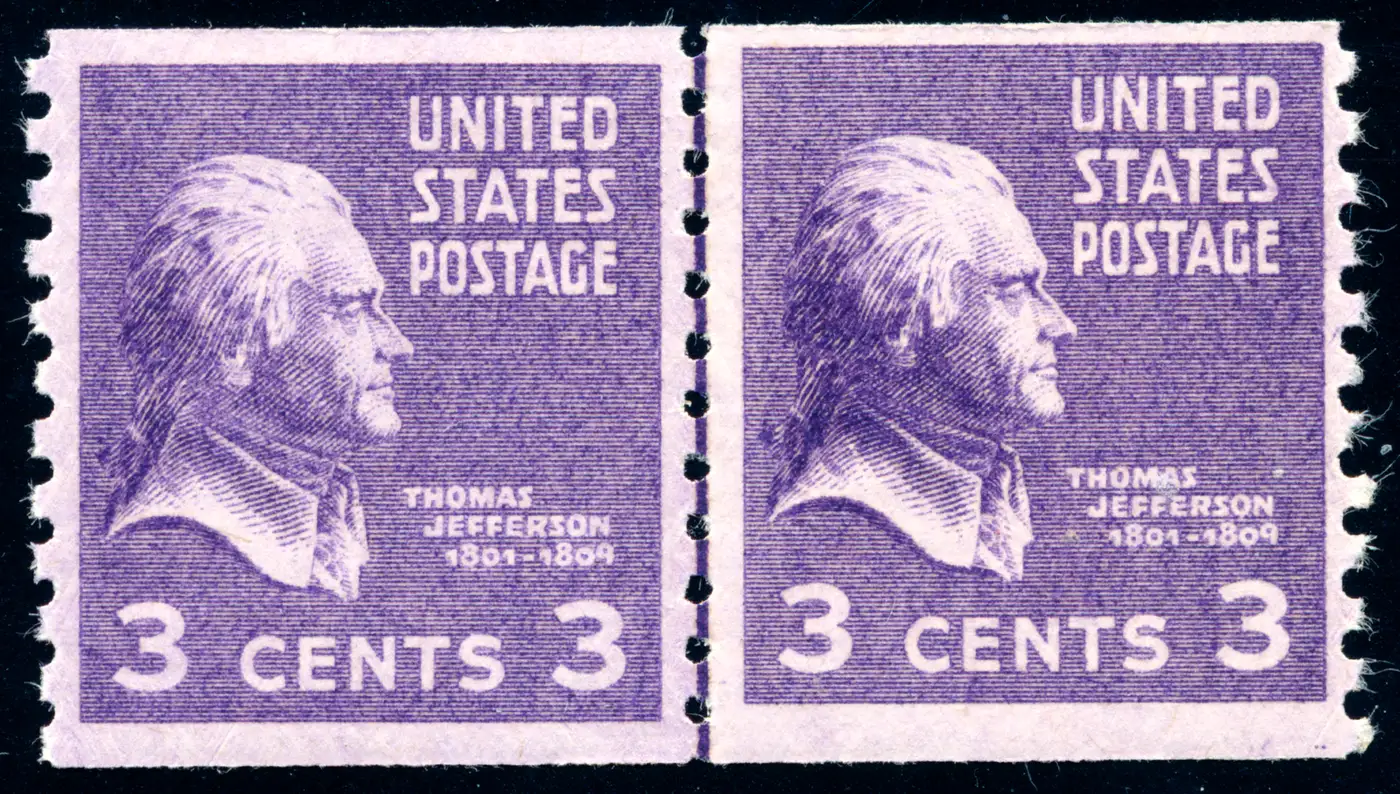 |
|
Send note to Staff
|
|
|
Pillar Of The Community
United States
1116 Posts |
|
|
I understand that anyone can ask any price (!), but I can offer this: I sold a "small-hole" variety Scott 842 MNH line pair in March, 2025 for $57.50. I have NOT seen a price list from any dealer. 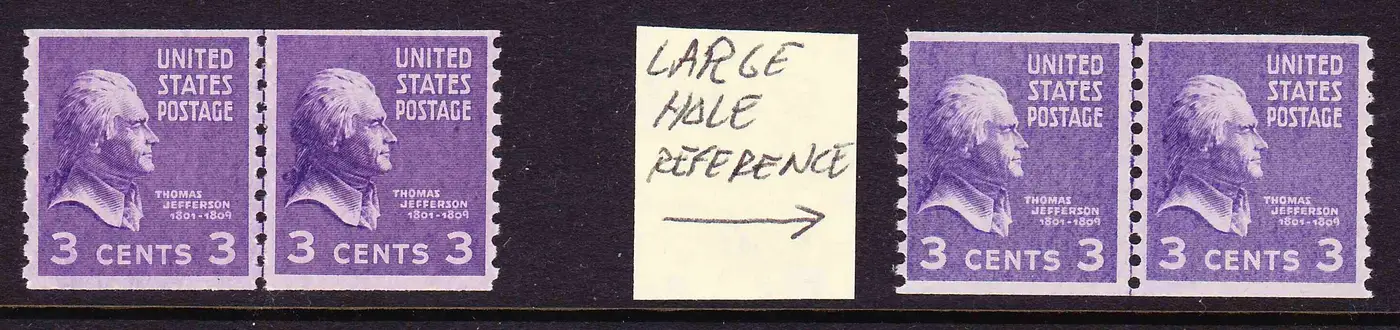 |
|
Send note to Staff
|
|
|
Valued Member
United States
10 Posts |
|
|
The BIA plate number survey on the USSS website lists Scott 842 plate 22324 used between 11/19/1940 and 8/14/1943, confirming that smaller pins were used during World War II. Surprisingly, prices for Scott 496a the 5c Washington-Franklin small hole coil, have been robust. Scott lists a very fine never hinged 496a joint line pair at $750. While larger quantities of 842 small hole coils could have been produced during World War II, few may be in the hands of collectors. Only a few small hole examples of the 4 cent Scott 495a exist. Why do so many 496a examples exist? The reason may be that a dealer in the Northwest had a partial roll of 496a that he broke up and sold to local dealers. Soon after the initial discovery was published in the Scott Monthly Journal, a Seattle area dealer found two pairs in his stock and other discoveries followed. 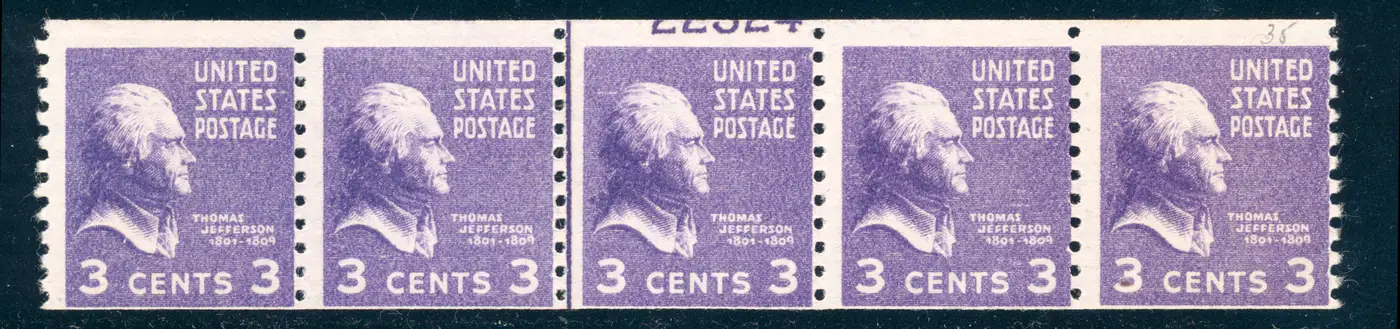 |
|
Send note to Staff
|
|
| |
Replies: 13 / Views: 2,940 |
|



 Posted 03/02/2019 3:25 pm


