There's an old adage amongst experienced collectors that goes something like "It's not the items I overpaid for that I regret the most, but rather the items I didn't overpay for that got away." It took me a number of years to realize that this is incredibly true.
When we start collecting and are typically on a tight budget, either as children or as someone just dipping a toe in the water, and most of our collecting circle are also spending nominal amounts, the initial mindset tends to be "I would never pay more than X% of catalogue value" or "If you're paying more than Y% you're overpaying." Even amongst certain groups of lifelong collectors, that can be a prevalent mindset (some of the members of my local club spring to mind). For some, it's due to financial constraints, and that's understandable. For others, they never graduate to more advanced or more specialized collecting where pursuit of material goes outside of "fill the spot in the album" collecting where one needs to go beyond discrete catalogue value percentages.
I say that not as a criticism. If a collector doesn't feel the need to "stretch" for items financially, yet are content and enjoying the hobby, more power to them!
One of the tough things is determining how much is enough... or too much for an item, especially if it has a low population or exceptional condition/grade, where the catalogue norms either go out the window, or are completely irrelevant. The spread in perceived value can be all over the map and extremely subjective.
For example, one of the items I lusted after for years was the document below, the improper use of fourteen 25-cent Parcel Post stamps (Scott #Q9) as revenues on a 1916 warranty deed (image courtesy of Stamp Auction Network).
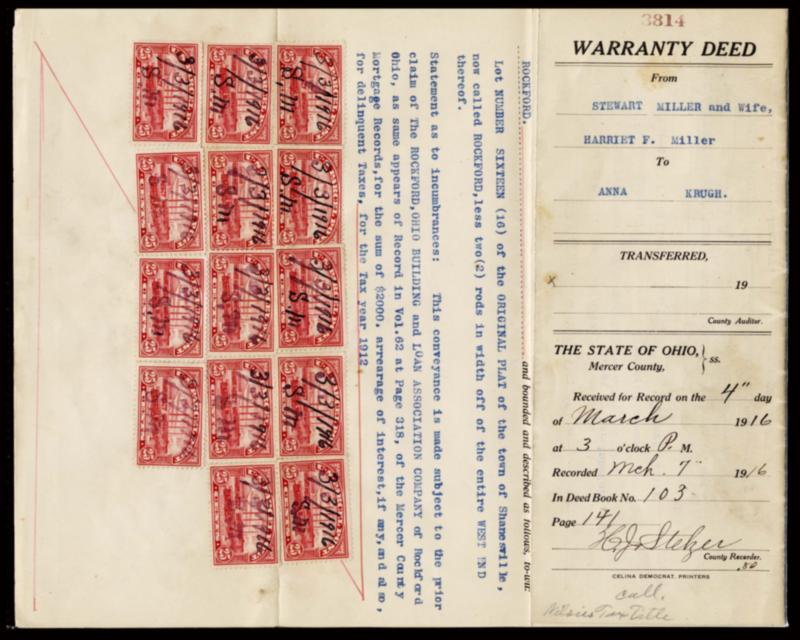
Mike Morrissey consigned it with Eric Jackson, where it languished for many many years at the eyewatering price of $12,500. Yes, it's unique and spectactular, but that's a very aggressive price IMO. More recently, Denny Peoples attempted to purchase it after it went back to Mike, but to no avail. Then it was consigned to Richard Friedberg, who offered it to me for $4,000. A HUGE difference in perceived value from the previous asking price, but unfortunately still beyond my means. It last resurfaced in a Michael Aldrich auction on SAN in October of 2025, where it garnered $3,500 + $525 buyer premium.
I was initially sad that it had been consigned with Aldrich, as that meant I would never own it, as I will not participate in his auctions on principle, but since it ended up being more than I was willing to pay anyway, I won't lose any sleep over it.
I've learned to not beat myself up over items I lose out on at public auction or
ebay auctions. It's easy to say "I should have just bid one more increment", but that mindset is a trap. You have no way of knowing whether the opposition's maximum was one increment, 5 increments, or 10 times your maximum bid. You can never know. Those parameters are outside your control unless you have unlimited funds.
On the other hand, when an item is offered to you at a fixed price, then that *IS* a situation within your control. You just have to decide whether you can or are willing to pay the asking price. It's a different set of conditions...
This brings us to today... the Indiana Spring Stamp Fair is this weekend. I made the 2 hour journey, and as usual, my first visit was with Denny Peoples. After I had looked through most of his inventory that I typically check, he said "I have a piece to show you." I looked at it... and asked how much? He quoted a price, and it was a firm one. After I stopped wincing, I said "No, I can't justify that." He said "Fine, I just wanted to give you first shot at it." I started looking at other things, but after a few minutes I asked if I could have the document back to take pictures of it, as "I know I'll never see anything like it again."
It was at this point that I had to stop and take a step back for a second to reassess based upon that very thought. If it truly was this scarce of an item (and it fell SQUARELY within my collecting focus), was the price unreasonable?... or just unexpected and not within my immediate means or planning. If the latter, I felt I needed to consider what I could do to possibly acquire it. Yes, the price was 3X what I had budgeted for the entire show (and I hadn't been to anyone else's table yet!), but was it worth doing some financial finagling or ramping up my
ebay selling activity after the fact to make it happen?
So after some pondering and some online research, I told Denny I would take it.
Was it (fiscally) painful? Yes. Absolutely! But I take solace in the fact that the financial pain will ebb, whereas the heartache, had I NOT stretched to acquire the piece, would have lasted FAR longer, and I would have kicked myself for years knowing I had the chance to add it to my collection.
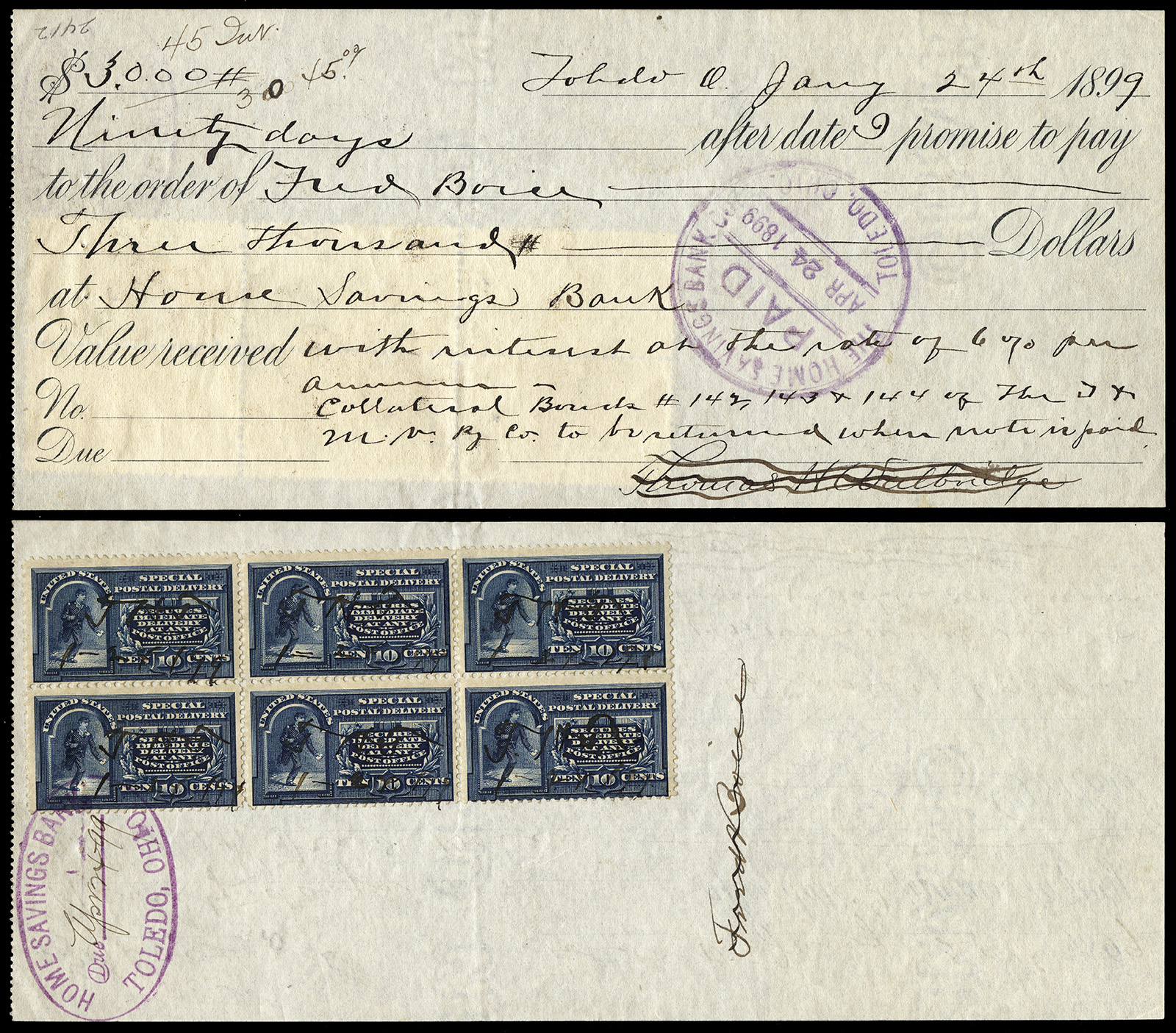
So what is this supreme "OMFG I gots to have it!!!!" piece? It's rather mundane on its face, and likely of less interest to those who specialize in the stamps in question, but to someone who specializes in improper revenue uses it's almost on the scale of the document shown above.
It's an 1899 90-day promissory note in the amount of $3,000. The tax rate owed was 2 cents per $100, thus a total of 60 cents tax... paid via a block of 6 of 10-cent Special Delivery stamps (either Scott # E4 or E5, depending on watermark presence). All stamps are manuscript cancelled on the day the document was written (January 24, 1899), and then the block was also handstamp cancelled by Home Savings Bank on the date of payment (April 24, 1899).
This document was previously owned by Robert L. Markovits and included in his award winning exhibit "U.S. Special Delivery." He also indicated that this document was the largest known used multiple. He identifies the stamps as E5 (watermarked).
In the world of improper revenue uses, this is a spectacular one-of-a-kind document... and now it has a new home.






 Posted 04/11/2026 9:40 pm