| Author |
 Replies: 21 / Views: 1,274 Replies: 21 / Views: 1,274 |
|
Pillar Of The Community
United States
605 Posts |
|
|
|
PlateAI — Plating the 1851–1857 3c with Artificial Intelligence
How many collectors of United States stamps have at least 1 copy of the 3c 1851–1857 stamp in their collection? Probably almost everybody!
How many of those collectors have wondered what position their stamp is — but have not been willing to deal with the drudgery of learning to plate?
How many collectors wonder if their supposed Scott #10 is really a Scott #11 — or visa-versa?
If you are one of those collectors — you will soon have a tool in your hands that will change all of that – PlateAI!
Watch here for a major announcement – expected within the next week or so.
PlateAI will forever change the wide world of plating the 1851–1857 3c issue as we know it today. Gone forever will be the drudgery aspects of plating – as PlateAI leverages the process – enabling the collector to focus on arriving at that "aha moment" much more enjoyably and efficiently!
Who will make all of this possible you may ask? The answer is Phillazilla — another fellow collector who is quite active here on SCF — and J. Bryan O'Doherty who has graciously agreed to host PlateAI on his StampPlating.com website.
In a way, SCF can be partly credited for making all of this possible — as if not for SCF, Philazilla and I would have never connected — a fortuitous turn of events to be sure.
I first connected with Philazilla here on SCF back in October 2024. A serious philatelist with an interest in the 3c issue – but not a plater. Back then, he had a pair of Scott #10 that he was trying to plate and was asking for some help. Since that time, in just a year and a half, he has become a serious student of the issue – learning to plate from scratch – and has grown into a proficient plater in his own right. Couple that with his information technology background and data analytics expertise — and viola — PlateAI went from concept to reality.
As I write this post – the utility is in the final stages of beta-testing – and the release candidate is getting its final polishing touches to deliver an incredible user experience.
So, stay tuned and watch for Philazilla's announcement coming soon!
Regards to All // ioagoa
edited only to fix spelling and grammar
|
|
Send note to Staff
|
| Edited by ioagoa - 04/30/2026 3:02 pm |
|
|
|
|
Valued Member
50 Posts |
|
|
I am so excited to see this become reality! Dave's contribution to plating AI will break new ground at the highest level I can imagine. |
Send note to Staff 
|
|
|
Pillar Of The Community
United States
804 Posts |
|
|
Pillar Of The Community
United States
1086 Posts |
|
|
This is fantastic. I have about 30 or so more of these I have not been able to plate after spending more time than I would like on each one. Most are missing parts of the frames making it more difficult. Identifying or even narrowing down to a small set with the help of AI would be awesome! |
|
Send note to Staff
|
|
|
Pillar Of The Community
United States
3487 Posts |
|
|
Quote:
Posted Oct 6, 15 12:27
Analytics, Cognitive Computing and Philately
Thought for the day. Analytics and Cognitive computing are moving along at a pace that most would not believe. The momentum in the IT industry in this space is crazy. We already have technology that allows very complex parallel problems to be solved using fairly simple programming paradigms. That leads me into thinking about where this could be applied in the stamp hobby. Pertinent to this board, would be obvious things like cover analysis, stamp identification - fake detection, plating, etc. One would simply snap a picture of the item with your smartphone, and it would be fully analyzed via an app.
Someone would still have to generate the digital data, such as genuine examples of stamps, postal markings and the like. Some sort of rule infrastructure defining what is what would have to be created. What is evolving quickly in IT, are usable infrastructures to consume this data and enable someone to write a program to analyze it much easier than previously possible. Its still a lot of work, at this point in time, for an individual to write such a program, assuming the data has been gathered (also a non-trivial issue - but better understood). Soon, however, I think many of these capabilities will be common-place.
My reasons for mentioning this are twofold -
1) Analytics and Cognitive computing already exist in many industries today, and are spreading insanely quickly. How many of you have gotten the phone call from a robot, that says your credit-card account has suspicious charges on it? That's pretty common these days, and is driven by computer analytics studying what normal behavior is for your credit-card use, and notifying you when it detects something abnormal. Like a charge from Antarctica, maybe.
2) Finally my real reason for writing this, is I wonder if or when such tools exist for philately, what would the impact be?
Will it take some of the fun out of researching an item?
I think it may make the study and understanding of complex issues in philately, more accessible to anyone. For example, being able to expertise any stamp or cover from any country immediately with no help other than your smartphone and a philately-app.
Might this help make the stamp hobby more accessible to all? I'm just reflecting on a post I made on Richard Frajola's board almost 11 years ago, and how far we've come. My post was not met with enthusiasm by the way. I am very excited to hear about the AI plating project. That's just awesome - bravo ! I am a programmer and I use AI in my job every day now. Its great to see some real tech advancement in the stamp community - we need it. |
|
Send note to Staff
|
|
|
Bedrock Of The Community
United States
10601 Posts |
|
|
[qFor example, being able to expertise any stamp or cover from any country immediately with no help other than your smartphone and a philately-app.][/q]
I suspect that this is still a long way off. It might, and I repeat might be possible to tell a correct catalog number. If the design is clear enough. But would you want to trust a PC scan for a valuable shade? Too many variables involved to do so. And it will not be possible to examine a stamp for faults just from a scan unless the are very obvious ones. |
|
Send note to Staff
|
|
|
Bedrock Of The Community
United States
10601 Posts |
|
|
And that does not take into account watermarks, and coil edges, and paper types. |
|
Send note to Staff
|
|
|
Pillar Of The Community
United States
3487 Posts |
|
|
Clearly we are not all the way yet - things like colors are really hard of course; not to mention things that require in person id.
But - AI has some serious potential here. Really.
There is no question in my mind but that it "could" get to a point of being quite prolific at cover analysis and many other things that can be done from a scan - with appropriate caveats for things one has to see in person.
It really comes down to whether some dedicated people, such as those here in this thread put forth the effort to birth such things. |
|
Send note to Staff
|
|
|
Pillar Of The Community
United States
3487 Posts |
|
|
There has been discussion of loss of philatelic experts.
This is part of the solution to that.
Emphasis on "part".
With programming, these AI agents are great assistants at the moment, but they cannot be fully trusted. They don't "know" that 2+2=4. They just know that statistically it usually is. They often fail to add correctly. With time, they will get better. |
|
Send note to Staff
|
|
|
Bedrock Of The Community
United States
10601 Posts |
|
|
There is no question that it can be a big help, especially with teaching newbies the basics, and with eliminating research lines that are not productive in postal history. |
|
Send note to Staff
|
|
|
Pillar Of The Community
United States
804 Posts |
|
|
The limiting factor for every AI application in philately (or anything else) is the data. Given enough training data, plating, stamp identification, and some kinds of stamp fraud are good candidates for machine learning applications. I think the lowest-hanging fruit in US Philately now is probably type-identification on banknotes or Washington-Franklins. The 1¢ is a huge challenge because of lack of training data, though 1L and probably 1E could be plated-by-machine in the short term.
Already ChatGPT can tell you the Scott number of uncomplicated issues, though, of course, it sometimes confidently lies to you. . .The tools to build a general-purpose stamp-identification tool exist, and the methods and architecture are not complicated, but it would be a huge manual undertaking to find and handle all the images. Probably someone will try it and succeed. The barriers to build this kind of thing have come way down in the last year - and that trend will continue for the foreseeable future. |
|
Send note to Staff
|
|
|
Pillar Of The Community
United States
804 Posts |
|
|
Large Language Models don't know that 2+2=4 . . . but LLM's are only one AI tool we have available. |
|
Send note to Staff
|
|
|
Pillar Of The Community
United States
1086 Posts |
|
|
We have a sign at work that says "2+2=5, for sufficiently large values of 2". |
|
Send note to Staff
|
|
|
Pillar Of The Community
United States
3487 Posts |
|
|
Bedrock Of The Community
United States
10601 Posts |
|
|
Valued Member
United States
91 Posts |
|
|
I've been a PlateAI Beta tester for the past couple of weeks. WOW!! I started specializing in the 3c 1851-57 (colors) in 1982 and my adventures with plating the 3c 1851-57 started about 1990, mainly to id. #10s from #11s. I spent long hours bent over the Smithsonian's Chase set of photos with a 10x magnifying flashlight comparing an unknown with the photos, sometimes plating a few stamps a night and sometimes taking several days to find one stamp (or never find it). Pure determination and drudgery. Then along came Bryon and his web site 'stampplating'. That 40 year old magnifier of mine is still nearby but seldom used. This put some fun into plating but still there was the drudgery. Then the 'compression' technique shortened the drudgery and made plating faster and easier. Stampplating made confirmation almost painless. With PlateAI I can have a list of 10 (or 20) candidates 30 seconds after uploading a 1200dpi scan of a stamp. Of course, the unknown stamp still has to be compared (plated) against the list of candidates. 90% of the drudgery is gone. I've plated more stamps in the past 2 weeks than I have in the past year. StampAI does fairly well with 2 margin stamps that I have had for years and never wanted to spend the time plating them. The stamp below StampAI placed in the 13th candidate slot in 30 seconds. Using the comparison tools StampAI provides, it took me less than 10 minutes to make the tentative match to 77L4 (slot 13) and another minute to confirm the position on stampplating. 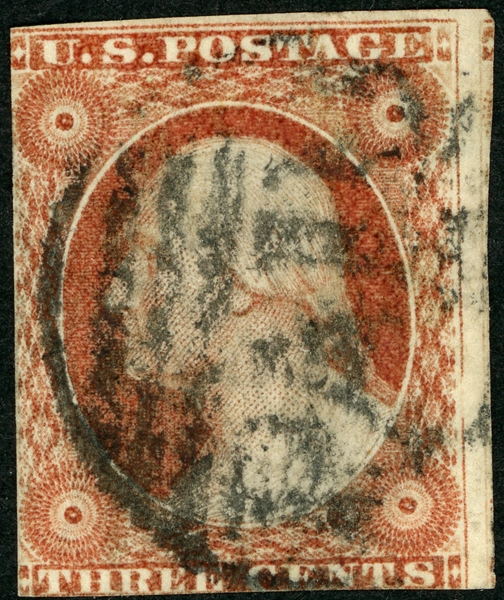 |
|
Send note to Staff
|
| Edited by 3c1851Fritz - 05/01/2026 02:58 am |
|
|
Replies: 21 / Views: 1,274 |
|



 Posted 04/30/2026 12:52 pm


