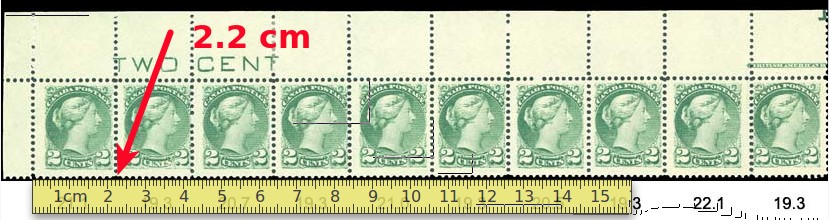
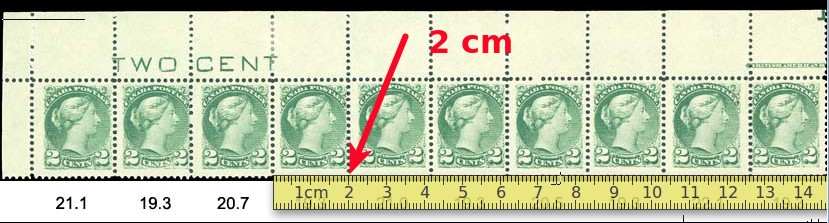
Quote:
Hi lithograving
Was looking at these stamps of yours and I really don't think they are a match or were even attached to each other.
Look at the picture..The one on the left measures 11.8 cm and the one on the right measures 12.6 cm.
If they were once together, the perfs should be even....IMO
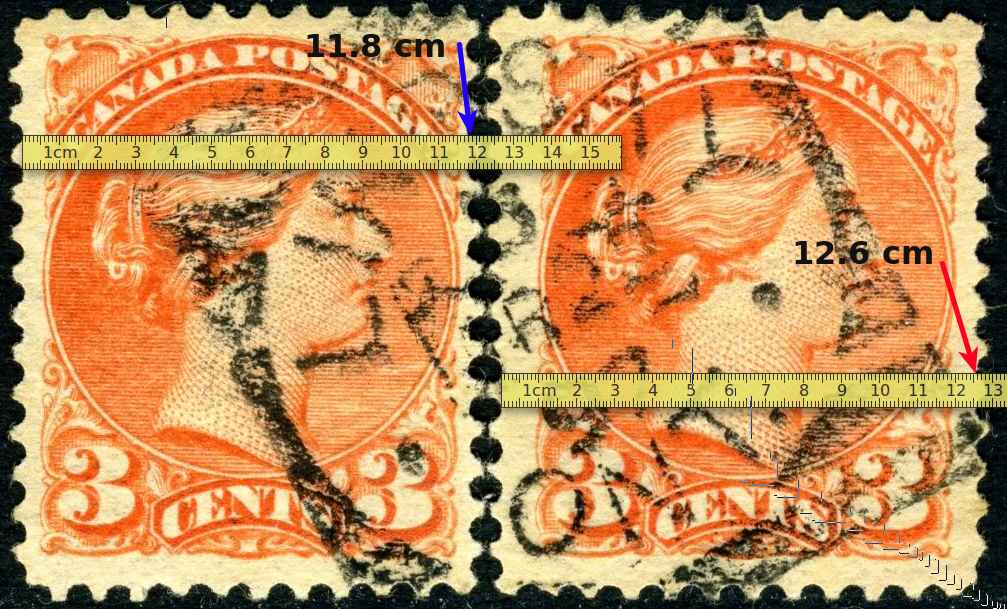
Hi wert
Shouldn't that be in millimeters not centimeters ?
I'm not really into classic stamps or the small Queens but
I do know that the perforation techniques were not as
precise then as they are now nor was print quality that important.
Therefore isn't it possible that sometimes even on the same sheet
the vertical or horizontal spacing of the pins varied causing
a one or two mm difference in the width of adjacent stamps.
Here is a quote from the Small Queens Study Circle of BNAPS
March 1990.
Quote:
Let us consider some facts about perforations on Small Queens . High perforation anomalies are found on all Small
Queen issues from the earliest to latest printings . A typical example occurs with the 3c 1870-73 printings
From research done by the author there is evidence that
perforator pin sharpening results in a perf gauge increase of approximately 0 . 10 for each sharpening ( see the
art itl'Q I 6 S S6 V01 .14 60). Thy' 12.30 recording in figure -2a is most likely the result of a pin wheel that has
been sharpened 2-3 times. Pin sharpening was an irregular maintenance procedure and we note many instances where
only the problem pin wheels were sharpened resulting in compound perf examples. It is difficult to predict how many
high perf examples exist, however , for each double sharpened pin wheel one can expect twenty compound perf stamps
per sheet perforated ( ie. 20% of the total stamp production ). Figure-2b shows the horizontal perf gauges on the
same stamps and we note perforation values as high as 12 .20. There will no doubt be even higher perf values found
once collectors search their accumulations.
Thanks
studystamps you beat me to it. Nice illustration.





 Posted 10/14/2012 12:27 pm