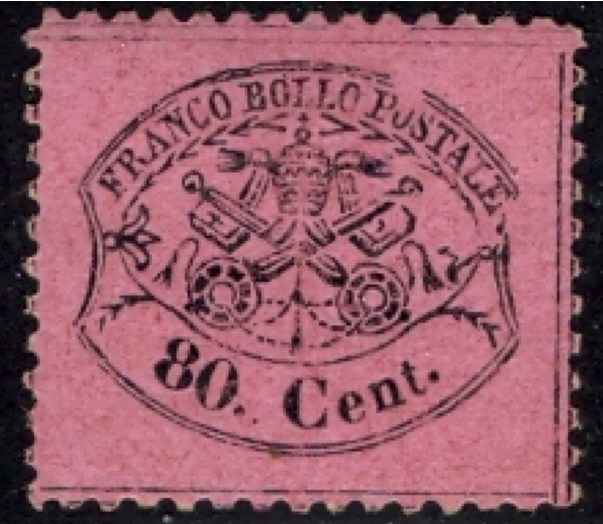
Here's a note I found online:
Reprints:
ATTENTION: most of the centesimi stamps of the Papal States have been reprinted in large quantities. They are very hard to distinguish from original stamps. The only easiest way [
sic] to distinguish them seems to exist for perforated stamps (imperforate reprints are very difficult to distinguish from genuine stamps): genuine perforated centesimi stamps should have the perforation 13 1/4 (irregularly). Unofficial reprints were made by:
Usigli (1878) 2, 3, 30, 40 and 80 c (thick paper, colours different and different gum), imperforate or perforated 11 1/2 or 12. He also made essay-strips with all values together on one sheet (thus also creating stamps with background colour different from the genuine stamps), for an example see: 'Philatelic Forgers Their Lives and Works' by Varro E. Tyler, page 53.
Moens (Brussels, 1889): All values, imperforate or perforated 12
Gelli&Tani (Brussels) (Bonasi?): All values, some different colours, perforated 11 1/2 to 13 (very regularly)
David Cohn (1890):All values (with or without gum), shining paper, imperforate or perforated 11 1/2, printed in enormous quantities, these are the most common reprints.
From
http://catalogue.klaseboer.com/vol2...l/papal2.htm





 Posted 12/21/2010 6:36 pm