Lately I have been going through my envelopes of used pre-1900 Canada stamps to see if I should sub-divide them based on cancels. Many, of course, are the side by side town postmark/obliterator know as the duplex marking. In 1891 (Boggs p625), it was decided to try integrating the postmark and cancel into one entity and they did so in January, 1892 for 8 of the larger post offices (Halifax, Hamilton, London, Montreal, Ottawa, St. John, Toronto, Winnipeg).
In April, 1893, this single entity evolved into the squared circle design with thin bars in the field between the inner circle and the outer perimeter and over the next two months they were issued to 25 post offices. The lines, however, immediately proved to be too thin and the design was superseded in June by one with thicker bars and, I assume, heavier print in the city-date portion judging by Boggs' image (see below). This design became standard till shortly after 1900 (Boggs reported it from over 250 post offices and four railway routes).

There is, I assume, a narrow window here for cancellation collectors, namely, the thin-barred duplex cancel that supposedly lasted only a few months. I am not a cancellation expert but wonder if usage of the thin bar duplex cancel continued for a time after the introduction of the thick-bar design. Below is a Dec 18. 1894, Ottawa cancellation on the 2c Queen Victoria (Scott#36) that might be the thin-barred type (or seems to on the actual stamp). Anybody have any ideas on this?
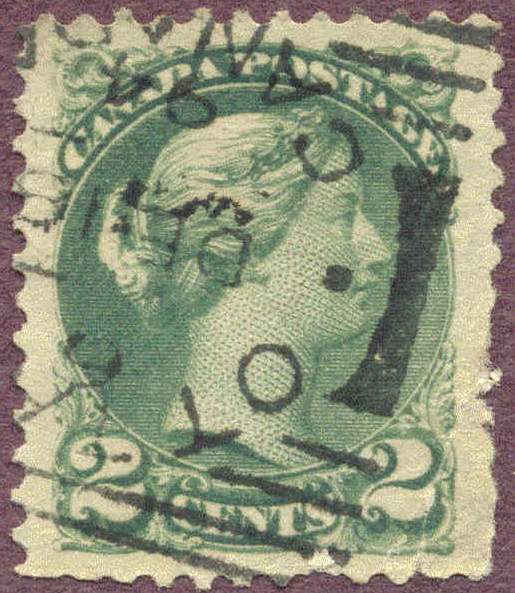
I should add that of the 25 communities supplied with the thin-bar type, at least four either no longer exist or have been re-named.





 Posted 01/06/2011 4:49 pm


