| Author |
 Replies: 11 / Views: 2,430 Replies: 11 / Views: 2,430 |
|
|
Pillar Of The Community
Australia
2156 Posts |
|
|
I recently bought a large lot of old Italian stamps. This is possibly the most interesting item I've noticed so far. This is the 25c olive-green and green issued in June 1926 (Sassone 200) as part of the Floreale definitive series. The stamp is shown on the left is the way it's supposed to look - that on the right is an example that is missing the olive green. 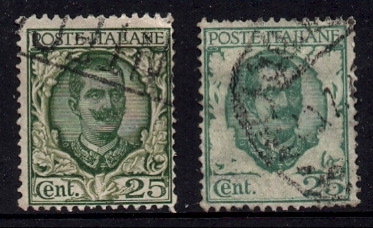 This is a larger image of the stamp on the right: 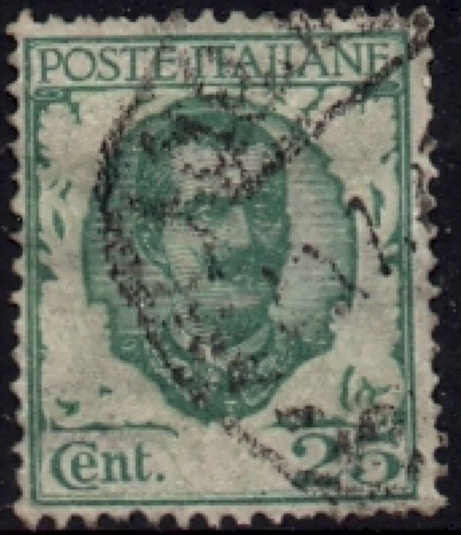 What I'm wondering is whether this stamp is a case of a printing error (olive green colour omitted) or a colour changeling. Is it possible that at some stage the stamp was washed in something that made the olive green ink dissipate entirely? What do people think? |
|
Send note to Staff
|
|
|
|
|
Pillar Of The Community
United States
7105 Posts |
|
|
I think the washing out of the remaining green makes fade/soak/chemical something the most likely answer. |
Send note to Staff 
|
|
|
Pillar Of The Community
Australia
2156 Posts |
|
|
Cjd, that's the nub of the problem. I have 7 other examples of this stamp and after looking at them I find such variation that it's not at all clear to me that the remaining green in the stamp on the right does have a 'washed out' look: http://www.freeimagehosting.net/ima...1ce1e824.jpgSo this could just be what the stamp looks like without the olive green printing. |
|
Send note to Staff
|
| Edited by jimjamtwo - 01/10/2011 12:05 am |
|
|
Pillar Of The Community
United States
2547 Posts |
|
|
Some of the loss of detail in the outer ornaments may be due to plate wear. These lighter detail lines are cut shallower than the other lines. I don't know enough about the ink used on these issue to comment about their stability. Many ealier inks did fade and change color especially where applied very thin such as in worn plates. |
|
Send note to Staff
|
|
|
Pillar Of The Community
Australia
2156 Posts |
|
|
Green inks seem to be particularly unstable. I've noticed that in the case of an Edwardian issue from Hong Kong in which the green colour has changed so much that it's sometimes taken for an uncatalogued variety.
However, I've never seen a colour 'fade' to invisibility. It's always possible, of course, but it seems highly unlikely to me.
|
|
Send note to Staff
|
| Edited by jimjamtwo - 01/10/2011 12:23 am |
|
|
Pillar Of The Community
United States
2547 Posts |
|
|
The U.S. 1851 3 cent ia the most note U.S. stamp for plate wear. The ink used is know to oxidize but does not tend to fade badly. In the worn plates large amount of the design is literally invisible. Under 30X mag the impressions are normally at least partially visible. Can you see signs of the impressions under magnification? |
|
Send note to Staff
|
|
|
Pillar Of The Community
Australia
2156 Posts |
|
|
Russ, I can, but they're very, very faint. |
|
Send note to Staff
|
| Edited by jimjamtwo - 01/10/2011 12:35 am |
|
|
Bedrock Of The Community
Australia
38679 Posts |
|
|
I'm with Cjd, the original emerald
has turned almost to turqoise.
A hot water bath may have been the culprit.
|
|
Send note to Staff
|
|
|
Pillar Of The Community
Australia
2156 Posts |
|
|
Well, it's definitely not emerald, that's for sure - but it also seems too bright a green to be a case of fading. Some of the stamps shown in this bunch (those hosted offsite) are actually paler than this one (although more emerald). |
|
Send note to Staff
|
|
|
Pillar Of The Community
Finland
753 Posts |
|
|
@jimjamtwo... I've got a pile of these stamps too. If I'm not completely mistaken, Your "mystery stamp" is bluegreen/lightgreen color variation (Michel #240b). It's slightly harder to come by than it's darker looking cousin, but still very common (both variations are of minimum catalog value). |
|
Send note to Staff
|
|
|
|
Bedrock Of The Community
Australia
38679 Posts |
|
|
That's good to know,
I have the same print variety duo then with the 75c scarlet.
|
|
Send note to Staff
|
|
|
Pillar Of The Community
Australia
2156 Posts |
|
| |
Replies: 11 / Views: 2,430 |
|




 Posted 01/09/2011 8:44 pm


