| Author |
 Replies: 12 / Views: 1,895 Replies: 12 / Views: 1,895 |
|
|
Pillar Of The Community
Australia
2156 Posts |
|
|
I came across this interesting stamp yesterday. It's from occupied Germany circa 1945/46:  Instead of a watermark, it has fat lines impressed in the paper, leaving behind a kind of pattern of ridges that really looks very good. I'm not sure that there's a design as such, but it's certainly an interesting variation on the idea of a watermark. 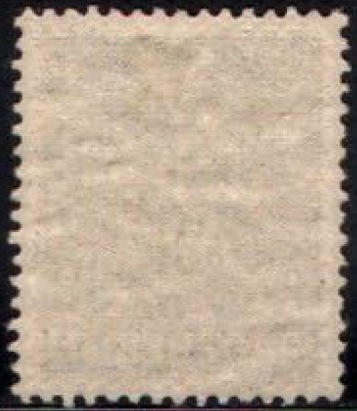 Has anyone heard of this technique before or know anything specific about the kind of 'watermark' being used here? The only comparable instance I can think of is the 19th century Swiss ovals that were impressed in the paper. |
|
Send note to Staff
|
| Edited by jimjamtwo - 01/24/2011 03:04 am |
|
|
|
|
Bedrock Of The Community
Australia
38679 Posts |
|
|
I cannot see anything from your scan of the back of the stamp. This is my guesstimation. If we were going to make our own paper and I made a small frame of wood and nailed flyscreen over it then sieved a small amt of wood pulp and let it dry then that would be "woven" paper. If we added a fine wire every inch or so, next to the flyscreen sieved the pulp and shook the screen so the paper fibres settled in one direction, that would be "laid" paper The paper when dried would show the lines of the wires next to the screen. (sort of a semi watermark) If we laid the wires in a diamond shape, that may give the result which you see. Do you get my drift  |
Send note to Staff 
|
|
|
Pillar Of The Community
Australia
2156 Posts |
|
|
rod222, I was quite pleased with the scan - all the lighter areas are raised surfaces. It looks deliberate to me, but as you suggest it may just have been an accidental by-product of the process by which the paper was made. Regardless, it looks very nice in real life. Of course, it really needs to be seen in 3D - and, in fact, I only noticed the contours when I held the stamp at an angle to the light.
The stamps of immediate post-WWII Germany seem to be full of unusual papers and watermarks. Clearly, it's a very large field of study I have happened upon. |
|
Send note to Staff
|
|
|
Pillar Of The Community
Australia
2156 Posts |
|
|
Anyway, I've processed the image of the reverse of the stamp so as to make the contours more visible. 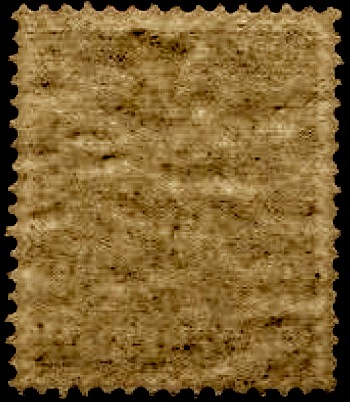 It would be very odd, surely, if wires were placed to produce this kind of result, but if it was done intentionally this would make it a very unique kind of paper. |
|
Send note to Staff
|
| Edited by jimjamtwo - 01/24/2011 3:42 pm |
|
|
Pillar Of The Community
United States
7108 Posts |
|
|
That looks like laid paper. My business cards are printed on laid paper. It can have a look that might be described as something akin to corduroy fabric.
I think there were four paper types for this issue, but it is outside my usual era, so I haven't paid that much attention to them. |
|
Send note to Staff
|
|
|
Pillar Of The Community
Australia
2156 Posts |
|
|
Cjd, I suppose I thought laid paper always involved lines going in the same direction, e.g., vertically, horizontally, or, much less frequently, diagonally. I'm not sure it would make sense to lay wires in this kind of pattern - unless, of course, the idea was to give the paper a distinctive appearance. |
|
Send note to Staff
|
|
|
Pillar Of The Community
United States
7108 Posts |
|
|
I guess we were looking at two different characteristics on the scan. Laid paper is a series of parallel "lines." I'll have to let someone who spends time with these stamps take a shot at this...if no one does, I'll see what Michel has to say later this evening. |
|
Send note to Staff
|
|
|
Pillar Of The Community
Australia
2156 Posts |
|
|
Cjd, I see what you mean. Yes, the stamp is on horizontally laid paper. But what's interesting is rather the pattern of ridges - in the processed scan all the lighter areas you can see are raised, as if embossed.
This seems to my eyes to have been deliberately done and, from an aesthetic standpoint, the result is extremely pleasing. I'd be interested in knowing what the catalogues say about the watermarks for this issue. |
|
Send note to Staff
|
| Edited by jimjamtwo - 01/26/2011 12:24 am |
|
|
Pillar Of The Community
Australia
2156 Posts |
|
|
I think I've found the answer to this question: on StampsX.com someone is selling this stamp and one other from the same set. The seller states that the stamps have 'horizontally ribbed gum.' I've never heard of this before, but I'd say that this is what is happening here. |
|
Send note to Staff
|
| Edited by jimjamtwo - 01/26/2011 4:59 pm |
|
|
Bedrock Of The Community
Australia
38679 Posts |
|
|
Your scans make it hard to asess,
but have you considered this may be an example of "spargummi" ?
That may be an option.
Another option, "gum breakers" can look like laid paper sometimes.
|
|
Send note to Staff
|
| Edited by rod222 - 01/26/2011 5:14 pm |
|
|
Pillar Of The Community
United States
2547 Posts |
|
|
jimjam, here is a scan of my copy of the 20pf value in the same set. The gum is applied in horizontal rows with a small elongated hexagon making up the rows. The hex shape is most visible in the lower right corner. I have several other values in this set and all have the same gum pattern. 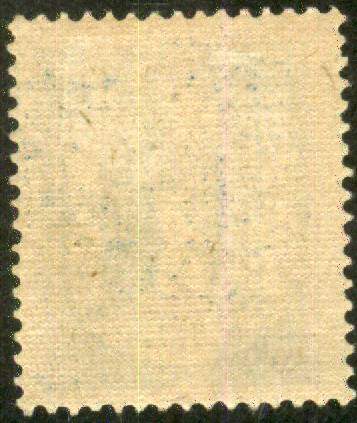 |
|
Send note to Staff
|
| Edited by Russ - 01/26/2011 11:52 pm |
|
|
Pillar Of The Community
Australia
2156 Posts |
|
|
Russ, I greatly appreciate the info and thanks for the scan. I thought there was a kind of pattern to it and that it had been done intentionally. I am very surprised, though, to learn that it's the gum not the paper.
|
|
Send note to Staff
|
|
|
Pillar Of The Community
United States
2547 Posts |
|
|
The gum has a "fishscale" appearance in horizontal rows. |
|
Send note to Staff
|
| Edited by Russ - 01/27/2011 09:00 am |
|
| |
Replies: 12 / Views: 1,895 |
|




 Posted 01/23/2011 7:35 pm


