| Author |
 Replies: 59 / Views: 6,021 Replies: 59 / Views: 6,021 |
|
|
|
Pillar Of The Community
United States
6756 Posts |
|
|
OK, I dug out my Finland collection to confirm that I didn't misread the catalogs. My #80 is on wove paper, as implied by the catalog listing. I see no mention of laid paper for this stamp in any of my catalogs. Can you please show the front of the stamp? Thank you. |
Send note to Staff 
|
|
|
Pillar Of The Community
Finland
753 Posts |
|
|
Quote:
(1), it's hard to be definite, but I think the date is 1890. If 1890, then there's only one possible print for this value. Norma 39Aa, greenish blue, issued 10/1889. So likely this is a color changeling of some sorts. Quote:
It's definitely laid paper, not gum residue. Only regular paper is known for these stamps; but I've seen plenty of mint copies were glue has "stained" the paper to look as laid. That is why I suggested there is gum remainder. |
|
Send note to Staff
|
|
|
|
Pillar Of The Community
United States
6756 Posts |
|
|
Quote:
scb, the cancel on (2) can be read clearly. The date is 6.2.84 Yes I saw that. Unfortunately, that is a rather late date of use cancel, which means it could any of the printings. |
|
Send note to Staff
|
|
|
Pillar Of The Community
Australia
2156 Posts |
|
|
khj, it's nearly 2 am here in Sydney so I'll have to scan the front of the stamp in the morning.
I hadn't washed it in warm water, so I just did so. It's still drying, but I just had a good look with a magnifying glass and the shadow lines still seem to be there.
I wonder whether they'll be there in the morning!!
|
|
Send note to Staff
|
|
|
Pillar Of The Community
United States
6756 Posts |
|
|
Quote:
magnifying glass and the shadow lines Don't look at it with a magnifier. Hold it up to a light bulb and look at it through the back of the stamp. If laid paper, then those vertical lines should appear as thins. Regarding stamp 1, it's either "90" or "00". What appears to be a 9 may actually be a smudged/scratched 0? |
|
Send note to Staff
|
|
|
Pillar Of The Community
Finland
753 Posts |
|
|
Quote:
Yes I saw that. Unfortunately, that is a rather late date of use cancel, which means it could any of the printings. I don't have the delivery tables for this model, but AFAIK Helsinki Post Offices usually received/used the latest printings. So unless this lied in someone's drawer for over a year before being licked, this is likely Norma 23Bdz, reddish orange, issued 13.9.1883. This was the last print of this value; and also the most common one with print of nearly 1 million copies. |
|
Send note to Staff
|
|
| Edited by scb - 04/25/2011 12:01 pm |
|
|
Pillar Of The Community
Australia
2156 Posts |
|
|
The lines are still there. This is the reverse as it looks after a wash in warm water: 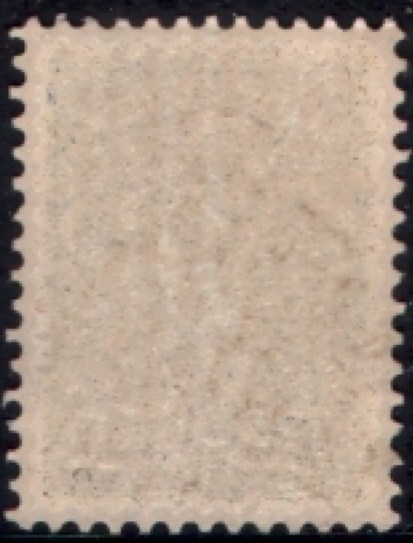 This is the front: 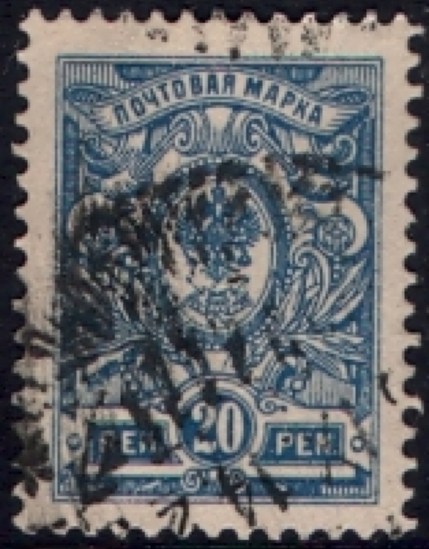 |
|
Send note to Staff
|
|
|
Pillar Of The Community
United States
6756 Posts |
|
|
Good morning, jjt!
Thanks for the front-side pic! I agree, you have a Scott #80.
Did you confirm that those lines appear as thin "bright" lines when you hold the stamp up to a light and look through the back side of the stamp? I keep asking this because on most stamps, you usually can't see the lines of the laid paper just by putting it face down and looking at the back (at least I can't). Call me a skeptic, but I'm not convinced those relatively thick dark bars we are seeing were caused by laid paper wires. I'll be honest with you, I'm looking for an alternative explanation. Sorry if I seem to be wasting your time. If it is in fact vertical laid paper, this is something very new to me for that stamp. As scb stated, that stamp is not known to have been printed on laid paper (at least not known to us). |
|
Send note to Staff
|
| Edited by khj - 04/25/2011 7:57 pm |
|
|
Pillar Of The Community
Australia
2156 Posts |
|
|
khj, I just held the stamp up against a bright light and no, the lines do not appear as thin, 'bright' lines. The lines are thickish and darker than the rest of the reverse of the stamp. (If anything, they're more distinct now, AFTER the wash, than they were before.)
It's impossible for me to tell what the lines are. They seem to be IN the paper and not to be gum residue. That's as far as I can go.
I should add the observation that I have quite a few examples of this stamp and the difference between this one and the rest was apparent straight away (as soon as I laid them down alongside one another with their reverses facing up). |
|
Send note to Staff
|
| Edited by jimjamtwo - 04/25/2011 8:02 pm |
|
|
Pillar Of The Community
United States
6756 Posts |
|
|
OK, thank you for doing that check. If they are not thin bright lines, then it is NOT laid paper.
I can give you a reasonable guess to what you are seeing, as I have seen this before on stamps that were stored in photo albums for prolonged periods. Some older photo albums (at least here in the US) have either a simple ribbed page or even lines of light adhesive to keep the photos from moving around. These can be diagonal or horizontal/vertical. Some collectors used these photo albums as stamps albums. When these albums got stored horizontally or pressed, these paper ribs or adhesive ribs would either make a relatively permanent imprint/stain on the back of the stamp. I have a hunch that is what you are looking at.
Again, no thin bright lines, then not laid paper.
I appreciate all your extra effort. I was REALLY REALLY curious, and silently hoping you had really found this stamp on laid paper!
I am open to correction or any other ideas from you or the others. |
|
Send note to Staff
|
| Edited by khj - 04/25/2011 8:05 pm |
|
|
Pillar Of The Community
Australia
2156 Posts |
|
|
khj, I'm forced to admit it's just a case of gum residue, as our Finnish expert suggested initially - I just found a Finnish stamp from the 1917 issue that still has vertical gum on the reverse. It looks exactly the same as the 'shadows' on this particular stamp.
There doesn't seem to be any gum left at all, but nonetheless we have a 'shadow' of the gum. Bizarre ...
Thanks for spending time on this matter; even though it hasn't proven productive, I suppose it's educational in a sense! |
|
Send note to Staff
|
| Edited by jimjamtwo - 04/26/2011 01:17 am |
|
|
Pillar Of The Community
United States
6756 Posts |
|
|
Thanks for the update! I was thinking it must have been caused by some sort of ribbed adhesive or ribbed backing page. Either way, it is caused by improper storage by one of the previous owners. |
|
Send note to Staff
|
|
|
Pillar Of The Community
Australia
2156 Posts |
|
|
Next question (forgive me, I'm working my way through a large lot of old Finnish stamps) is there a listing for the following: 10 mk Saarinen Lion (without watermark - probably Scott# 108), perf 13.75? 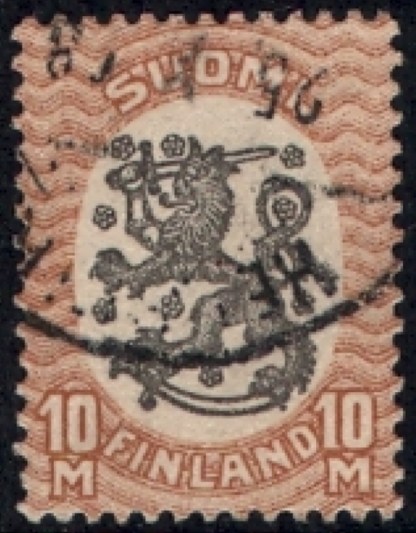 |
|
Send note to Staff
|
|
|
Pillar Of The Community
Finland
753 Posts |
|
|
jimjamtwo... Re, type-1911 stamp... I've seen copies similar to yours, and I have a theory (or actually first hand trial&error experience) how this kind of stamp can be created. Am I correct, if I assume the paper is slightly "more toned" (either to reddish or yellowish) than with other stamps? This is not due to a paper variety, but instead by unfortunate soaking. A lot of these stamps were affixed to "bright pink" address cards, that give away color extremely easily when wet. The second part to unraveling this mystery is to know about gumming of these stamps. First, the stamps are not gummed evenly. Some stamps have flat gumming, some have "vertically striped" gumming (with thin/thick stripes of gum). The gum used on these stamps is also very strong; it does not come off easily, it does not absorb water easily, and it does not let any bleed color run through easily - except on areas with weaker/non-existant gumming. If looking closely on your scan, you can actually see how the gum has started soaking away from tooth/edges - leaving a kind of frame like border. Also the stripes (with lighter gum) are caused by same phenomena - these areas have lifted up first, and thus toned differently than areas still fixed on paper.  Just to share a bit of education You can't find in printed books. I learned this the hard way about a decade ago when I spent a complete summer soaking up kiloware from this series  |
|
Send note to Staff
|
|
| Edited by scb - 04/26/2011 02:18 am |
|
|
Pillar Of The Community
Australia
2156 Posts |
|
|
Interesting presentation, scb!
It's also interesting that you've seen something like this before.
By the way, the stamp in question is not very toned - only VERY slightly yellowish, if at all. |
|
Send note to Staff
|
| Edited by jimjamtwo - 04/26/2011 02:32 am |
|
|
Replies: 59 / Views: 6,021 |
|



 Posted 04/25/2011 11:43 am


