Stamp Community Family of Web Sites
Thousands of stamps, consistently graded, competitively priced and hundreds of in-depth blog posts to read


Stamp Community Forum
 
Username:
Password:
Save Password
Forgot your Password?

This page may contain links that result in small commissions to keep this free site up and running.

Welcome Guest! Registering and/or logging in will remove the anchor (bottom) ads. It's Free!

Old Fiji Stamp

 
To participate in the forum you must log in or register.
Author Previous TopicReplies: 8 / Views: 2,953Next Topic  
Valued Member
Sweden
116 Posts
Posted 09/26/2011   08:05 am  Show Profile Bookmark this topic Add mrmagic to your friends list Get a Link to this Message
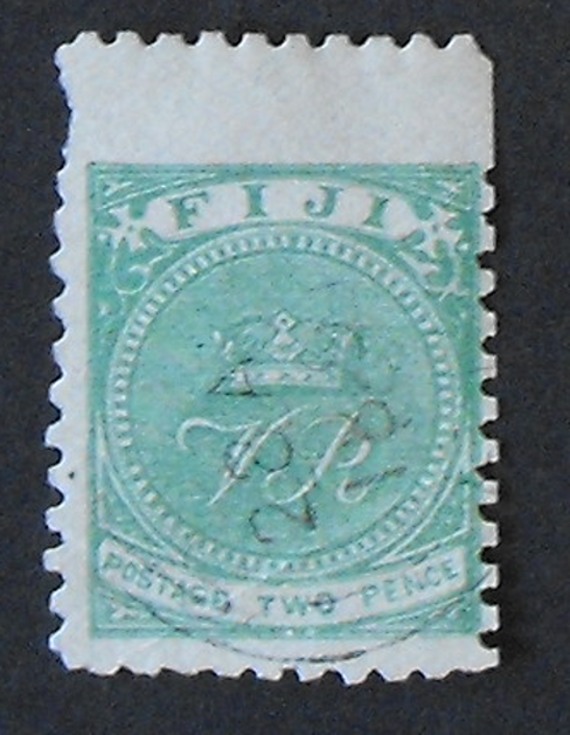
I was wondering from what year this Fiji stamp was.
and perhaps more interesting who made these.

Thanks in advance guys


Send note to Staff

Bedrock Of The Community
United States
12128 Posts
Posted 09/26/2011   08:23 am  Show Profile Bookmark this reply Add wt1 to your friends list  Get a Link to this Reply
I have a very old Scott Worldwide Catalog that shows that stamp to be a Scott #41 definitive issued between 1878-1891.

I am no expert on Fiji stamps, but interestingly the catalog shows this stamp in the 2p denomination to be "green" in color, that would look to me to be better defined as light green, or blue green, as in your example, perhaps because it has become faded through the years?

Maybe someone else can chime in with more information.
Send note to Staff  Go to Top of Page
Valued Member
Sweden
116 Posts
Posted 09/26/2011   08:27 am  Show Profile Bookmark this reply Add mrmagic to your friends list  Get a Link to this Reply
Thanks for the quick reply.
you are propably right about the fading. It sure look more like light green irl to.

Send note to Staff  Go to Top of Page
Pillar Of The Community
Australia
3547 Posts
Posted 09/26/2011   09:33 am  Show Profile Bookmark this reply Add tonymacg to your friends list  Get a Link to this Reply
These were issued between 1878 and 1899. They were printed by the New South Wales Government Printing Office in Sydney. This one looks as if it's what Gibbons calls 'blue-green'. They exist in quite a range of perforations: 12½, 10, 10x12½, 12½x10, and others in more yellow-green shades. If you can tell us the gauge of the perforations, we may be able to pin your stamp down a little more accurately.
Send note to Staff  Go to Top of Page
Valued Member
Sweden
116 Posts
Posted 09/26/2011   12:42 pm  Show Profile Bookmark this reply Add mrmagic to your friends list  Get a Link to this Reply
Well I am not very good in calculation Gauges but I will give it a try.
would be nice have all the data about the stamp.
Send note to Staff  Go to Top of Page
Pillar Of The Community
Australia
3547 Posts
Posted 09/26/2011   8:13 pm  Show Profile Bookmark this reply Add tonymacg to your friends list  Get a Link to this Reply
Depending on which perforation gauge your stamp is, it could have a catalogue value of £19, £5.50, £60 or so uncommon that Stanley Gibbons can't quote a price for it. Unfortunately, the damage to the top left of the stamp will reduce its value considerably.

Perforations can be interesting, though. If you want to keep your collection simple, and ignore its value, you can also ignore the perforations. If you want to go a step further, and consider the small differences between stamps (that can make a big difference to their value!), you will need to pay attention to the gauge of the perforations.

And when you become highly specialised, perforations become very important.

As an example, 80 or 90 years ago, the Indian State of Cochin had its stamps printed by Perkins, Bacon in London. They were the printers of the Penny Black - the first postage stamp - and were still a big and busy printer. The big Gibbons Commonwealth and British Empire Stamps 1840-1970 catalogue says that the 1916-30 set of Cochin, showing Raja Rama Varma II, was perforated '13½ to 14'. Most collectors will be happy to stop there. However, Gibbons mention in a footnote that in fact four different perforating machines were used. Each produced slightly different sized perforations, which you can distinguish with a good perforation gauge. Gibbons also list which machines were used to perforate which stamps, but don't give prices for them.

The 9 Pies stamp on this cover


is from a type 'b' perforating machine, which was previously not known to have been used to perforate the 9 Pies stamp. Not worth very much, perhaps, but it's nice to know that I have something noone else knew existed. And to know that I've increased our knowledge of the stamps of Cochin State ... by maybe 0.0001%

So it's all up to you. You can just enjoy your stamps and not bother with the perforations. Or you can go more deeply into your stamps, and find the small differences between them, that give more depth to stamp collecting.
Send note to Staff  Go to Top of Page
Valued Member
Sweden
116 Posts
Posted 09/28/2011   05:53 am  Show Profile Bookmark this reply Add mrmagic to your friends list  Get a Link to this Reply
Interesting Tony.
I have some stamps from State of Cochin but I cannot access them at the moment, due to heavy repair in my flat : (
but when they are available again I will look into them and propably post pictures of them them here.
Send note to Staff  Go to Top of Page
Pillar Of The Community
Australia
3547 Posts
Posted 09/28/2011   10:25 am  Show Profile Bookmark this reply Add tonymacg to your friends list  Get a Link to this Reply
I hope you will post your Cochin Mrmagic - but I warn you, they can be just as complicated as these Fiji stamps! There are some discussions of Cochin stamps from the King George V era here https://goscf.com/t/8478 and from the King George VI era here https://goscf.com/t/8289 which may help a little.
Send note to Staff  Go to Top of Page
Rest in Peace
Canada
5701 Posts
Posted 09/28/2011   11:25 am  Show Profile Bookmark this reply Add BeeSee to your friends list  Get a Link to this Reply
As mentioned by Wt1 the Fiji stamp is Scott #41, but the catalog does not list perforation varieties.

The cancel appears to be 28 April or August, 1891.

Interestingly, the top seems to have a major perforation shift upwards hence the tear and cut on the left and right sides. Or it is possible that the sheets were printed with gutters between and an entire row of perforations is missing.

Send note to Staff  Go to Top of Page
BeeSee in BC
"The Postmark is Mightier than the Stamp"
http://brcstamps.com ---- BNAPS, RPSC, APS
  Previous TopicReplies: 8 / Views: 2,953Next Topic  
 
To participate in the forum you must log in or register.

Go to Top of Page

Disclaimer: While a tremendous amount of effort goes into ensuring the accuracy of the information contained in this site, Stamp Community assumes no liability for errors. Copyright 2005 - 2026 Stamp Community Family - All rights reserved worldwide. Use of any images or content on this website without prior written permission of Stamp Community or the original lender is strictly prohibited.
Privacy Policy / Terms of Use    Advertise Here
Stamp Community Forum © 2007 - 2026 Stamp Community Forums
It took 0.18 seconds to lick this stamp. Powered By: Snitz Forums 2000 Version 3.4.05