Number 1:
The so-called "Wayzata Airmail" stamp was issued in August 1932 to fund an historic cross-Atlantic flight from Wayzata, Minnesota to England, with relay stops in Newfoundland, Iceland, Norway, Sweden, Germany and Denmark. To fund the flight, Aerial World Tours planned to produce 400,000 stamps. They would sell 300,000 stamps at $1 each to cover their expenses and to buy a Sikorsky Amphibian aircraft (pictured on the stamp) capable of carrying 44 passengers. For 20% of the profits on the 300,000 stamps, the Government of Newfoundland agreed to sell a further and final 100,000 through its Post Offices thus giving the stamp full postal status. In July 1932, a total of 400,000 stamps were engraved and printed by the Bureau of Engraving of Minneapolis, MN, in sheets of 20 (4x5) under supervision of the city's Northwestern National Bank. However by early August, Aerial World Tours ran into financial problems. Funds which they believed had been committed to the project never materialized. With its original capital exhausted, the company made a valiant effort to survive. On August 11th the Company purchased a first lot of 25,000 stamps for $5000 from the Northwestern National Bank. To raise the $5,000 payment, representing the 20% share due to the Government of Newfoundland, the Company borrowed the money using the stamps themselves as collateral. A smaller 8-passenger Sikorsky S-38 (rechristened the "Newfoundlander") was leased, and despite disappointing stamp sales, the company decided that the flight should go ahead no later than September 25th. But on September 13th, the Government of Newfoundland cancelled the contract, apparently because the flight had been delayed, and demanded that all the stamps already issued be collected and returned. The remaining 375,000 stamps, along with the dies and proofs, were destroyed. In an attempt to obtain recognition for the stamps, the Company forwarded the prepared covers to Newfoundland in October, requesting that they be postmarked and forwarded to the addresses. The Newfoundland authorities refused to cancel the covers, but did forward them under official cover. Of the 25,000 stamps released to Aerial World Tours, those which had not been sold were subsequently offered to collectors. A final remaining batch of approximately 12,000 stamps were stolen from a home in Minneapolis in the late 1960's, and never recovered.
Number Two:
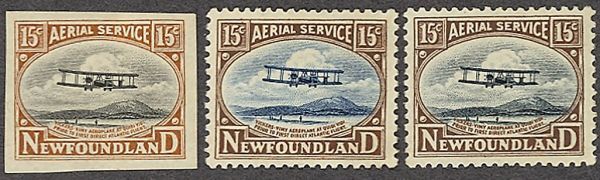
In May 1919, the Imperial Aircraft Company of London was authorized by the Newfoundland government to develop a "mail and express service across the Island of Newfoundland, and to Montreal, on the mainland". In 1922, the firm of De La Rue was commissioned by Newfoundland to produce an engraved 15c airmail stamp featuring the Vickers-Vimy biplane. Three separate essays were made: imperforated in red-brown with black centre, and perforated in sepia with black or blue centre. However, because of growing concerns about the reliability and safety of the aerial service due to Newfoundland's unpredictable weather, the contract with Imperial Aircraft was not pursued, and the stamp never produced. A. C. Roessler, a stamp dealer from East Orange, New Jersey, with a particular interest in airmail flights and covers, produced an embossed lithographed forgery of the essay which he offered for sale starting in 1931. The stamp has a green border and red-brown centre in a design very similar to the genuine essays. It appears to be perforated, but is in fact die-cut to create the appearance of a perforated edge. As such there can be no multiples of the stamp.
Number 3:
Listed in the Newfoundland section of the Unitrade catalog. This is #156. Issued in 1928. The design was re-engraved for some nearly identical Newfoundland stamps (# 170 without watermarks, and #180 with watermarks). You can tell the difference between the original and re-engraved as the "L" of "Leaving" is aligned under the "A" of "Airplane" in the original, and under the "T" of "First" in the re-engraved.
Hope this helps.
|





 Posted 12/29/2011 3:46 pm